
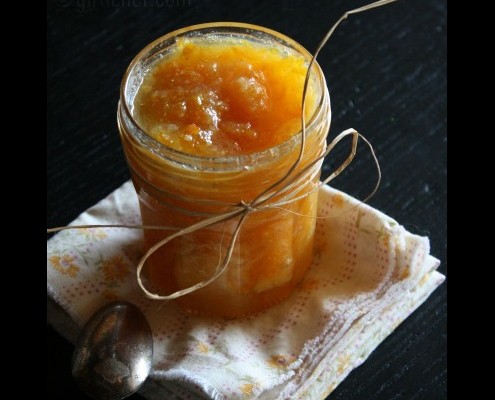
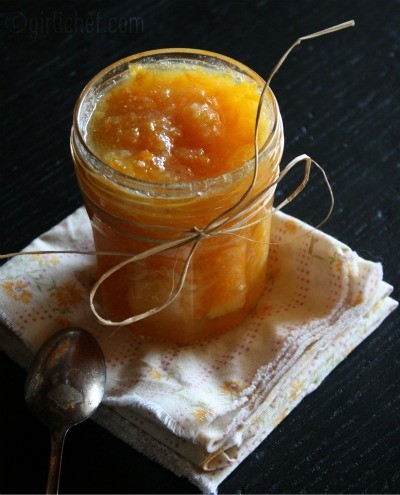
Okay. I’m going to admit something. Out loud. Right now. I prefer mandarin oranges from a tin. I don’t say that about many things. As a matter of fact, I can’t really think of anything else I can say that about at the moment. Maybe it’s just that I can never find a juicy mandarin here in Michiana (surprise, surprise). The ones in the tin are so sweet and they never have any of that pesky pith clinging to them. Soooo…when I mistakenly picked up a little net sack of mandarins thinking they were clementines, imagine my dismay. But, the kids didn’t seem to mind, they’ve been peeling them left and right. Now that the sack has dwindled down to just a few, I decided to try a making a jam from them. If nothing else, the bright, cheery, orange in a shiny glass jar will lift everybody’s spirits.
I adapted this from the original recipe in the fact that I only took the colorful zest from the orange and left the pith out. It can be thick and wrangly, bitter and pretty unpleasant if left in the jam. I followed the recommendation of leaving a few whole sections behind to stir in for texture at the end of the cooking time. The lighter color was a pretty contrast and I liked some of the bigger chunks, but since they weren’t really cooked down, it turned the final product a tiny bit watery. But really, it was still pretty thick and spreadable, so I think it’s okay to keep this step in or just forget it (personal preferance).
Try spread on thick, hearty toast with butter or use to make a coating for some roasted pork along with mustard and some rosemary or sage and some breadcrumbs.
Either way, I was right. The color alone brought a smile to our faces.
Print
Mandarin Orange Jam
- Total Time: 1 hour 15 minutes
- Yield: 1 jar
Description
Capture the bright orange of summertime in a jar with this slightly bitter, slightly sweet mandarin orange jam.
Ingredients
- 4 Mandarin oranges
- 1 1/3 cups (320 ml) sugar
- 1 cup (240 ml) water
Instructions
- Wash each mandarin orange in warm water. Remove the just the zest (leave the bitter white pith behind) from 2 of the oranges using either a zest that makes long, thin strips or a vegetable peeler (then slice or dice the zest).
- Place zest in a heavy-bottomed pot with sugar and water. Bring to a boil, then reduce heat to a simmer. Allow to cook for 20 minutes or until liquid is beginning to look a bit syrupy and peel is well-glazed.
- Meanwhile, peel the oranges and separate the segments. If yours is particularly juicy and falling apart, set in a colander over a bowl to catch any juices.
- After the 20 minutes is up, add all but a small handful of the orange segments to the pot and bring back to a boil. Reduce heat to a simmer again and allow to cook for 30-40 minutes, or until thick and “jammy”; stir often to keep from sticking.
- Test on a plate if you wish by dropping a small spoonful of the jam onto it and seeing if it sits in a blob without running. Toss in the reserved orange segments during the last five minutes of cooking time.
- Transfer to sterilized jars and process for canning (will keep 10-12 months this way) or keep in the fridge.
Notes
- Alternately, just add in all of the orange segments.
- Adding some towards the end makes it a bit runny but offers a nice texture variation.
- Try this jam spread on thick, hearty toast with butter, or use it to make a coating for roasted pork along with mustard, rosemary or sage, and breadcrumbs.
- Prep Time: 15 minutes
- Cook Time: 1 hour
- Category: Condiment
- Cuisine: American
Nutrition
- Serving Size: 1 tablespoon
- Calories: 50
- Sugar: 12
- Sodium: 0
- Fat: 0
- Carbohydrates: 13
- Fiber: 0
- Protein: 0
- Cholesterol: 0
If You Liked This Recipe, You’ll Love These
- Savory Tomato Jam
- How to Make Pumpkin Jam
- The Perfect Condiment: Garlic and Thyme Confit
- Baconnaise – Homemade Bacon Mayonnaise
Frequently Asked Questions
Why does the recipe only take zest from 2 of the 4 oranges instead of all of them?
The zest is stripped from just 2 oranges because you only want the colorful outer layer, not the bitter white pith beneath. Taking zest from all 4 would yield more pith risk, and the remaining 2 oranges are reserved for their flesh (the segments that get cooked into the jam).
The recipe says to stir in a handful of reserved segments near the end — why, and is it worth doing?
Adding those reserved segments during the last 5 minutes introduces a nice texture variation and a lighter color contrast. I’ll be honest — it makes the final jam a tiny bit watery, but still thick and spreadable, so it’s genuinely a personal preference call. Skipping this step is fine.
How do I know when the jam is thick enough?
Drop a small spoonful onto a cold plate — if it sits in a blob without running, the jam is set. The total cooking time after adding segments is 30-40 minutes, and you should stir often to prevent sticking.
How long does this jam keep, and does it need to be canned?
If you process it in sterilized jars using a proper canning method, it will keep for 10–12 months. Without canning, just store it in the fridge and use it like any fresh jam. I also love using it as a glaze for roasted pork with mustard, rosemary, and breadcrumbs — not just for toast.



Bright and sweet on morning toast.
That looks soooo delicous!