It seems like Egypt has long been looking to change, to grow, to develop, to bloom. A minor problem stands in its way – the Egyptian people hold on to outdated methods and rigid thoughts because for so long their life remained constant in its difficulty.
It’s better to stick to what you know than what you don’t know – this is the general mantra held in high regard.
Despite having a few recipes that have become intrinsically Egyptian throughout the years, we cannot seem to invent anymore using our own fresh and fragrant ingredients. Yes, I would be the first to break down in tears if these trusted street food shops were to disappear or change from what they are now but I’m often close to tears because of the sheer absurdity of copycat shops – one after another lining up the different Egyptian roads, serving up cheap and dependable fare that has always tasted the same. 
Growing up with a mother fearful of all food not cooked with her own clean hands, our homemade version of the Egyptian koshari bore no resemblance to that of the street. Street koshari was put together separately, every element cooked alone and mixed together at the end. Mom’s koshari cut down on the process by cooking ingredients together.
In essence, koshari is a mixture of rice, macaroni, lentils, chickpeas, fried onions, tomato sauce, chili sauce, and “daqqa” – a liquid combination of vinegar and finely minced garlic. Our homemade version cooked the lentils and rice together, prepared the macaroni in tomato sauce, had a spicy tomato sauce and fried onions to garnish. There were never any chickpeas and I had never heard of daqqa growing up. This all changed upon entering university.
Sneaking out in between classes, it became a new obsession to find the next greasy Egyptian food indulgence. Sitting at a long stainless steel table, sharing it with others entirely engrossed in their plates, I received my serving of koshari, street-style, for the first time. Possibly one of the best solutions to carb-cravings, the koshari experienced there, with fiery chili and a heavy serving of tomato sauce, was like nothing I had tasted at home and elevated the everyday koshari higher than I had regarded it before. If you’re ever in Egypt, I urge you to avoid eating it at your hotel. Instead, step into the nearest corner koshari store. Ask for extra lentils and fried onions and be gentle on yourself when it comes to the chili sauce; depending on the store, some are real scorchers.
Koshari-inspired Spaghetti
- Total Time: 55 minutes
- Yield: 4 servings 1x
Description
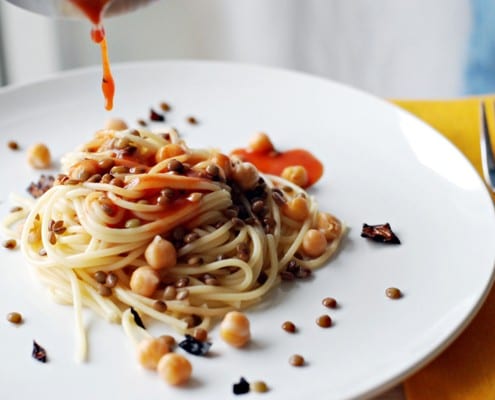
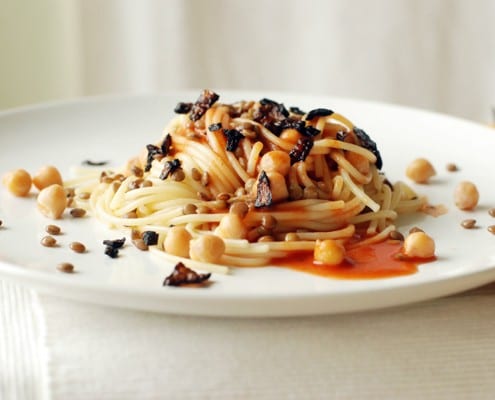
A creative twist on traditional Egyptian koshari, this spaghetti dish combines chickpeas, lentils, and a spicy tomato sauce for a hearty and flavorful meal.
Ingredients
- 500 gm of spaghetti, cooked al dente
- 2 small onions, chopped
- 2 tbsp (30 ml) of ghee
- 400 grams of chickpeas, cooked
- 150 grams of brown lentils, cooked
For the sauce:
- 1/3 cup (80 ml) of olive oil
- 5 heaped tbsp (75 ml) of tomato paste
- 2 leveled tbsp (30 ml) of all-purpose flour
- 5-7 cloves of garlic, sliced, depending on the strength
- 1 1/2 tsp of chili powder
- 3 tbsp (45 ml) of vinegar
- 1 tsp of cumin powder
- 1 tbsp (15 ml) of brown sugar
- 5-6 cups (1.2 - 1.44 L) of water, depending on your preferred sauce thickness
- Salt and pepper, to taste
Instructions
- Begin with the sauce. Heat the olive oil in a pot over medium heat. Add the flour and tomato paste, whisking constantly until combined into a smooth paste.
- Reduce the heat to low and cook for an additional minute until the mixture begins to thicken.
- Add the vinegar and minced garlic to the sauce, stirring well to combine. Season with salt and chili powder to taste. Allow the sauce to simmer on low heat for about 10 minutes, stirring occasionally.
- In a separate pan, heat the ghee over medium heat. Add the chopped onions and sauté until golden brown and crispy, about 8-10 minutes. Remove from heat and set aside.
- In a large serving bowl, combine the cooked spaghetti, chickpeas, and lentils. Pour the tomato sauce over the pasta mixture and toss to coat evenly.
- Top with the fried onions before serving. Serve warm and enjoy your koshari-inspired spaghetti.
Notes
- For a more authentic experience, add extra lentils and fried onions as toppings.
- Adjust the chili powder to your spice preference.
- This dish can be stored in an airtight container in the refrigerator for up to 3 days.
- Reheat gently before serving.
- Prep Time: 10 minutes
- Cook Time: 45 minutes
- Category: Main Course
- Cuisine: Egyptian
Nutrition
- Serving Size: 1 serving
- Calories: 550
- Sugar: 8 grams
- Sodium: 600 mg
- Fat: 18 grams
- Carbohydrates: 85 grams
- Fiber: 12 grams
- Protein: 18 grams
- Cholesterol: 0 mg
If You Liked This Recipe, You’ll Love These
- Spaghetti Pangritata with Fried Eggs
- Angel Hair Stracchino and Tomato Pasta
- Mujadara Recipe: Middle Eastern Lentils and Rice
- Spicy Pork Sausage Spaghetti
Frequently Asked Questions
What is koshari and why is this recipe described as “inspired by” rather than authentic?
The article explains that traditional koshari is a mixture of rice, macaroni, lentils, chickpeas, fried onions, tomato sauce, chili sauce, and a vinegar-garlic liquid called “daqqa.” This version uses spaghetti instead of rice and macaroni, omits daqqa, and simplifies the sauce — making it koshari-inspired rather than the classic street-food preparation.
Why does the sauce use flour along with tomato paste?
The recipe calls for 2 leveled tbsp of all-purpose flour whisked together with 1/3 cup olive oil and 5 heaped tbsp tomato paste to start the sauce. The flour acts as a thickener, giving the sauce a body that clings to the spaghetti, chickpeas, and lentils rather than running off.
Why is ghee used to fry the onions instead of olive oil?
Ghee has a higher smoke point than olive oil, which allows the 2 small onions to cook at medium-high heat for 8–10 minutes until they turn genuinely golden brown and crispy — the kind of deeply caramelized fried onions that are the essential koshari garnish — without burning.
How spicy is this dish, and can I adjust the heat?
The recipe calls for 1 1/2 tsp of chili powder in the sauce, with salt and additional chili powder adjusted to taste. The notes say to adjust chili powder to your spice preference. The article also warns that real street-side koshari chili sauces “are real scorchers” — so the recipe’s quantity is moderate by comparison.