
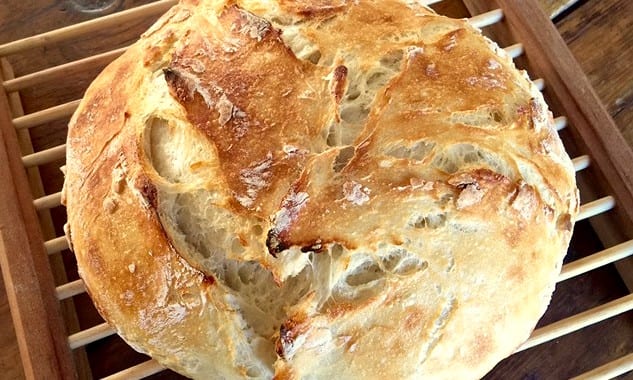
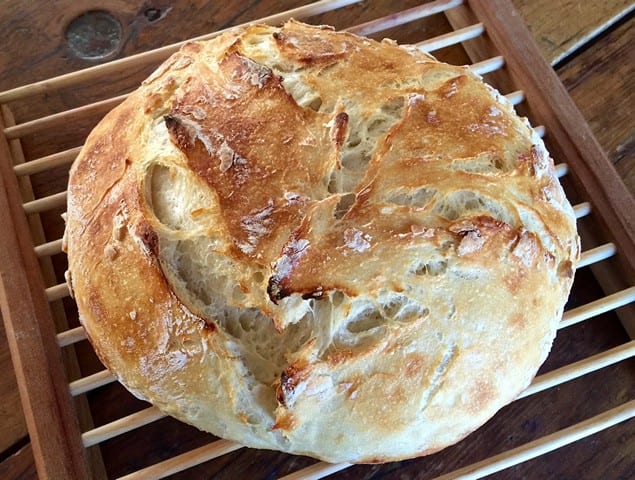
There’s no better breakfast than a thick slab of homemade bread. For me, anyway. Dense and chewy whole wheat or light, airy ciabatta, I love it all—as long as it’s made with high quality, unadulterated ingredients.
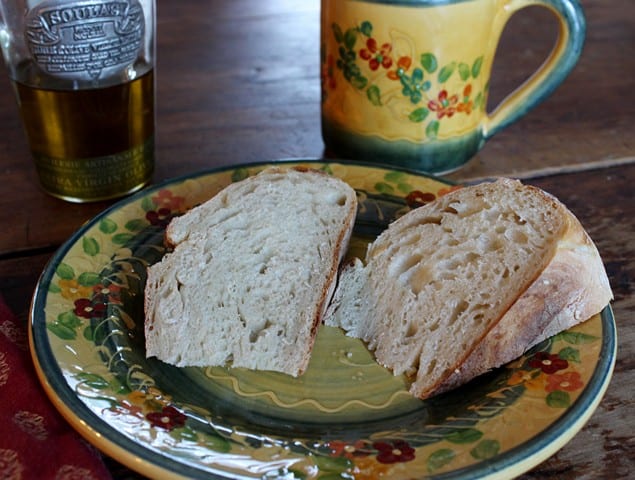

I used to bake bread back before Chris and I had kids, but then it became one of those things that was edited out. Not to mention that we’re fortunate to have five artisanal bakeries within about a 15 mile radius of our house. So I’ve never lacked for good bread. But a few months ago we were over at our friend’s house for dinner and were served homemade sourdough bread. With its toothsome crust and complex, moist crumb and the distinctive sourdough tang, we both couldn’t get enough of it.
On our way out the door, Maggie gave us a scoop of her sourdough starter in a jar. The instructions seemed pretty simple: keep it in a big, glass bowl in a warmish place in your kitchen and feed it every day with flour and water. Easy enough. Chris agreed to feed it every morning, and I would be in charge of making the bread.
With 1¼ cups of flour and water added to it every day, the starter rapidly grew. Bubbles from the fermenting wild yeast erupted on its surface, and the bowl emitted a pungent, yeasty aroma.
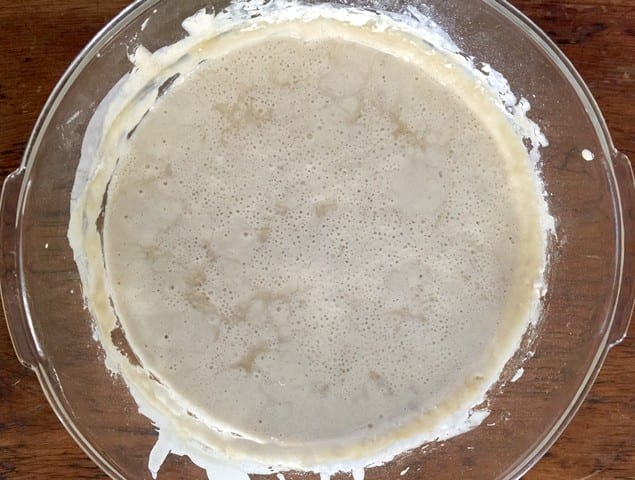
Sourdough bread is, after all, bread that is made with natural yeast drawn from the environment in which the starter resides—bread with terroir. No need to add yeast to the dough, but what you do need is a little more time and patience to get it right.
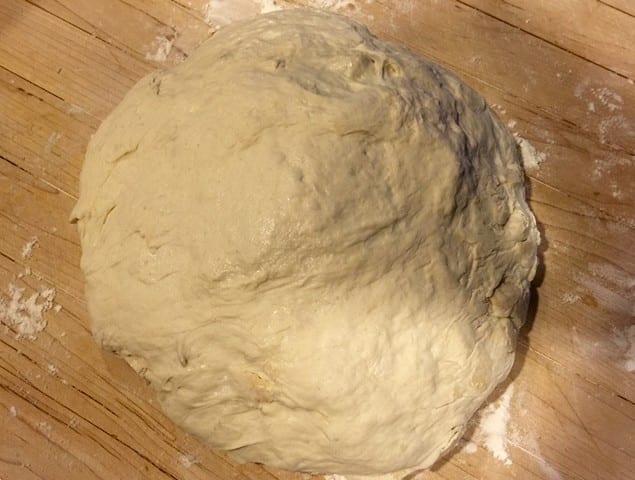
I set out to make bread once a week, a seemingly reasonable amount of bread for our family of (now) three to consume. I love bread, and would even go so far as to say that it’s one of my three favorite foods. I eat it every day, trying to limit myself to having it only in the morning which, if it’s an excellent bread or bagel, satisfies me for the rest of the day.
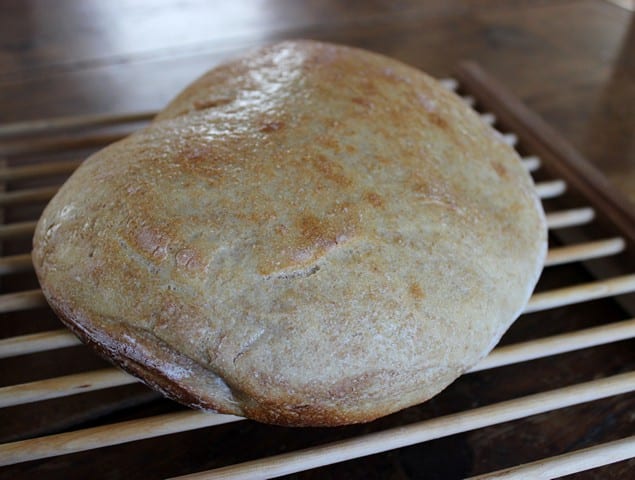
A few years ago, I made a failed attempt to go gluten-free. I really don’t know what possessed me. I lasted a mere few weeks. Fortunately I have no medical need to go without gluten and have been happily scarfing it down ever since (no offense intended to the many who successfully live gluten-free due to medical reasons or personal choice; it just didn’t work for me).
Now that we had some live starter and I was back to making bread again, the house filled in the early hours of the morning with that incomparable aroma of freshly baked bread—to me, one of the best smells in all the world. I would pull the bread out of the oven and cut into its golden crust, allowing the bread’s steam to further warm up my wintry kitchen. Slathered with fresh butter or drizzled with a rustic olive oil, a slice or two of this bread was a breakfast fit for a peasant or a queen.
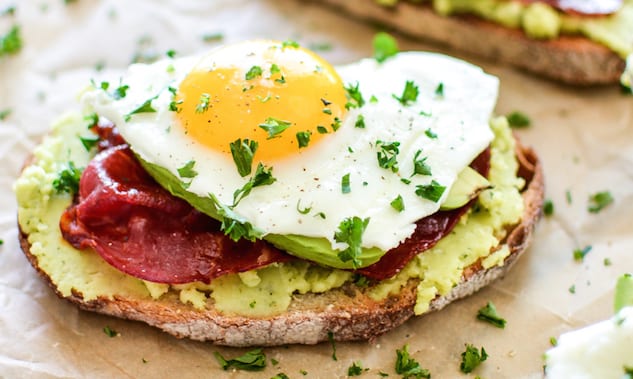
Sometimes I like to mix it up by making an avocado toast, or melting some cheese over top. Raclette is a favorite for its meltability and meatiness. It stands up especially well to a hearty whole wheat loaf.
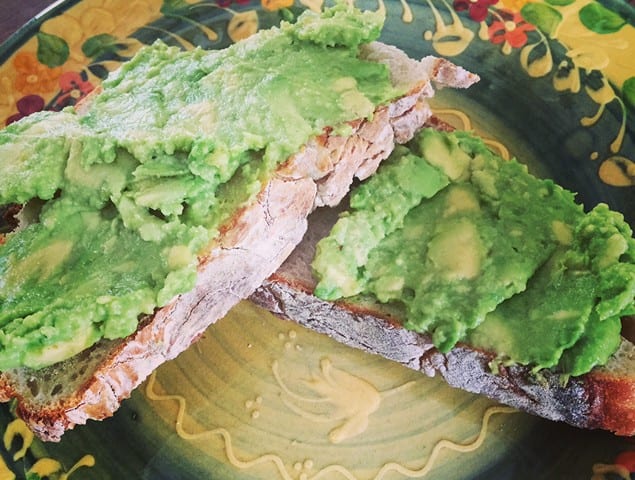
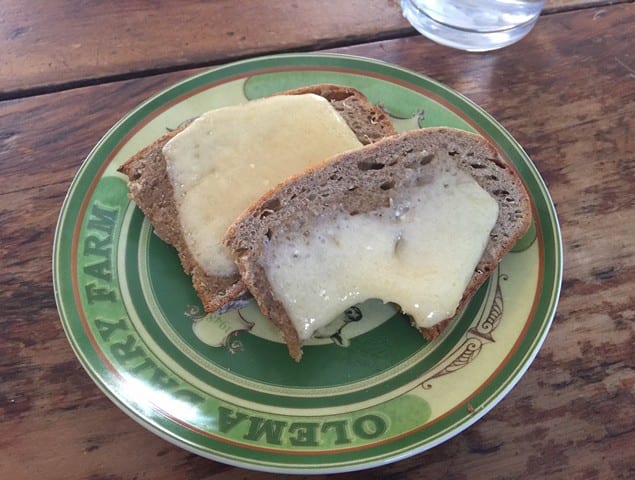
Part of the fun of making bread is experimenting with different flours. In addition to white and whole wheat, I tried a seven grain mix, oat flour, and a fine Italian style flour that makes an airy focaccia. My kitchen turned out a lot of bread this past winter.
But if you do the math, making bead once a week—which entails using one cup of starter—leaves you with a lot of starter sitting on your kitchen counter if you’re feeding it every day as you’re supposed to. Chris was diligent about his job, so the starter grew. It grew and grew, threatening to spill out over the edge of the bowl and creep across the kitchen counter. I began calling it The Beast and gave it away to friends and to my daughter’s friends, spawning Baby Beasts throughout Vermont. I started baking bread twice a week and freezing it. But eventually I threw up my hands. Too much starter! Too much bread!
The Beast had to go. With a mixture of sorrow and relief, Chris and I scraped the starter into the compost bin, its bubbles giving out their last gasps. We reluctantly sucked in our muffin tops and vowed to cut down on bread and hit the gym a few extra times each week.
Only now that we’ve finished up the last of the bread I had frozen am I beginning to feel some regret. I’m considering asking Maggie if she has any more starter she can spare (which I’m guessing she does, remembering the enthusiasm with which she passed on a portion of hers to us).
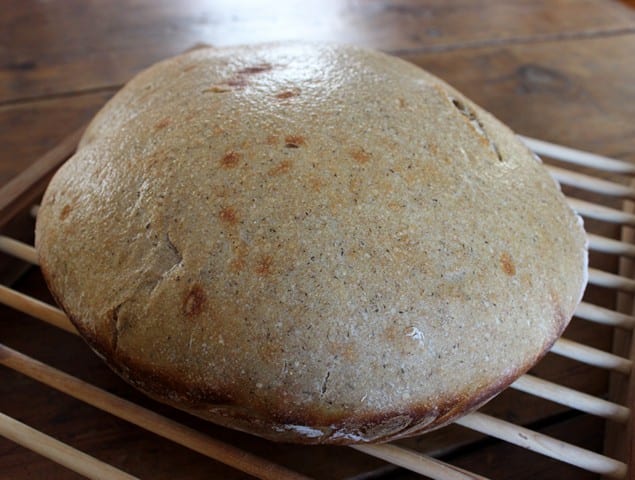
Maggie’s Sourdough Bread
- Total Time: 24 hours
- Yield: 1 large round loaf 1x
Description
This sourdough bread boasts a toothsome crust and a moist, complex crumb with a distinctive tang, perfect for breakfast or any meal.
Ingredients
- 5 cups flour
- 2 teaspoons salt
- 2 cups water
- 1 cup starter (see below for instructions on how to create your own)
Instructions
- In a large bowl, mix together 5 cups of flour, 2 teaspoons of salt, 2 cups of water, and 1 cup of sourdough starter until a shaggy dough forms.
- Cover the bowl with a cloth and let the dough sit at room temperature for 12 to 24 hours, allowing it to rise and develop flavor. The dough should become bubbly and double in size.
- Turn the dough out onto a lightly floured surface. Gently fold the dough into the center a few times, being careful not to over-handle it, to maintain the air bubbles.
- Shape the dough into a round loaf and place it on a piece of parchment paper. Cover it with a cloth and let it rise for another 2 to 4 hours, or until it has increased in size.
- Preheat your oven to 450°F (232°C) with a Dutch oven inside to heat up.
- Once the dough has risen, carefully remove the Dutch oven from the oven. Place the dough, still on the parchment paper, into the Dutch oven. Cover with the lid.
- Bake for 30 minutes, then remove the lid and bake for an additional 15 to 20 minutes, or until the crust is golden brown and the loaf sounds hollow when tapped on the bottom.
- Remove the bread from the Dutch oven and let it cool on a wire rack before slicing.
Notes
Experiment with different flours like whole wheat or a seven grain mix for variety. The bread can be frozen for later use. If you have excess starter, consider sharing it with friends or using it to make additional loaves. For a twist, try topping slices with avocado or melted cheese like raclette.
- Prep Time: 15 minutes
- Cook Time: 45 minutes
- Category: Baking
- Cuisine: American
Nutrition
- Serving Size: 1 slice
- Calories: 150
- Sugar: 0
- Sodium: 390
- Fat: 0
- Carbohydrates: 30
- Fiber: 2
- Protein: 5
- Cholesterol: 0
Frequently Asked Questions
How do I maintain the sourdough starter for this recipe?
You should keep the starter in a large glass bowl in a warmish place and feed it every day with 1¼ cups of flour and water.
What type of flour should I use for feeding the sourdough starter?
You can use high-quality all-purpose or whole wheat flour to feed your sourdough starter, as it helps promote healthy yeast growth.
Why does the sourdough starter need to be in a warmish place?
A warm environment encourages the fermentation process, helping the wild yeast to thrive and create the bubbles that are essential for your sourdough bread’s texture.



This is the BEST recipe and I’ve been using it for years. Turns out fabulous every time. Sometimes I adds tablespoon of apple cider vinegar with “the mother” to add a little extra tartness to the flavor.
After rising for 22 hours and baking for the required time, the bread was still not close to cooked. I added 10 minutes and it looked much better. Upon attempting to take it out of the dutch oven, the bread was horribly stuck (maybe there should be instructions for greasing and/or flouring the pan?). But after that amount of baking time, the middle was still not good and had the consistency of rubber.
You can sleep your starter in the fridge if it’s growing too fast or your are going away and can’t feed it. Mine woke up after two days of TLC after having a holiday in the fridge. It’s also survived me forgetting to feed it. They are pretty resilient.
I followed the recipe, and my loaf was awesome! I also used the recipe and instead of making it into a loaf…I divided it into 24 pieces and made English Muffins. They were a hit!
Followed by the recipe exactly using some inherited starter and it came out perfectly… beautiful looking loaf chewy crust and moist delicious center.
Thank you
Hi, I have enjoyed reading your sourdough info. here, thanks, and was wondering if you know if I can use my “dough hook” with the soughdough batter, and/or doughs? I bought this cool tool, but the hook end is stainless steel. I’m afraid it will ruin the batch of bread if I let it come in contact with the moistened mass! I’m finding it difficult to find consistant info. on the internet about soughdough recipes. Thank you for any help you can give. Jeanne Marie
Hi Cindi, That’s the recipe I use and the bread turns out great. The dough is pretty wet when it’s first mixed together, but less so after it rises. It makes a moist crumb, with the amount of moisture depending on the type of flour I’ve used (with denser flours usually yielding a moister crumb, so I sometimes adjust the ingredients a bit depending on the flour). I don’t know where you are in the process, but I wouldn’t give up on it yet. I hope it turns out!
Sadly I followed your instructions to a tee and I have a wet blob sitting on my counter. Way too wet. Using grams in recipes may help but what a waste. I bake a lot and should have realized the recipe was wrong. 5 cups of flour with 2 cups is water plus starter?