
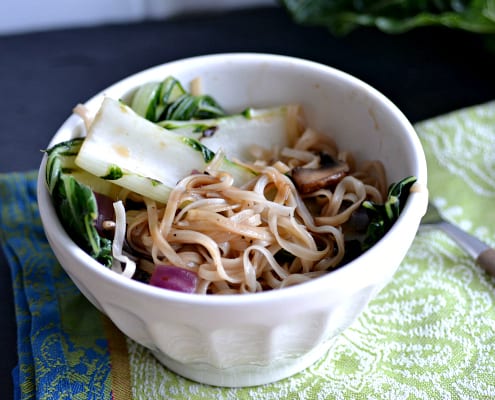
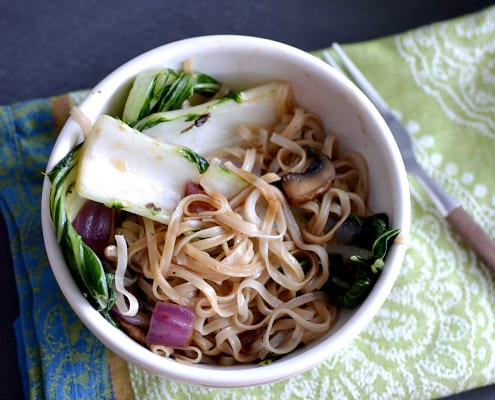
Sometimes, you just need a simple dish.
No crazy ingredients or weird preparation instructions, just a handful of good stuff and two – three instructions. These are the kind of dishes I’ve been flocking to lately. Not because I’m lazy or indifferent, but because simple means I have more time to spend with my husband. More time to read books, drink a glass of my favorite wine and cuddle with my puppy. As a girl who spends hours (and I mean hours) in the kitchen everyday for her day job, a simple Thai salad with a organic teriyaki sauce and sauteed bok choy is all I can manage come dinner time without collapsing on the cold tile of my suburban kitchen floor. Even though this simple bowl of comfort food is easy, don’t mistake that for meaning it’s under-flavored or not darn delicious. This bowl of noodles and vegetables is absolutely heart and stomach warming.
Don’t be alarmed if you eat two bowls of this (or more) in a sitting, it’s just that good. The star of the show is, easily, the sautéed bok choy. Bok choy is one of those amazing ingredients that is totally underutilized by most of the public, for reasons unbenounced to me. The crunchy stalk is the perfect compliment to the softer texture of the rice noodles. Paired with caramelized onions and garlic and you have something magnificent. Not bad for a dish with under ten ingredients!
Print
Simple Teriyaki Thai Salad with Bok Choy
- Total Time: 17 minutes
- Yield: 4 servings
Description
A comforting Thai salad featuring sautéed bok choy and rice noodles, tossed in a savory organic teriyaki sauce.
Ingredients
- 8 oz (225 g) rice noodles
- 1 tbsp (15 g) butter
- 1/2 medium red onion, chopped
- 4 cloves garlic, minced
- 1/2 cup (120 ml) mushrooms, sliced
- 4 stalks baby bok choy, leaves removed
- 1/4 cup (60 ml) organic teriyaki sauce
- 1 1/2 tbsp (22 ml) soy sauce
Instructions
- Soak the rice noodles in warm water for about 15 minutes, or until they start to soften. Drain and set aside.
- In a wok, heat the butter over medium-high heat. Once melted, add the chopped onions and cook for about 2 minutes until they begin to soften.
- Add the minced garlic and sliced mushrooms to the wok, cooking for an additional 3-4 minutes until the mushrooms are tender and the garlic is fragrant.
- Add the bok choy stalks to the wok and sauté for 3-4 minutes until they are tender-crisp.
- Stir in the organic teriyaki sauce and soy sauce, mixing well to coat all the vegetables.
- Add the soaked rice noodles to the wok, tossing everything together for another 2-3 minutes until the noodles are heated through and well combined with the sauce and vegetables.
- Serve immediately, enjoying the contrast of textures and flavors.
Notes
- This dish is best served immediately while the noodles are warm and the bok choy is crisp.
- You can store leftovers in an airtight container in the refrigerator for up to 2 days.
- Reheat gently in a pan over low heat.
- Feel free to add more vegetables like bell peppers or carrots for extra crunch and color.
- Prep Time: 5 minutes
- Cook Time: 12 minutes
- Category: Salad
- Cuisine: Thai
Nutrition
- Serving Size: 1 serving
- Calories: 250
- Sugar: 5
- Sodium: 600
- Fat: 8
- Carbohydrates: 42
- Fiber: 3
- Protein: 6
- Cholesterol: 10
If You Liked This Recipe, You’ll Love These
- Spring Salad Dressing
- Barley Salad with Radishes and Garlic Scapes
- Spring Asparagus and Fava Salad with Mustard Vinaigrette
- Fennel and Sweet Potato Gratin
Frequently Asked Questions
Why is the bok choy described as the star of this dish?
I think the sautéed bok choy is easily the star of the show — its crunchy stalk creates the perfect textural contrast to the softer rice noodles. Combined with caramelized onions and garlic, it delivers big flavour from a simple, underutilized ingredient.
Do I need to boil the rice noodles before adding them to the wok?
No — soak the 8 oz (225 g) of rice noodles in warm water for about 15 minutes until they start to soften, then drain them. They finish cooking in the wok for another 2-3 minutes after the vegetables and sauce are added.
Why does this recipe use butter in a wok instead of oil?
I use 1 tbsp (15 g) of butter as the cooking fat to help caramelize the red onion and garlic at the start. The teriyaki and soy sauces carry the main flavour, so butter adds richness without competing with the sauce.






Five things and two steps, which is about all i had in me last night. My market has only just started carrying bok choy so the timing worked out.