
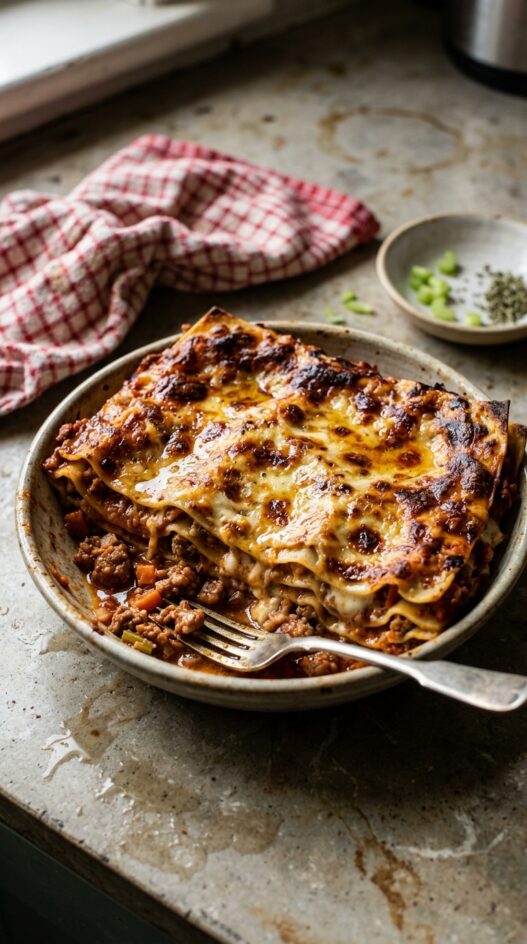
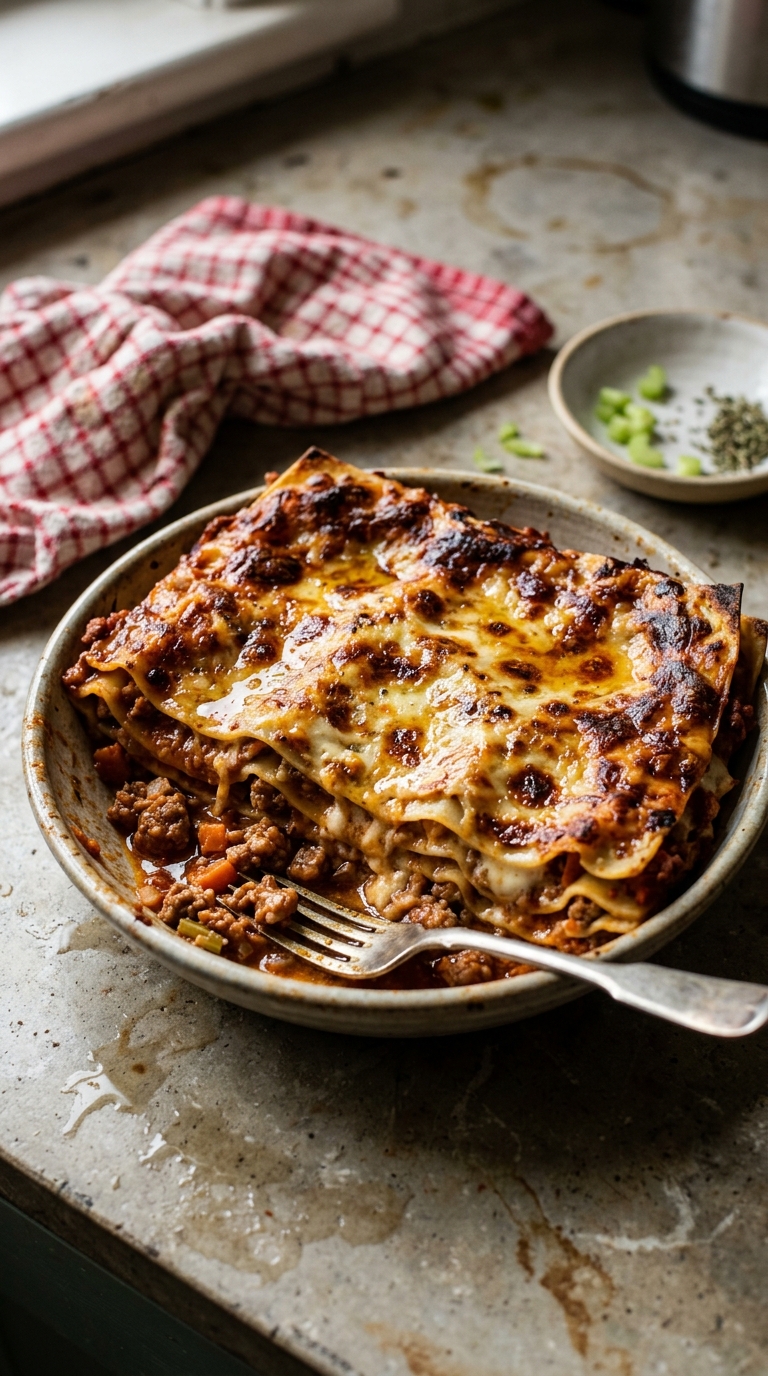
I would say that 95% of Italian people would think about sundays with their families whenever they hear the word “LASAGNE”. I guess it’s because of the amount of time you need to cook them, that most people eat it only on major holidays or on sundays. As usual, each region has it’s own recipe, in southern Italy they add boiled eggs, peas, chunks of meat, but I find it very hard to digest, so I prepare the basic recipe made with tomato sauce with meat, white sauce and mozzarella. If you like lasagne you should definitely try to make it at home, it’ll be a totally different experience!
You just need some time… let’s say 4 hours…if you want to make your own pasta, but if you’re not in the mood for kneading, you can use the dried pasta you buy in the stores, you will save a lot of time and if you choose a quality product no one will taste the difference.
The trick to make lasagne with dried pasta is to make a very liquid white sauce and tomato sauce, so the pasta will absorb the excess water during the cooking process and will double in size. (keep it in mind when laying the pasta sheets onto the tray.. )
Print
Sundays With The Family – Authentic Italian Lasagne
- Total Time: 3 hours 25 minutes
- Yield: 6–8 servings
Description
This authentic Italian lasagne features layers of rich tomato meat sauce, creamy white sauce, and melted mozzarella, perfect for a family Sunday feast.
Ingredients
For the Meat Sauce
- 800g canned tomato puree
- 400g minced meat (pork and beef) or 400g pork ribs
- 3 Italian sausages
- 1/2 carrot, finely chopped
- 1/2 celery stalk, finely chopped
- 1/2 onion, finely chopped
- 400ml water
- 2 tbsp (30 ml) olive oil
- Wine, for deglazing
- Salt, to taste
- Pepper, to taste
- Chili pepper, optional
For the Pasta (choose one)
- All-purpose flour, for fresh pasta
- Eggs, beaten, for fresh pasta
- OR: 500g dried lasagne sheets — skip Steps 3-4 below and see note in Step 3 on adjusting the sauces
For the Béchamel
- 100g butter
- 100g all-purpose flour
- 1 liter milk
- Nutmeg, to taste
- Salt, to taste
For Assembly
- 500g mozzarella cheese, sliced
- Parmigiano cheese, grated
Instructions
- Make the meat sauce: heat the olive oil in a wide saucepan over medium heat. Add the onion, carrot, celery, and chili (if using) and cook, stirring occasionally, until softened, about 5 minutes. Add the minced meat and sausages, breaking them up with a spoon, and cook until the meat has changed color. Pour in the wine and let it evaporate, about 2 minutes. Add the tomato puree and water, season with salt and pepper, and stir to combine. Reduce heat to low and simmer for 2 hours, stirring occasionally and adding a splash of water if the sauce dries out. If using pork ribs, remove the bones before assembling the lasagne.
- Make the béchamel: melt the butter in a saucepan over medium heat. Add the flour and stir constantly for 2 minutes to cook out the raw taste (this is your roux). In a separate pot, bring the milk just to a boil. Remove the roux from the heat and pour the hot milk over it in a thin stream, whisking vigorously to prevent lumps. Return to medium heat, add a grating of nutmeg and a pinch of salt, and continue whisking until the sauce comes to a boil and thickens to a creamy consistency, about 5 minutes. Lay a sheet of plastic wrap directly on the surface to prevent a skin from forming.
- Make the fresh pasta (or use the 500g dried lasagne sheets instead — skip Steps 3–4 and go straight to assembly, making the meat sauce and béchamel very liquid so the dried pasta absorbs enough moisture while baking): place the flour in a large bowl and make a well in the center. Add the beaten eggs and gradually incorporate the flour with a fork, then knead with your hands until the dough is smooth and elastic, about 10 minutes. Wrap in plastic and rest at room temperature for at least 15 minutes. Roll out on a floured surface to about 2 mm thick. Cut into rectangles roughly 10 x 15 cm (4 x 6 inches).
- Par-cook the pasta: bring a large pot of salted water to a boil. Prepare a large bowl of iced water. Cook the pasta sheets in batches for 3 minutes each, then lift out with tongs and transfer immediately to the iced water to stop the cooking. Drain on clean kitchen towels.
- Assemble the lasagne: spread a thin layer of meat sauce and béchamel over the base of a 40 x 30 cm (16 x 12 inch) baking dish. Lay a single layer of pasta sheets over the base. Add a ladleful of meat sauce, a ladleful of béchamel, a scatter of mozzarella, and a sprinkle of Parmigiano. Repeat the layers until you have used all the ingredients, finishing with a generous layer of béchamel, mozzarella, and an extra sprinkle of Parmigiano (more Parmigiano on top means a crispier crust).
- Bake at 200°C (390°F) for 45–55 minutes until the top is golden and bubbling. Let the lasagne rest for 10–15 minutes before slicing and serving — this allows the layers to settle and makes it much easier to cut.
Notes
- You can replace the fresh pasta with good-quality dried lasagne sheets to save time — if you do, make the meat sauce and béchamel slightly more liquid so the dried sheets absorb enough moisture during baking.
- The lasagne is even better the next day, reheated in a low oven.
- Prep Time: 2 hours 30 minutes
- Cook Time: 55 minutes
- Category: Main Course
- Cuisine: Italian
Nutrition
- Serving Size: 1 serving
- Calories: 450
- Sugar: 8
- Sodium: 800
- Fat: 20
- Carbohydrates: 40
- Fiber: 4
- Protein: 25
- Cholesterol: 60
If You Liked This Recipe, You’ll Love These
- Shrimp and Tofu Pad Thai
- Warm Puy Lentil Salad with Golden Halloumi
- How to Make Swedish Meatballs
- Grilled Chili Sesame Chicken
Frequently Asked Questions
Can I use dried lasagne sheets instead of making fresh pasta?
Yes — and the key adjustment: if using dried sheets, make the meat sauce and béchamel “slightly more liquid” so the dried pasta absorbs enough moisture during baking. Fresh pasta takes about 4 hours total; dried sheets are a legitimate time-saver when using quality brands.
Why must the lasagne rest 10–15 minutes before slicing?
Resting after the 45–55 minute bake at 200°C (390°F) allows the layers to settle and firm up, making it “much easier to cut” clean squares. Slicing immediately will cause the layers to slide and the filling to spill out.
How do I prevent the béchamel from forming a skin while I prepare the other components?
Lay a sheet of plastic wrap directly on the surface of the finished béchamel (not over the top of the pan). Direct contact with the plastic blocks air and prevents the protein in the milk from setting into a tough skin.
Is leftover lasagne worth saving?
Absolutely — it’s even better the next day. Reheat it in a low oven, which firms up the layers further and deepens the flavors.




I would love to use this recipe but I do not know grams and such can you translate for me to cups and pounds please I want to use this recipe. thank you for your time.
Tina Palasota
Hi Tina, Try out these weight converters: https://www.google.com/search?q=grams+to+pounds&oq=grams+to+&aqs=chrome.2.69i57j0l5.3798j0j7&sourceid=chrome&ie=UTF-8
Happy cooking!
Is it ok to make this a day or two ahead and leave in refrigerator covered until ready to bake? Or will it compromise the fresh pasta?
Hi Claudia, it’s perfectly ok, one day is better that two, or you may end up with a very dry lasagna. To make it a couple of days ahead you can actually use the fresh pasta without boiling it first and make the bechamel sauce a little runny or add water. This way the fresh pasta will slowly absorb the liquid and by the time you cook it, it will be perfect.
Hope you like it!
Thanks
Elisa
I LOVE this recipe!!! My family thinks TRUE Italian MUST have meat….. after trying this I DO NOT agree with them. Being a Southern USA girl, this is EXACTLY how I would think TRUE ITALIAN LASAGNE would be. THANK YOU for sharing and for me WINNING the argument!
Thank you so much! I’m truly glad you liked the recipe :)
Have you ever made this and froze it before baking? Wondering if you still boil the noodles? Absolutely LOVE this recipe. It’s our favorite!
Hi Erin sure you can freeze it before cooking I do it often, so I have it ready when I don’t have time to cook. Glad you like the recipe! Thanks
Can’t wait to cook it again. Thankyou! Amazingly good ; )
thankyou sooo much for your recipe im always trying something new with a lasagns recipe but oohhh my lord your is the BEST bellissimo.