
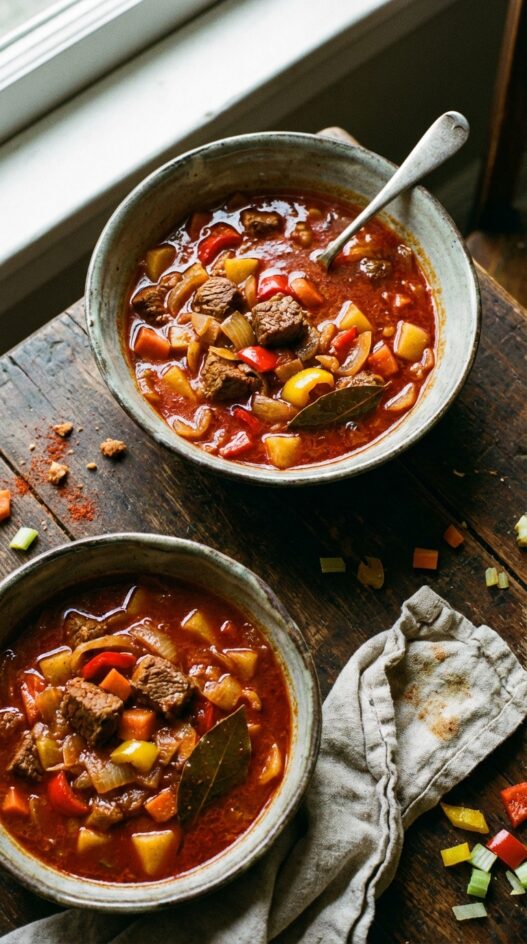
Hungary holds a special place in my heart, in my family’s hearts. My brother lived there for 2 years as a young man, regularly wrote home to us about his experiences there, the beautiful scenery and breathtaking buildings, his love for the Hungarian people. When I visited Budapest I immediately fell in love with it. It has become one of my most favorite European cities. Its name comes from the two sides of the city (Buda and Pest) separated by the Danube River running through it. I don’t know that any city has a more breathtaking site than Budapest’s famous chain bridge, its parliament building, and the incredible Buda Castle.
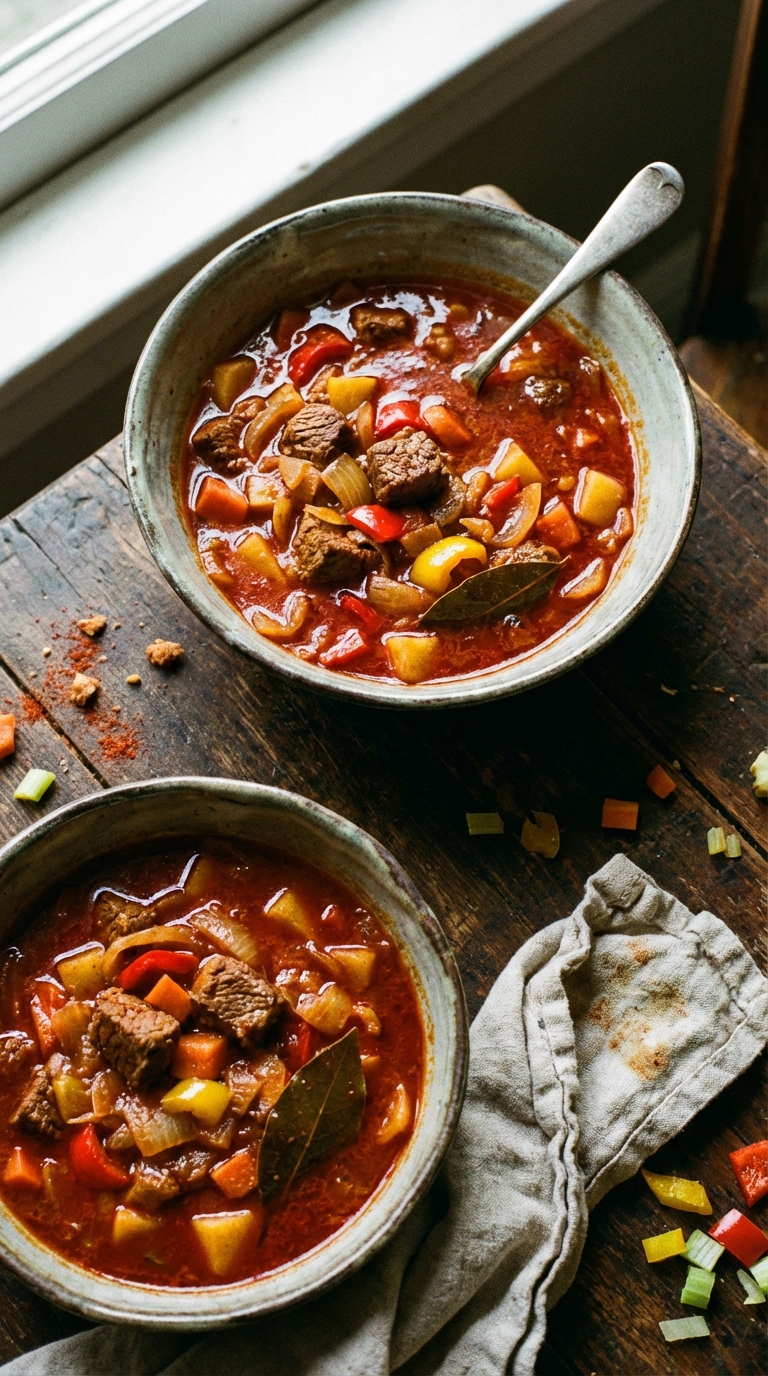
I also love Hungarian food. Their breads and smoked sausages are fantastic, as are their meats, stews, sauces, desserts. Today I’m going to share the national dish of Hungary: Goulash, or, as Hungarians call it, gulyás, meaning ”herdsman.” Its origins are from Turkey and it was brought to Hungary by invading Turks and tweaked to Hungarian standards over time. Goulash is kind of in between a soup and a stew. Unlike some stews, Goulash is not overly packed full of beef and vegetables, it is a little more brothy. But through the cooking process, the broth becomes thicker and more like a rich sauce.
And no, contrary to popular belief here in the U.S., goulash is NOT made with ground beef or (heaven forbid) macaroni noodles!
To achieve the ultimate flavor, the cooking method is important and quality Hungarian paprika is essential. And lots of it! None of this “2 teaspoons of paprika” jazz. Hungarians use very generous amounts of paprika, and that’s key. A Hungarian once told us, “however much paprika the recipe calls for – at least double or triple it!” For this size batch of Goulash, you want to use a full 1/4 cup of it. When I lived in Germany Hungary was just a few hours away and I would stock up on it when I visited. Now I order it online and recommend this imported Hungarian paprika. I mentioned earlier, many variations of goulash exist. Some include turnip or wine or caraway seeds, to name a few. But this recipe is the traditional, old-fashioned way of making Goulash that my brother and I learned from older generations of Hungarian women and it needs no embellishments. It’s simply delicious!
Traditional Hungarian Goulash
- Total Time: 60 minutes
- Yield: Serves 6
- Diet: Omnivore
Description
A hearty, flavorful stew perfect for a chilly evening. Simple ingredients create a rich and satisfying dish.
Ingredients
- 3 tbsp lard or butter
- 2 lbs (907 g) yellow onions, chopped
- 1/4 cup good quality sweet Hungarian paprika
- 2 lbs (907 g) beef (see note), cut into 1/2 inch pieces
- 5 cloves garlic, minced
- 2 red bell peppers, seeded/membranes removed, cut into 1/2 inch chunks
- 1 yellow bell pepper, seeded/membranes removed, cut into 1/2 inch chunks
- 2 tomatoes, diced
- 2 carrots, diced
- 2 medium potatoes, cut into 1/2 inch chunks
- 5 cups (1183 ml) beef broth
- 1 bay leaf
- 1 tsp salt
- 1/4 tsp freshly ground black pepper
Instructions
- Melt the butter in a Dutch oven over medium-high heat and cook the onions until beginning to brown, about 7-10 minutes.
- Remove from heat and stir in the paprika.
- Add the beef and garlic, return to the heat, and cook for about 10 minutes, or until the beef is no longer pink.
- Add the bell peppers and cook for another 7-8 minutes.
- Add the carrots, tomatoes, potatoes, beef broth, bay leaf, salt, and pepper.
- Bring to a boil, cover, reduce the heat to medium (approximately 300°F/150°C), and simmer for 30 minutes.
- Add salt to taste.
Notes
- For deeper flavor, brown the beef in batches to avoid steaming.
- Substitute chuck roast or stew meat for the beef for a more tender result.
- Leftovers can be frozen for up to 3 months; reheat gently on the stovetop.
- Prep Time: 20 minutes
- Cook Time: 40 minutes
- Category: Main Course
- Method: Braising
- Cuisine: Hungarian
Nutrition
- Serving Size: 1½ cups
- Calories: 450
- Sugar: 5
- Sodium: 700
- Fat: 25
- Saturated Fat: 8
- Unsaturated Fat: 15
- Carbohydrates: 35
- Fiber: 5
- Protein: 35
- Cholesterol: 90
Frequently Asked Questions
What cut of beef is best for Hungarian goulash?
Beef chuck or shank are traditional choices because the connective tissue breaks down during the long braise, making the meat tender and giving the broth a rich body. Avoid lean cuts like sirloin, which dry out with extended cooking.
How much paprika should I use, and does the type matter?
Hungarian sweet paprika is the defining spice here and should be used generously, typically several tablespoons for a full pot. Hot paprika can be added alongside it for heat, but smoked paprika is not traditional and will change the flavor profile significantly.
Should the goulash be thick like a stew or more like a soup?
Authentic Hungarian goulash is closer to a hearty soup than a stew, with a broth that is flavorful but not as thick as a Western-style beef stew. If it reduces too much during cooking, add a bit of water or stock to bring it back to the right consistency.
If You Liked This Recipe, You’ll Love These
- French Onion Soup with Braised Short Ribs and Gruyère
- Rustic Italian Meatball and Potato Soup
- Brisket Ho Fun Rice Noodle Soup
- How to Make Homemade Ukrainian Borscht
- Miso-Coconut Noodle Soup






Really enjoyed this the flavors blended beautifully together. Next time I’d like to try reducing the stock as I found there was too much gravy but I want to do it without lessening the flavor
How can I re-size this for six people? I’d like to follow this closely if I can find the sweet paprika in time for next week-end!
I must admit, this is one of the more true to form recipes for Hungarian Gulyas I have seen on the internet. However, peppers, tomatoes, and sour cream is not used nor is beef broth. Nor is it served with cucumber salad. Sorry!
Hi Zita! That’s correct, lard is what’s traditionally used and gives it such a great flavor. Breaking from tradition, rather than lard I used butter. Butter still provides a lot of flavor, much more so than oil, but I have to admit that nothing beats the taste of good pork lard!
No butter in the goulash, please! Lard is ok but nowadays sunflower oil is used to saute/cook the onions.