
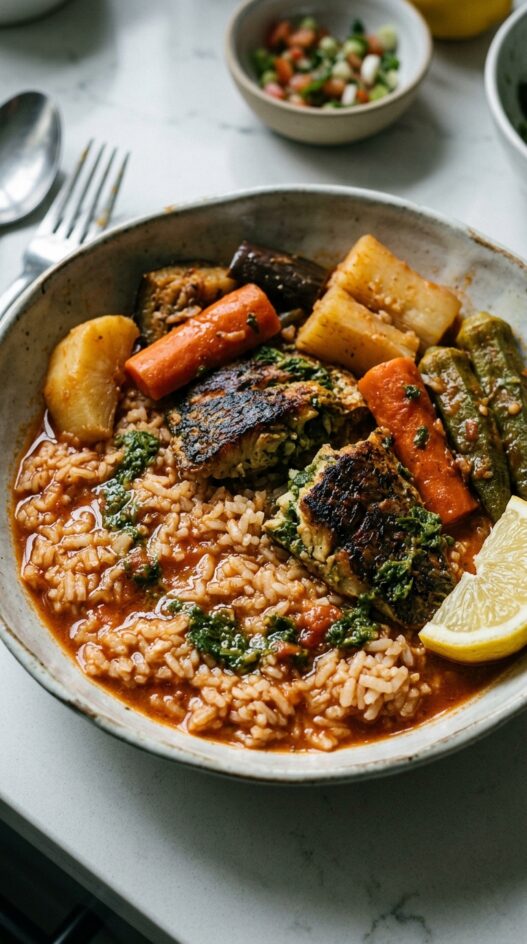
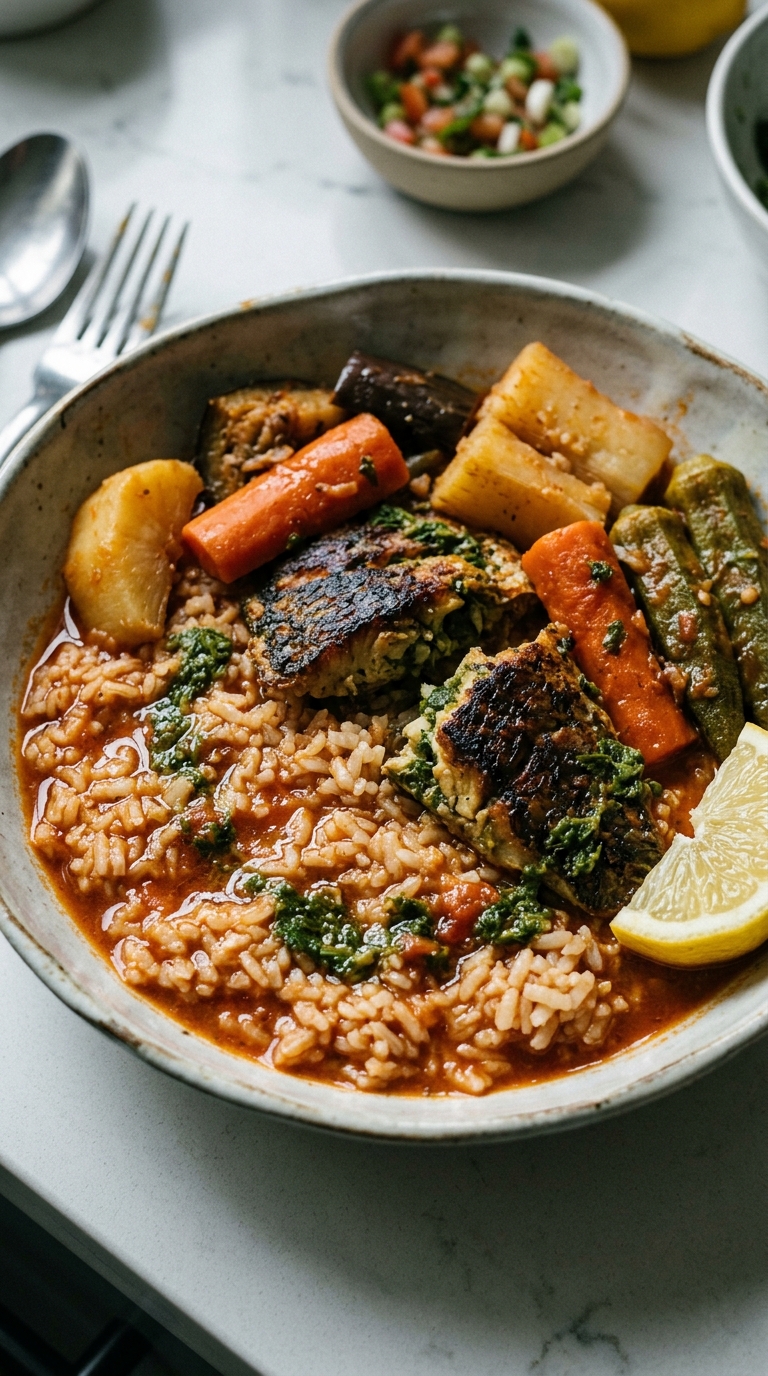
A business trip to Senegal in 2007 and long-lasting friendships with the Senegalese community has taught me a great deal about the Senegalese culture and African food. I have been privileged to learn some staple African food recipes of Senegal including Thieboudienne, or ceebu jen along with, Soupoukanja, Thiou poisson and Yassa which I will feature in subsequent posts on Honestcooking. Traditionally presented in a large dish, today, I feature modern deconstructed Thieboudienne showing differents adaptations of this eclectic dish that has been transformed and re-adapted overseas. It is made from fish, rice and tomato sauce. Its other ingredients include onions, carrots, cabbage and which ever vegetable you prefer.
Print
Senegalese Thieboudienne
- Total Time: 1 hour 30 mins
- Yield: 8-12
Description
African food recipes are versatile and Thieboudienne from Senegal is an example of staple rice dish that is as recognized as the country flag.
Ingredients
- 3 Tilapia cleaned and cut into 4 pieces each
- 3 branches of parsley finely chopped
- 3 branches of cilantro finely chopped
- 3 bay leaves
- 1 tablespoon of thyme
- 3 green onions finely chopped,
- 2 tablespoon of Afro Fusion Cuisines’ All Purpose Seasoning
- 4 ounces of tomato paste
- 2 plum tomatoes finely chopped
- 3 medium onions finely chopped
- 3 lb broken rice (broken one once or twice)
- 1 cup of oil
- salt , black pepper
- Vegetables of your choices
- 2 large carrots root cut into 4 inches pieces
- 1 eggplant root cut into 4 inches pieces
- 1 cassava or yucca root cut into 4 inches pieces
- 3 okra
Instructions
- Clean the fish very well and set aside
- Prepare the special marinade called “Nokoss” by mixing in a blender all your spices and herbs
- With a sharp small knife make small cut on the fish. Using 1/2 of your marinade in step 2 stuffed the fish and immediately broil or fry then set aside
- Parboil or steam your rice and set aside
- In a heated pot, using 4 tablespoon of the oil used to fry your fish, put a dash of salt , add onion, tomato paste and plum tomatoes (cook for 5-7mn stirring) .
- Add 6 cups of water to the pot, add the cut veggies, add the fish already fried and lastly add
- The remaining half of the marinade Let simmer for 15 minutes for the fish and Juices to blend
- Remove the fish roe from the pot and start plating
- Then remove from the sauce the cooked veggies and add it to the plate.
- Add the pre-cooked or steamed broken rice to the boiling sauce
- Put the fire on low and let it reduce…should take about 15-30 mns depending on the nature of your rice. Your Thieboudienne is ready!
Notes
Now you need to serve it Senegalese style…like the locals… meaning: put the rice in a large plate or large serving bowl. Put the fish steaks in the middle of the rice and put all around it the veggies and fish steak. Add the cut lemon.
- Prep Time: 30 mins
- Cook Time: 1 hour
Frequently Asked Questions
What is thieboudienne and how is it different from jollof rice?
Thieboudienne (also spelled ceebu jen) is Senegal’s national dish — a one-pot rice cooked in a tomato-and-fish broth with vegetables. Jollof rice is a broader West African category cooked in a tomato base, typically with chicken or meat and no fish. Thieboudienne is distinguished by the “nokoss” marinade stuffed directly into the fish, broken rice, and the inclusion of vegetables like carrots, eggplant, cassava, and okra cooked in the same pot.
Can I substitute tilapia with another fish for thieboudienne?
Yes. Any firm, white-fleshed fish holds up well to broiling or frying and then simmering — red snapper, grouper, or sea bass are traditional West African choices. Avoid delicate fish like sole or flounder, which will fall apart during the second cooking phase in the broth.
How far in advance can I make thieboudienne, and does it reheat well?
Thieboudienne reheats very well and is commonly eaten the next day in Senegal. Store leftovers in an airtight container in the fridge for up to 2 days. Reheat gently on the stovetop with a splash of water to loosen the rice. The fish is best reheated separately to prevent it from drying out.


It is a great and rich recipe. I am going to practice with the Nile Perch which is plenty in Tanzania.
I tried this after a friend told me about thieboudienne and wow what a dish, so good and full of flavor. Every bite is layered with tomato and fish and it just gets better, took a while but so worth it. My whole kitchen smelled AMAZING, so good i will make it again for a group, thanks!