
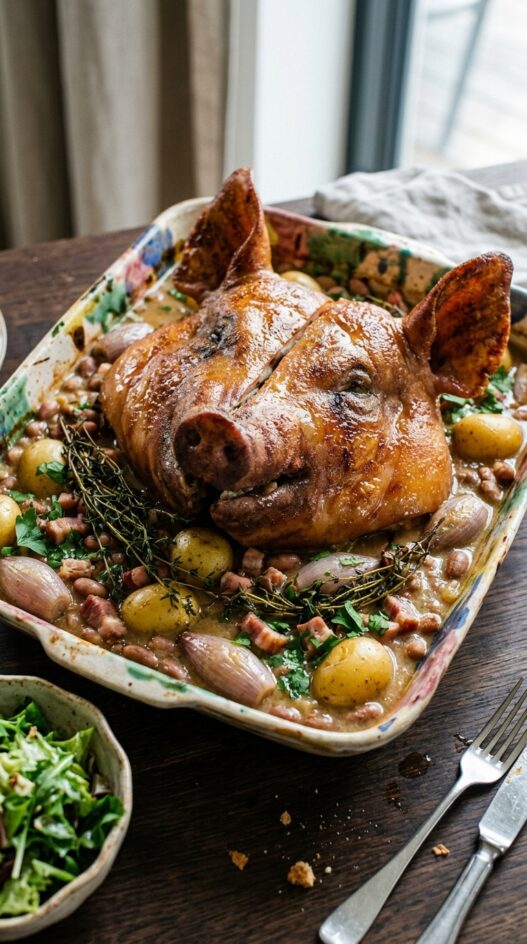
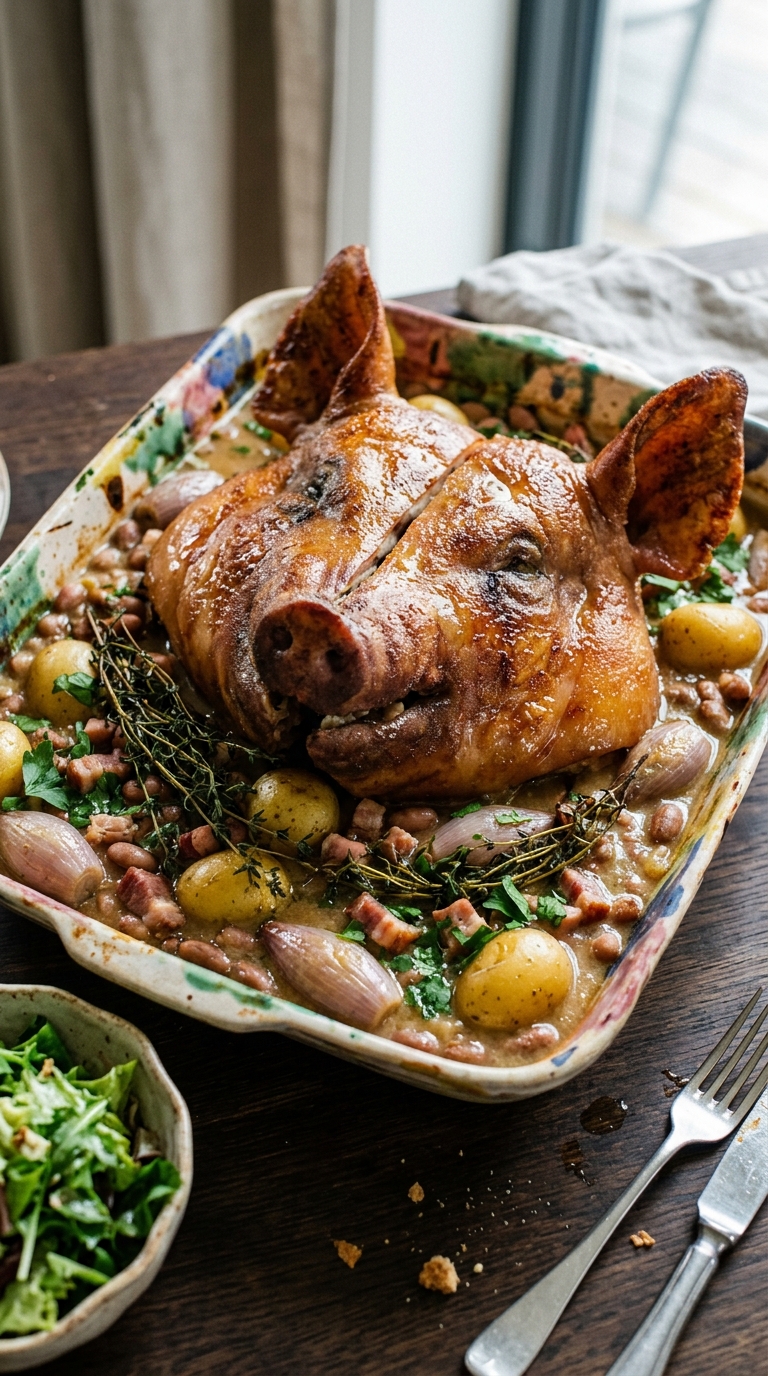
This column is an insult to columns. Pig of the Week? More like Pig of the Year. But enough about my failings and inconsistent contributions. I have a truly memorable event to report on: the cooking of a whole pig’s head.Yes, the whole head, chopped in two. Not just the cheeks or the ears. The whole swine shebang – brains, snout, strange unidentifiable glands and fatty glory holes – braised off with beans, wine, and some spuds.
My previous encounter with a pig’s head was at St. John Bread & Wine in London, where their head chef (no pun intended, but that title never seemed more apt), Lee Tiernan, served it with black pudding, beans and golden, crispy skin. So, in order to honour the proud animal I consulted Lee for some tips and direction on the cooking.
As an addition to the recipe from the second of the St. John cookbooks, Lee suggested boiling the head for a few minutes to clear off the worst filth, and then brine or salt it overnight. We went for salt, but you could also marinate the whole mug in Breton cider, according to our headmaster.
One final thing to consider; our butcher offered to remove the gnarly bottom of the ear and the eye. But after he had done this to the first half of the head, the pig looked a bit manhandled and sad. So for the second half we decided to keep things intact; just as God had intended this glorious animal to look.
Print
Roasted pig’s head
- Total Time: 4 hours 30 minutes
- Yield: 4 servings
Description
Experience a medieval feast with this roasted pig’s head, braised with wine and served with beans, black pudding, and crispy skin.
Ingredients
- A whole pig's head, split in two (get your butcher to do this)
- 1 cup (240 ml) sea salt, for overnight salting
- 2-3 tbsp (30-45 ml) duck fat, for sautéing
- 1 kg small potatoes, peeled
- 15-20 shallots, peeled and kept whole or halved
- 4-6 cloves garlic, peeled
- 400 g smoked bacon
- Borlotti beans (soaked overnight)
- 1 bundle of fresh thyme
- 2 litres chicken stock
- 750 ml (1 bottle) white wine
- 2 tsp Dijon mustard
- Small bunch flat leaf parsley, roughly chopped
- Salt and freshly ground black pepper, to taste
Instructions
- Give the two halves of head a good shave with a disposable razor to remove all hairs.
- Boil them in a large pot of water for about 5–10 minutes to clear off the worst scum.
- Rinse the heads and pat them dry.
- Give them another once-over with the razor and a small knife. Especially the inside of the ears need a good clean.
- Salt them generously, wrap up and leave overnight in the fridge.
- Depending on the size of your oven and the heads, you can either use a large roasting tray or two separate ones for each half.
- Start off by placing your roasting tray(s) on the hob and heat up a dollop of duck fat.
- Fry off the shallots, garlic and bacon.
- Place the beans in the tray and nestle the pig’s heads on top. Add the bundle of thyme and fill up with stock and wine until the head is halfway submerged up towards the middle of the cheek.
- Wrap the ear in tin foil and cover the whole tray with parchment paper and then tin foil. Put the tray(s) in a preheated moderate oven and leave to braise for about three hours.
- Take out the tray, unwrap the pig, add the potatoes and put back into the oven for another hour or so. You want the skin to crisp up and turn golden, but not burned. If the skin still feels a bit soggy at the end, you can crank up the grill for a few minutes, but be very careful.
- Once the head is ready, remove it from the tray and leave to rest for a few minutes. Stir the Dijon mustard and chopped parsley into the bean and potato stew, then season with salt and pepper to taste.
- Place the two halves of pig’s head back in the tray on top of the bean mixture and serve with a crunchy green salad on the side.
Notes
- Ask your butcher to split the head for you.
- Soaking the borlotti beans overnight is essential — dried beans need a full soak before braising.
- Prep Time: 30 minutes
- Cook Time: 4 hours
- Category: Main Course
- Cuisine: British
Nutrition
- Serving Size: 1 serving
- Calories: 800
- Sugar: 2
- Sodium: 1500
- Fat: 60
- Carbohydrates: 20
- Fiber: 5
- Protein: 50
- Cholesterol: 200
If You Liked This Recipe, You’ll Love These
- How to Make Panko Fried Scotch Eggs
- How to Make Flæskesteg: Danish Pork Roast with Crispy Crackling
- Al Pastor Pork Tacos
- Italian Pulled Pork with Creamy Parmesan Polenta
Frequently Asked Questions
Why does the recipe call for boiling the pig’s head before salting and braising it?
This tip comes from Lee Tiernan, head chef of St. John Bread & Wine in London: boil the two halves in a large pot of water for 5–10 minutes “to clear off the worst scum,” then rinse and pat dry before salting overnight. It’s a purging step to remove impurities before the long braise.
Why does the ear get wrapped in foil during braising?
Wrap the ear in tin foil before covering the whole tray for the 3-hour braise. The delicate cartilage and thin skin of the ear would overcook long before the cheeks and head are done — the foil protects it.
Do the borlotti beans need to be soaked in advance?
Yes — soaking the borlotti beans overnight is essential; dried beans need a full soak before braising. Add them to the roasting tray with the head, stock, and wine after the overnight soak.
What does the recipe suggest serving alongside the pig’s head?
The final step says to stir Dijon mustard and chopped flat-leaf parsley into the bean-and-potato stew, season with salt and pepper, and serve the two head halves on top — with a crunchy green salad on the side.


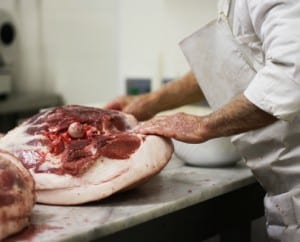

I was eyeing off the pig’s heads at the market the other day, which totally creeped-out my shopping partner. I can’t wait to do this!
Head chef! ;-) This is kind of like Dexter meets Gordon Ramsey, isn’t it. And given Gordon’s personality, it’s really not such a stretch…
Gordon certainly looks like he’s got some lovely juicy cheeks, which, after all, are the best part of the pig ;) Haven’t watched Dexter but I’m a big fan of any TV programme that showcases some good knife skills