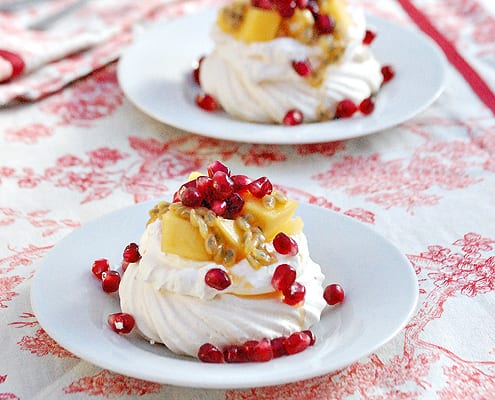
This one is for the boys out there who have a special girl to impress this Valentine’s Day. And by boys, of course, I mean anyone who might not be much for spending too much time in a kitchen. Wait, I’m being sexist, so let me rephrase that: For all you cook-o-phobes, this one’s for you.
Pavlovas are meringues topped with whipped cream topped with fruit. Simple, stunning and sooooo good. My spin is to use fresh exotic fruits, chosen for their contrasting colours and textures and also for their acidity, which balances out the sweetness of the meringues. Mangoes are a sensual fruit, being soft, sweet and juicy. Pomegranates, an ancient symbol of fertility, are gorgeous ruby red, the colour that most stimulates the senses and gets the blood flowing. And passion fruit… well, the name says it all really. While these three might not all come from the same corners of the world, the flavours do work wonderfully together.
Pavlovas are impressive yet simple, even when you bake the meringues yourself. But, as promised, I’m not going to make you do that. Good meringues are easy enough to find in grocery stores and farm shops. And, so long as your meringues are the only things you’re ‘cheating’ on, your relationship will surely survive this tiny little indiscretion.
Print
Passionate Pavlovas
- Total Time: 10 minutes
- Yield: 2 servings
Description
These Passionate Valentine’s Pavlovas are a delightful dessert featuring ready-made meringue shells topped with whipped cream and a vibrant mix of mango, passion fruit, and pomegranate seeds.
Ingredients
- 1/2 cup (125 ml) double (whipping) cream
- 1 tsp vanilla extract
- 2 ready-made meringue shells, individual serving size
- 1/2 mango, diced
- 2 passion fruits (look for those with slightly wrinkled skins)
- 1/2 cup (120 ml) pomegranate seeds
Instructions
- Pour the cream and vanilla into a large bowl and whisk until it forms soft peaks. This can be done by hand but is much easier with an electric whisk. If you’re not sure whether you’ve whisked it enough, lift the whisk out of the bowl; the cream should form a peak that gently folds over.
- Place each meringue shell on a serving plate.
- Spoon the whipped cream evenly onto each meringue shell.
- Top the cream with diced mango, passion fruit pulp, and pomegranate seeds, distributing the fruit evenly across the pavlovas.
- Serve immediately to enjoy the contrast of textures and flavors.
Notes
- For best results, use ripe fruits for maximum flavor.
- The meringues can be purchased from most grocery stores.
- Serve immediately after assembling to maintain the crisp texture of the meringue.
- If you prefer to make your own meringues, you can find recipes online, but store-bought ones work perfectly for this quick dessert.
- Prep Time: 10 minutes
- Cook Time: 0 minutes
- Category: Dessert
- Cuisine: Australian
Nutrition
- Serving Size: 1 pavlova
- Calories: 250
- Sugar: 25
- Sodium: 50
- Fat: 15
- Carbohydrates: 30
- Fiber: 2
- Protein: 3
- Cholesterol: 40
If You Liked This Recipe, You’ll Love These
- Riso al Latte con Fregole e Mandorle – Easy Rice Pudding
- Strawberry and Mint Pavlova
- Homemade Strawberry Pop Tarts
- Plantains Foster: A Caribbean Twist on New Orleans’ Classic Dessert
Frequently Asked Questions
Does the recipe really mean it’s okay to use store-bought meringues?
Yes — I use 2 ready-made meringue shells, and store-bought meringues from grocery stores or farm shops work perfectly. My focus here is the topping combination, not the meringue itself.
How do I know when the cream is whipped enough?
Lift the whisk out of the bowl — the cream should form a peak that gently folds over. That’s the soft-peak stage you’re looking for. I use ½ cup (125 ml) of double cream with 1 tsp of vanilla; an electric whisk makes it easier but it can be done by hand.
How do I pick a ripe passion fruit?
Look for passion fruits with slightly wrinkled skins — that wrinkling signals ripeness and means the fruit inside is sweet and full of juice rather than tart and underdeveloped.