
I grew up with gargeer as a regular in our household, a segment of our salad, a healthy green with a sharp zing that burns your tongue like a scalding soup. Peppery and overpowering, Egyptian gargeer, washed under a stream of cold water then plopped down on a plate to chomp on, was one of the first greens I looked for while living abroad. I never knew it as anything else and often wondered what it was called in English. After all, I had never paid much attention to it and had only ever seen it in Egyptian homes with mothers asking their daughters to get the gargeer from the kitchen while they spread white cheese into sandwich bread.
I wasn’t one to eat gebna beida (Egyptian white cheese) and so would never get the opportunity to stuff the leaves into my sandwich like my sister, allowing it to add some crunch into a rather boring ingestible. Instead, I’d eat it as a side, allowing it to sting my tongue.
Growing a little older, I began to notice the same leaf take its place comfortably in my eating habits albeit under different names that I had now learned: rocket, arugula, gargeer, or rucola. There were arugula pizzas, rucola salads and rocket-packed sandwiches. The possibilities were endless; I could not understand why we Egyptians reserved it to eat with cheese or as an accompanying side that laid on a plate spattered with water droplets and nothing else. I also wonder why we use the Indian name for this leaf.
Last month, I visited a more traditional restaurant with my husband who shared with me a beef knuckle soup, a fatta with rice mixed together with whole wheat bread and a big bowl of molokheyya, a stretchy green soup. Yes, we like soup. Being the only ones at the restaurant, the waiter decided to treat us to a little surprise – a plate of fresh gargeer placed right in front of my husband. Confused, I asked why he would give us gargeer.
It turns out that the kind man was trying to do us a favor; he was offering a well-known aphrodisiac that I had not been aware was such. It was his way of saying, “You’re a nice couple. Stay together.”
Only recently did I decide to cook rocket, serving it as a side dish and incorporating it into other dishes. I’ve found that I prefer it wilted quickly and cooked simply. Paring it with duck has also been one of my favorites, making me use the combination in a variety of dishes: in pastas, in sandwiches, in salads. Use this leaf, filled with vitamin C and potassium. It’s good stuff.
Print
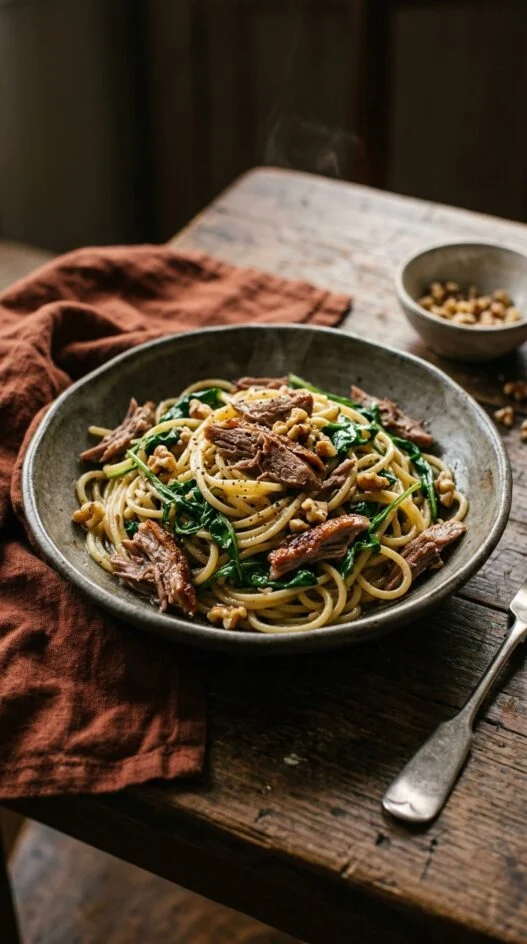
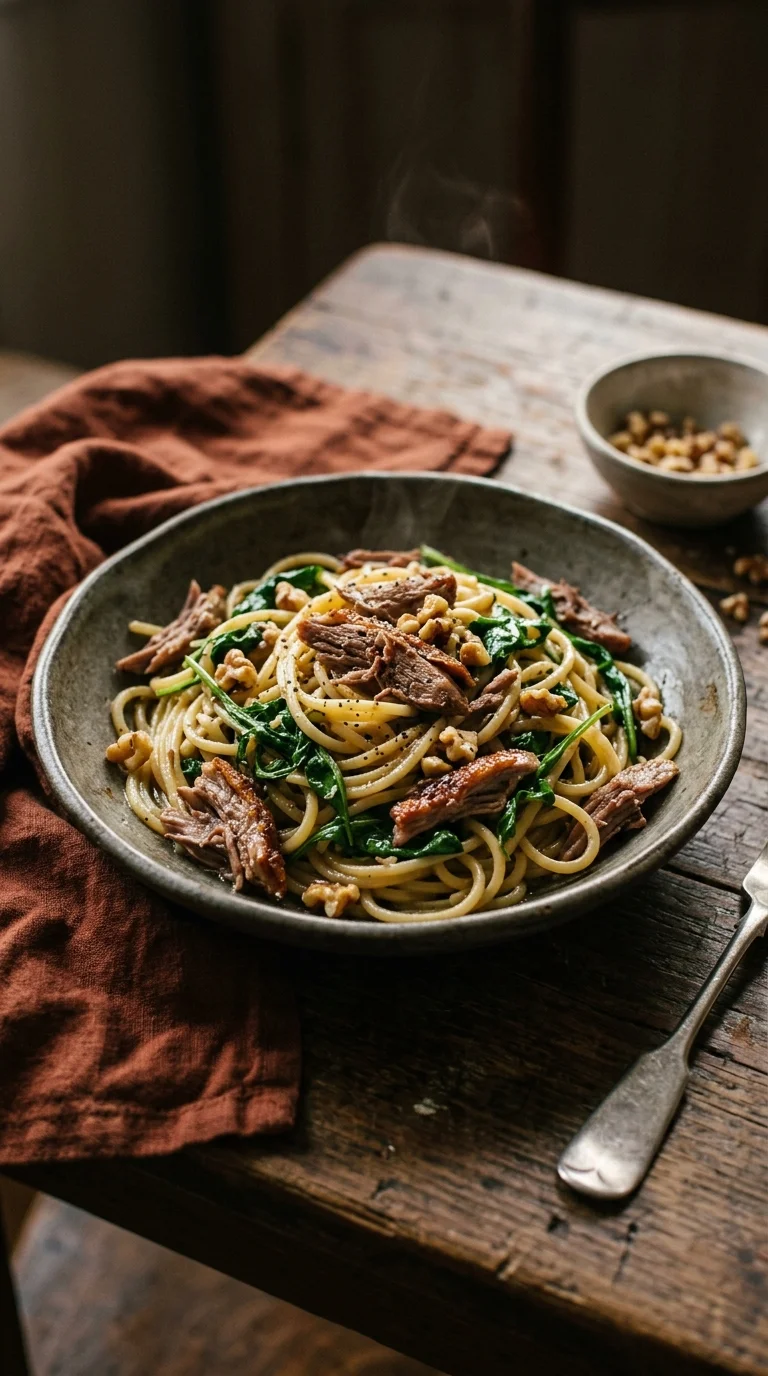
Pasta with Slow-roasted Duck and Wilted Rocket
- Total Time: 3 hours 15 minutes
- Yield: 4 servings
Description
A savory pasta dish featuring tender, slow-roasted duck and peppery wilted rocket, perfect for a comforting meal.
Ingredients
For the duck, you'll need
- 3 duck legs, shredded
- Extra salt
- 1/2 cup (120 ml) of melted ghee
- Salt and pepper to taste
For the pasta:
- 200 grams of pasta, cooked al dente
- 2 handfuls of rocket
- 1-2 tbsp (15-30 ml) of duck fat (from the duck legs)
- 1 tbsp (15 ml) of butter
- 4 clove of garlic, finely minced
- Salt and pepper to taste
- 1/2 cup (120 ml) of walnuts, roughly chopped
Instructions
- Preheat your oven to 150°C (300°F).
- Pat the duck legs dry with a paper towel. Use a hairdryer on a cool setting to ensure the skin is completely dry.
- Prick the duck skin with a needle at an angle, being careful not to pierce the flesh. This allows the duck fat to render out and crisps the skin.
- Generously salt the duck legs all over, ensuring the salt gets into the pricked holes.
- Place the duck legs in a roasting pan and roast in the preheated oven for 2-3 hours, or until the meat is tender and the skin is crispy.
- Once cooked, remove the duck from the oven and let it cool slightly before shredding the meat off the bones. Reserve 1-2 tbsp of the duck fat.
- Cook the pasta according to package instructions until al dente. Drain and set aside.
- In a large pan, heat the reserved duck fat over medium heat. Add the garlic and cook for a minute until fragrant, then add the walnuts and stir. Add the shredded duck meat and cook until warmed through.
- Add the cooked pasta to the pan and toss to combine with the duck.
- Add the rocket to the pan and cook for 1-2 minutes, just until wilted.
- Season with salt and pepper to taste, and serve immediately.
Notes
- Rocket, also known as arugula, adds a peppery flavor that complements the rich duck.
- The dish can be stored in an airtight container in the refrigerator for up to 2 days.
- Reheat gently to avoid overcooking the rocket.
- If you prefer, substitute ghee with olive oil for a different flavor profile.
- Prep Time: 15 minutes
- Cook Time: 3 hours
- Category: Pasta
- Cuisine: European
Nutrition
- Serving Size: 1 serving
- Calories: 600
- Sugar: 1 gram
- Sodium: 800 mg
- Fat: 30 grams
- Carbohydrates: 45 grams
- Fiber: 3 grams
- Protein: 40 grams
- Cholesterol: 120 mg
If You Liked This Recipe, You’ll Love These
- Slow Cooker Chicken Enchilada Soup
- Al Pastor Pork Tacos
- Edamame Succotash
- Our Favorite Chicken Tinga Recipe
Frequently Asked Questions
Why does the recipe use a hairdryer on the duck skin?
After patting the duck legs dry with a paper towel, I use a hairdryer on a cool setting to ensure the skin is completely dry before it goes into the oven. Dry skin renders and crisps far more effectively than damp skin — moisture on the surface creates steam, which prevents browning.
What does pricking the duck skin do?
Prick the skin at an angle with a needle, being careful not to pierce the flesh. This creates channels for the duck fat to render out during the 2–3 hour roast at 150°C (300°F), resulting in crispier skin without the fat pooling underneath.
What is rocket and how does it behave in the pan?
Rocket is the British name for arugula (also known as gargeer in Egyptian Arabic, or rucola in Italian) — peppery and sharp. I add 2 handfuls to the pan at the very end and cook for just 1–2 minutes until wilted — overcooking kills the peppery bite that contrasts with the rich duck.
Why use duck fat from the rendered legs rather than olive oil for the pasta?
I use 1–2 tbsp of the reserved duck fat to cook the shredded meat and toss it with the pasta. Duck fat carries far more flavor than olive oil and ties the pasta to the duck, though you can substitute ghee or olive oil if preferred.
Worth every hour, thanks Sarah!