
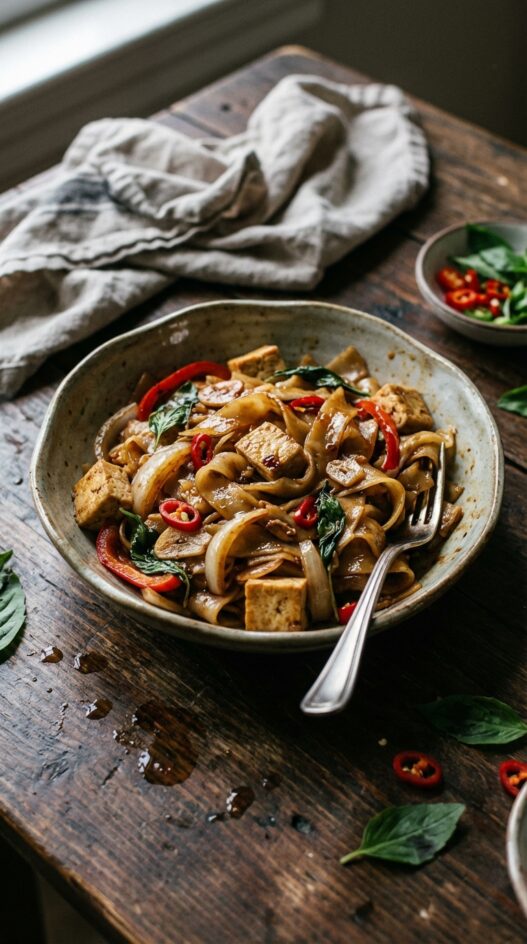
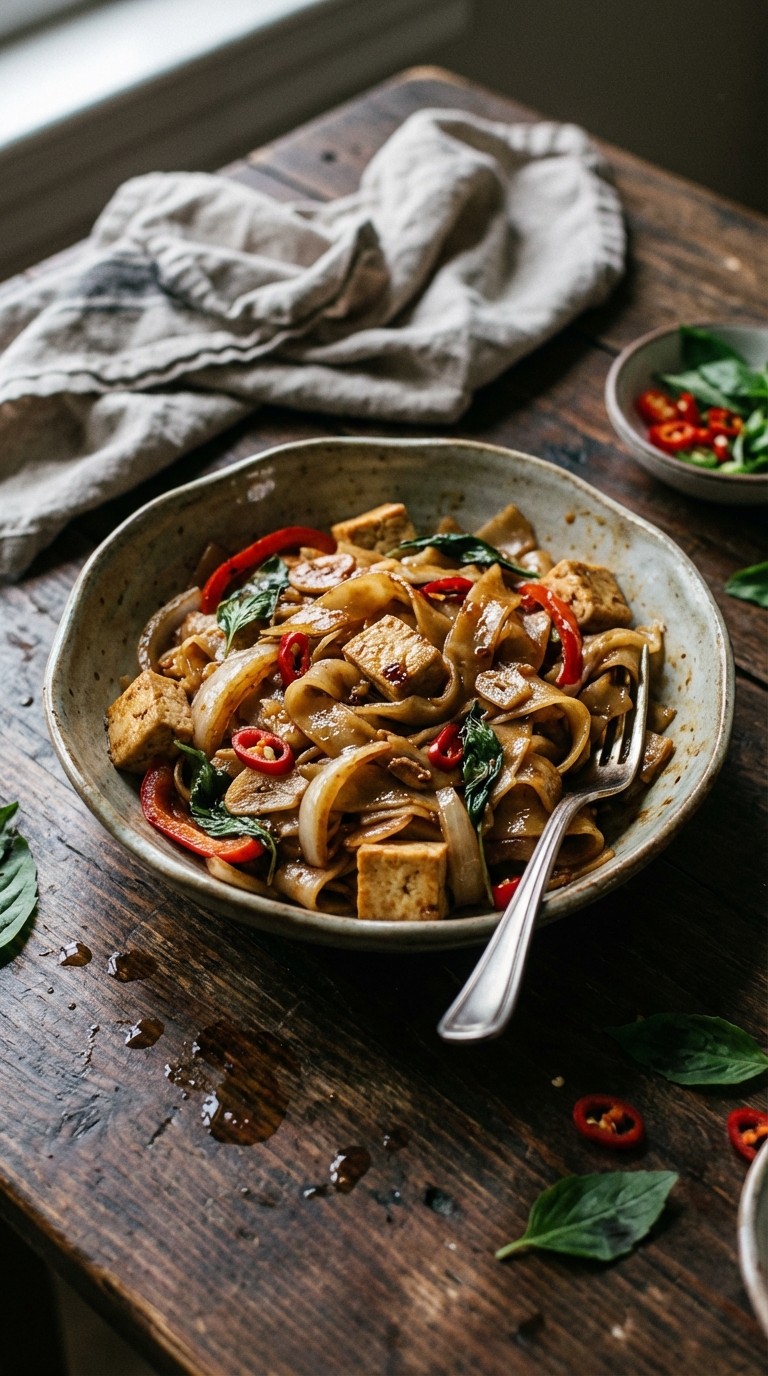
Drunken Noodles, or pad kee mao, is a Chinese-inspired dish served in Thailand and Laos. There are several theories about how this dish was named. Some say that you have to be drunk to tolerate the heat. Others say it’s because it’s one of the only street foods available to late night partygoers. However, the story I grew up hearing was that the dish is so hot, that you get drunk trying to temper the heat by the consumption of alcohol.
In this Drunken Noodle recipe I used tofu as the protein, though feel free to use an animal protein such as chicken, beef, or shrimp. So let’s talk about the name-sake ingredient, the noodles. I have seen this dish prepared with one of two rice noodle varieties. One is made with wide rice noodles that resemble the width of something like fettuccine. The other, (and the one that I prefer) is to use rice flakes – par boiled rice grains that are rolled and shaped into sheets. Once dried, they are cut into squares, rectangles, or triangles – and can be found at most Asian grocery stores. Unfortunately, rice noodles don’t have a European equivalent – so if you don’t have an Asian grocery store near by, try online. In a pinch, I’ve used Udon noodles and they’ve worked well.
When you’re preparing the rice noodles/flakes, do not boil them. You want to soak them in warm water. This way the noodles will soften slightly, allowing the them to soak up all of that wonderful spicy liquid from the stir-fry.
Print
Pad Kee Mao: Thai Drunken Noodles
- Total Time: 30 minutes
- Yield: Serves 2
- Diet: Omnivore
Description
Spicy, savory noodles with tofu. A quick weeknight meal inspired by Thai and Lao cuisine.
Ingredients
- 8 ounce (227 g) rice flakes or other wide rice noodle
- 14 ounce (397 g) firm tofu, cubed and dried
- vegetable oil
- 1/3 cup (80 ml) chicken stock
- 1 tablespoon sugar
- 1 tablespoon soy sauce
- 1/4 teaspoon molasses
- 1 tablespoon oyster sauce
- 1 tablespoon fish sauce
- 2 teaspoons sambal oelek
- 1 teaspoon sriracha
- 1 small onion, quartered and layers pulled apart
- 1 red pepper, seeded and sliced
- 6-8 red Thai chilies, seeded and sliced (more or less to adjust the heat)
- 2 cloves garlic, thinly sliced
- 1 cup (142 g) Thai basil
Instructions
- Soak the rice flakes or rice noodles in warm water for 40 minutes, then drain.
- Line a large plate with paper towels.
- Fill a large sauté pan with 1/4 cup of vegetable oil. Add the tofu and cook over medium-high heat (approximately 160-180°F/71-82°C) for 10 minutes, or until lightly brown. Remove the tofu with a slotted spoon and allow to cool on the prepared plate.
- Save 2 tablespoons of the oil.
- In a small bowl, combine the chicken stock, sugar, soy sauce, molasses, oyster sauce, fish sauce, sambal oelek, and sriracha. Set aside.
- In a large sauté pan or wok over high heat (approximately 400-450°F/204-232°C), warm 2 tablespoons of the reserved vegetable oil.
- Add the onions, bell peppers, Thai chilies, and garlic. Toss/stir constantly for 2 minutes.
- Add the drained rice flakes and cook for 4 minutes, tossing/stirring frequently.
- Lower the heat to medium-high (approximately 300-350°F/149-177°C) and add the sauce. Stir to coat and cook for another 2 minutes, or until the liquid is absorbed.
- Turn off the heat, and fold in the tofu and Thai basil.
- Serve.
Notes
- For a vegan option, substitute the oyster sauce with a vegan oyster sauce alternative or a combination of soy sauce and mushroom broth.
- To prevent sticking, ensure the noodles are thoroughly drained before adding them to the pan. A higher heat helps to sear the noodles and prevent clumping.
- Leftovers can be stored in an airtight container in the refrigerator for up to 3 days. Reheat gently in a pan or microwave.
- Prep Time: 20 minutes
- Cook Time: 10 minutes
- Category: Main Course
- Cuisine: Thai-Inspired
Nutrition
- Serving Size: 1.5 cups
- Calories: 450
- Sugar: 10
- Sodium: 800
- Fat: 20
- Saturated Fat: 5
- Unsaturated Fat: 10
- Carbohydrates: 70
- Fiber: 5
- Protein: 20
Frequently Asked Questions
What type of noodles work best for Pad Kee Mao?
Wide fresh rice noodles are traditional and give the best texture. If you can’t find fresh ones, dried wide rice noodles soaked until pliable will work, but avoid thin vermicelli since they don’t hold up to high-heat stir-frying.
Can I make drunken noodles less spicy?
Yes, just reduce or omit the fresh Thai chilies. The dish gets most of its heat from those, so cutting them back significantly tames the spice without changing the overall flavor profile much.
Why do my noodles clump together when stir-frying?
This usually happens when noodles are too wet or the wok isn’t hot enough. Make sure your noodles are well-drained and your pan is screaming hot before adding them, and toss frequently to keep them moving.
If You Liked This Recipe, You’ll Love These
- Japanese Popcorn Shrimp
- Fried Rice with Kimchi and Pork Belly
- Mujadara Recipe: Middle Eastern Lentils and Rice
- Baked Salmon with Basil Chimichurri and Crispy Thyme Fries
- Basil and Mozzarella Stuffed Braised Beef Braciole


Looks very good…how many servings as written?