
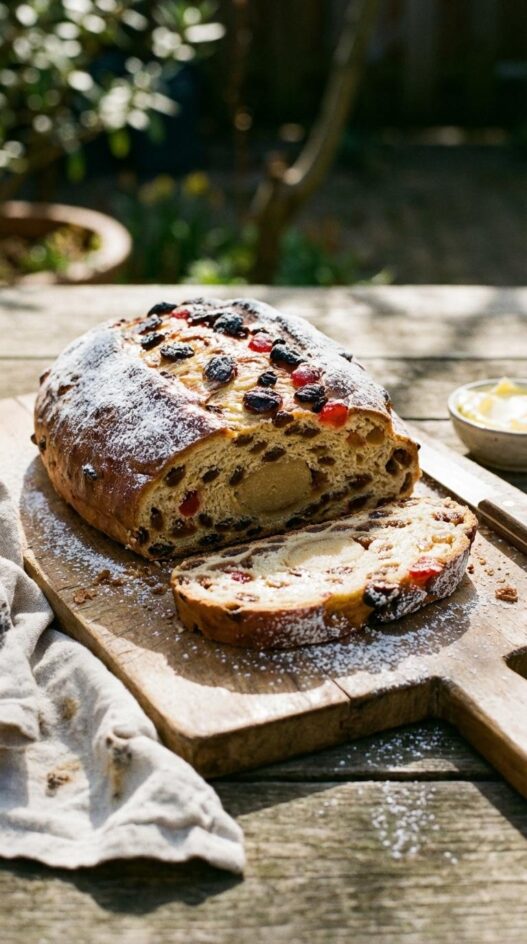
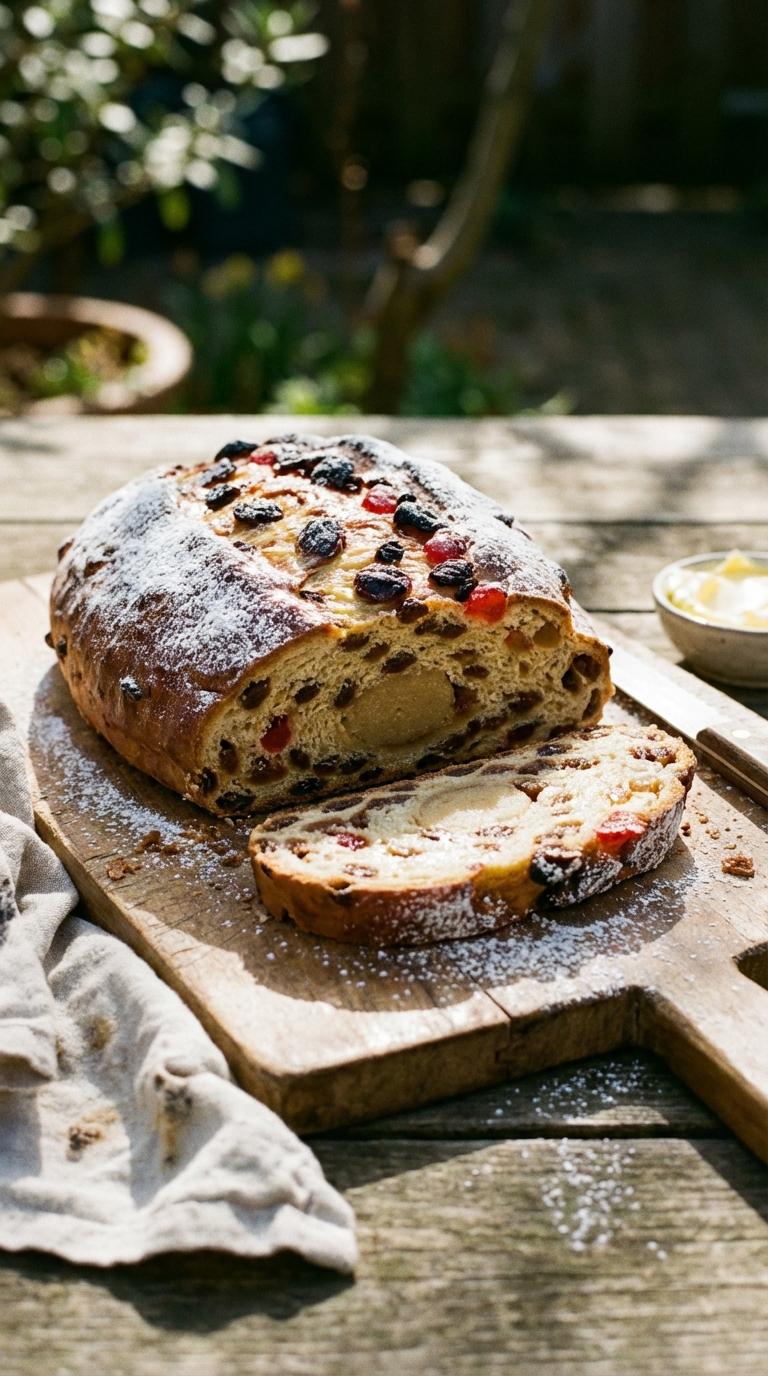
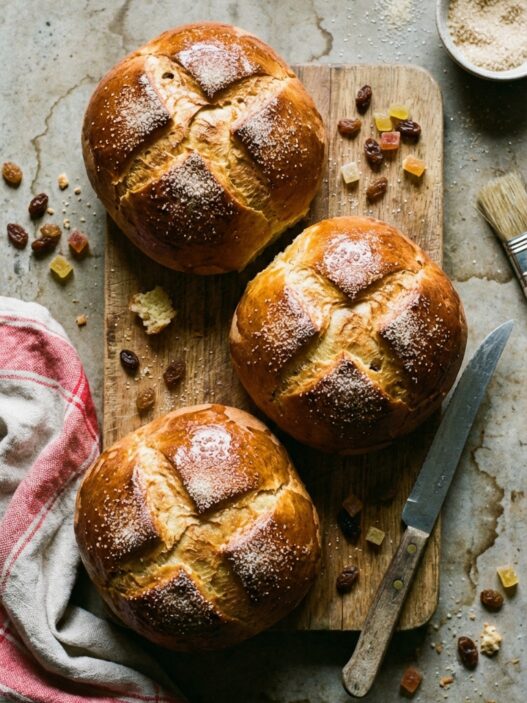
In the Netherlands, Easter baking is a bigger deal than I realized until I spent a spring in Utrecht years ago. Paasstol is the bread that sat at the center of every holiday table I visited, a golden, fruit-studded loaf wrapped around a core of almond paste that softens into the crumb as it bakes. I love it. The dough is rich with butter, egg, sugar, and orange peel, and it needs a full ten minutes of kneading before you fold in the fruit.
So much fruit. Rum-soaked currants and raisins, candied cherries, and succade all go in before the first rise. After an hour, you shape the dough around a log of almond paste, seal it tightly, and let it rise once more before baking at 200C (390F) for forty minutes. Brush it warm with butter and dust with powdered sugar. I bake this every spring now, and again at Christmas. Any excuse works.
How to Make Paasstol – Dutch Easter Bread
Start With a Proper Yeast Paste
Crumble the 50g (2 oz) fresh yeast into a small bowl and stir in about a third of the tepid milk along with a teaspoon of the sugar. Let it sit for ten minutes until it turns foamy and smells faintly sweet, which tells you the yeast is alive and ready.
Pour the yeast mixture into your flour along with the rest of the milk, the melted butter, egg, remaining sugar, and grated orange peel. Mix until you have a shaggy mass, then turn it out onto a lightly floured surface.
Knead for a full ten minutes, and I mean a real ten minutes by the clock, not a guess. The dough should go from sticky and rough to smooth, springy, and slightly tacky. If you poke it with a finger and it slowly pushes back, you are there.
Shaping Around the Almond Paste
After the dough has risen for an hour and roughly doubled, punch it down gently and roll it out on a floured surface into an oval about 30cm (12 in) long and 20cm (8 in) wide. Keep the center slightly thicker than the edges.
Roll your 200g (7 oz) almond paste into a log just shorter than the length of the oval. Lay it slightly off-center, then fold the larger side of the dough over the paste and press the seam firmly closed with the heel of your hand. Tuck and pinch the ends shut so nothing can leak out during baking.
Place the loaf seam-side down on a parchment-lined baking sheet and let it rise for another thirty minutes under a clean towel. It will not double this time, but it should look visibly puffed and feel soft when you press the side.
Baking and the Butter Finish
Bake at 200C (390F) for about forty minutes. The top should be a deep golden brown, and if you tap the bottom of the loaf it should sound hollow rather than dense. I usually check at thirty-five minutes, because ovens vary and a dried-out paasstol is a sad thing.
While the bread is still hot from the oven, brush the entire surface generously with melted butter. Let it soak in for a minute, then dust a thick layer of powdered sugar over the top. Without the butter, the sugar just slides off the first slice.
Let the loaf cool for at least an hour before cutting into it, as tempting as that will be. The almond paste center needs time to set, and the crumb firms up enough to slice cleanly without tearing.
Paasstol – Dutch Easter Bread Recipe
- Total Time: 180 minutes
- Yield: 1 bread
Description
A rich and sweet bread filled with dried fruits and almond paste, traditionally served in the Netherlands with Easter and Christmas.
Ingredients
- 500 g (18 oz) flour
- 10 g (2 tsp) salt
- 50 g (2 oz) fresh yeast
- 200 ml (7 fl oz) milk, tepid
- 100 g (3,5 oz) sugar
- 100 g (3,5 oz) butter, molten
- 1 egg, whisked
- grated peel of 1 orange
- 300 g (10 oz) currants, soaked, washed and dried
- 200 g (7 oz) raisins, soaked, washed and dried
- 50 g (2 oz) candied cherries, chopped
- 75 g (2,5 oz) succade, chopped
- 200 g (7 oz) almond paste
- butter
- powdered sugar
Instructions
- Make a paste of the yeast and some of the milk.
- Mix flour, salt and sugar.
- Mix milk, egg and molten butter (this mixture should be tepid).
- Make a well in the dry ingredients, pour in the wet ingredients and the yeast mixture and mix with a fork or wooden spoon.
- When the fluids are roughly incorporated, knead it well by hand for 10 minutes.
- After kneading the dough will be slightly sticky, soft and smooth.
- Mix in the grated orange peel, currants, raisins, candied cherries and succade.
- Put the dough in a bowl, cover with cling film and leave to rise on a warm spot for 1 hour.
- After rising, knead the dough well.
- Put the dough on a lined baking sheet and flatten it to an oval of 3 cm thick.
- Shape the almond paste in a log, 1 cm shorter than the dough oval.
- Put the almond paste log on the dough and fold the sides of the dough over. Close well!
- Cover with cling film and leave to rise for another 30 minutes.
- Brush the bread with milk and put it in a preheated oven at 200C.
- Bake the stollen for about 40 minutes, cover it with aluminium foil when the fruits on the top get too dark.
- The bread is cooked when it sounds hollow when tapped on the bottom.
- Leave it to cool on a rack.
- Brush with butter and sprinkle with powdered sugar.
Notes
The dried fruit can be substituted by other dried fruits and nuts.
The dried fruit can be soaked in water, fruit juice or even in alcohol (rum, orange liqueur, etc).
By making portions of the dough and the almond paste, mini-stollen can be made. The cooking time will then be shorter, keep an eye on them!
Using dried yeast instead of fresh is possible, check the package for conversions.
- Prep Time: 2 hours
- Cook Time: 1 hour
- Category: Bread
- Cuisine: Dutch
Frequently Asked Questions
Can I use instant yeast instead of fresh yeast for paasstol?
Yes, use about 7g (2¼ tsp) instant yeast in place of the fresh yeast. You can mix it straight into the flour without blooming it first. The bread will taste the same, though I find fresh yeast gives a slightly softer crumb that I prefer for holiday baking.
What can I use instead of succade in paasstol?
Succade is candied citrus peel, and it can be hard to find outside the Netherlands. Thick-cut candied orange peel works well, or you can candy your own by simmering strips of orange and lemon peel in sugar syrup until translucent. Chop it into small pieces so it distributes evenly through the dough.
How do I store paasstol, and can I freeze it?
Wrap the cooled loaf tightly in plastic wrap and it will keep at room temperature for about four days. It stays moist longer than most breads, so four days is realistic. For freezing, wrap it in plastic and then foil; it freezes well for up to three months. Let it thaw at room temperature before slicing.

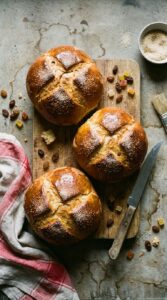

Made these for easter, turned out really delicious. Thanks so mcuh!
The dough came out wonderfully before i added the fruits in. After adding in the dry fruits it became a lot more watery, I guess I didnt dry the fruits as well as I thought. I added some more flour so the texture would be right and then left it on the floor warming tile to help it rise. Its now going to go into the oven and it looks so pretty, fingers crossed it turns out well :P Mijn nederlandse vriend wil graag dat ik krentenbollen zou maken dus dat recept ga ik later in de week proberen. Alvast bedankt!
Where does one acquire succade in the USA?
Succeed is candied citrus zest Any good Italian market will have it. You can also make it; it holds forever in the frig. Basically you save all of your citrus peels, removing much of the pith; put them in a saucepan covered w water; boil, rinse and repeat boiling until the peels are soft. Once peels are soft refresh the pan w equal parts water and sugar (enough to cover the peels). Bring to a boil, dissolving the sugar, reduce to a simmer. Continue simmer until peels are translucent. Cool & store in syrup
Syrup can be used on pancakes etc or in tea
Fruit can be chopped for baking or dried until tacky and then sugared
The short answer: yes, you can freeze this recipe, but it will have an effect on the taste/texture.
The long answer: I’ve never tried to freeze a paasstol myself, but I regularly freeze krentenbollen (https://honestcooking.com/dutch-currant-buns-recipe/) without problems. And I know that people freeze almond paste successfully. Both can be safely frozen for up to 3 months, but the quality will deteriorate over time. Wrapping it well will certainly help, but I would not freeze it for longer than 2-3 weeks myself, although I would prefer to make the bread fresh.
You can defrost it in the microwave, but this will make the bread soggy for sure. Better is to place the whole thing on a rack (without its wraps) and leave to defrost on room temperature. If you freeze the bread in slices, you can also grill them or bake them in a little butter to defrost.
Dear Ena,
I’d like to make this recipe but here in Australia Christmas can be quite hot.
Is it possible to freeze this recipe and how long could you freeze it for.
Thankyou katherine
Dear Ena,
I want to thank you for this article and a great recipe. I am a food blogger from Serbia and I made this Dutch bread looking at lots of recipes on teh net. At the end I opted for a combination of 2 recipes, one of whick was yours. Thank you for the great introduction to the recipe.
http://foodforthought-jelena.blogspot.com/2013/05/paasstol.html
The recipe was featured in the Serbian online gastronomy magazine MEZZE on page 108-109 that food bloggers write when we made Easter breads from around the world. My pick was Paasstol.
http://mezze.rs/april-2013/
Than you once again
Jelena, Belgrade
Deze maak ik morgen voor Pasen in Zuid-Afrika! A taste of home in South Africa. Really looking forward to this. Ah, the nostalgia!
I am making this for Easter in Australia. I have a German guy here & we were discussing the recipe & hour’s seems to be the winner! Much more concise than the German one! Love it! Thank you Ena
This looks amazing. I have to make it. I bet it’s delicious too. Just mouthwatering…
I didn’t know a variation of stollen was served at Easter–how nice to have it twice a year! I love the log of almond paste in the center.