
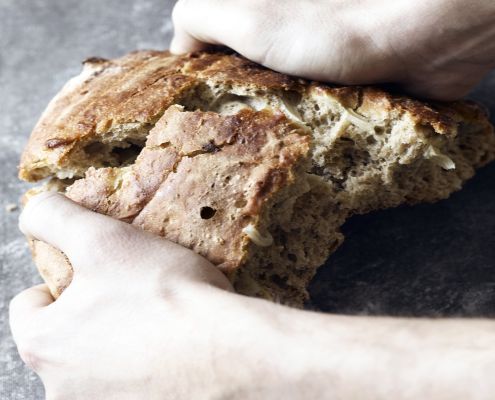
– Photo by Torben Morsø
There is something magical and beautiful about rising dough. The smell of home made, freshly baked bread. What a treat.
This bread is baked using an Old Nordic wheat variety called Ølandshvede. This flour has a high gluten content, which ensures that the bread gets a nice texture. Ølandshvede also gives the bread a beautiful, golden color and a flavorful taste! 
You can buy bread baked with Ølandshvede at Meyers Bakery in Copenhagen, but it’s much more rewarding to make your own. So try out this bread, to get to know this kind of flour, with a rather quickly risen bread. The onions give it a sweet and savoury taste, which makes it ideal as a side dish or for sandwich.
If you cannot find this type of flour, use normal wheat flour mixed with a little whole wheat flour or spelt flour.
Print
Onion bread – made with Ølandshvede
- Total Time: 2 hours 15 minutes
- Yield: 10-15 servings 1x
Description
This onion bread, made with Ølandshvede flour, offers a sweet and savory taste with a golden crust, perfect as a side dish or for sandwiches.
Ingredients
- 2 yellow onions
- 1 clove of garlic
- 1 tbsp (15 g) butter
- 1 liter cold water
- 20g fresh yeast
- 1 tsp honey
- 1 1/2 tbsp (15g) salt
- 2 tbsp sour cream
- 9-10 dl (8 cups) Ølandshvede flour or substitute with a mix of wheat flour and whole wheat flour or spelt flour
- 2 tbsp (30 ml) rapeseed oil
Instructions
- Peel the onions and garlic and cut them into thin slices.
- Melt the butter in a pan over medium heat and add the sliced onions and garlic. Fry until the onions are golden and soft, about 10-15 minutes.
- In a large mixing bowl, dissolve the yeast in the cold water. Add the honey and stir until combined.
- Add the fried onions and garlic to the yeast mixture, followed by the salt, sour cream, and rapeseed oil. Mix well.
- Gradually add the Ølandshvede flour (or substitute flour) to the mixture, stirring until a dough forms.
- Knead the dough on a floured surface for about 10 minutes until it is smooth and elastic.
- Place the dough in a lightly oiled bowl, cover with a damp cloth, and let it rise in a warm place for about 1 hour, or until doubled in size.
- Preheat the oven to 220°C (428°F).
- Once risen, punch down the dough and shape it into a loaf. Place it on a baking sheet lined with parchment paper.
- Let the loaf rise again for about 30 minutes.
- Bake in the preheated oven for 25-30 minutes, or until the bread is golden brown and sounds hollow when tapped on the bottom.
- Allow the bread to cool on a wire rack before slicing.
Notes
- If Ølandshvede flour is unavailable, substitute with a mix of wheat flour and whole wheat or spelt flour.
- The bread pairs well with soups and stews or can be used for sandwiches.
- Store in an airtight container for up to 3 days.
- Reheat in the oven for a fresh-baked taste.
- Prep Time: 1 hour 45 minutes
- Cook Time: 30 minutes
- Category: Baking
- Cuisine: Scandinavian
Nutrition
- Serving Size: 1 slice
- Calories: 200
- Sugar: 2
- Sodium: 350
- Fat: 4
- Carbohydrates: 35
- Fiber: 2
- Protein: 6
- Cholesterol: 10
If You Liked This Recipe, You’ll Love These
- Rosemary Garlic Challah Bread
- Kalács – Traditional Hungarian Sweet Braided Bread
- Soft and Fluffy Sourdough Sandwich Loaf
- How to Make “Lussekatter”: Traditional Swedish Lucia Buns
Frequently Asked Questions
What is Ølandshvede flour and what can I use if I can’t find it?
Ølandshvede is an Old Nordic wheat variety with high gluten content, which gives the bread its nice texture, golden color, and deep flavor. The article says it’s sold at Meyers Bakery in Copenhagen but is hard to source elsewhere. The recipe specifically says to substitute it with a mix of normal wheat flour and a little whole wheat flour or spelt flour.
What does the sour cream do in this bread dough?
The 2 tbsp of sour cream adds a subtle tang and a small amount of fat that keeps the crumb tender and moist — which the recipe highlights as the defining quality of this bread. It also contributes a slight richness that plain water-yeast breads lack.
Why does the recipe use cold water to dissolve the yeast instead of warm water?
The recipe specifies 1 liter of cold water — this slows initial yeast activation for a longer, more controlled fermentation during the 1-hour rise, which develops more flavor. Warm water would speed things up but at the cost of complexity.










I agree there is nothing like home baked bread. I know I won’t be able to find this flour but maybe a mix of bread flour and whole wheat flour would work. It sounds delicious.