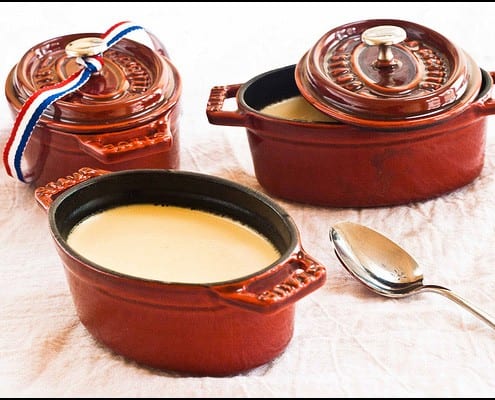
I always hesitate a bit about custard – not because I’m worried about the classic concerns, such as a glum pudding that resembles runny scrambled eggs (though I worry about that too) or that comes out overcooked (also angst-inducing)–but because it feels a bit profligate to use all those egg yolks. I feel bad wasting whites, so they just build up in my freezer.
Yes, the guilt. (What is that old saw about women feeling needlessly guilty all the time?) My husband, who is very encouraging of my making of custard, has been trying to convince me this is silly and to just make some already. (Might I note that he also is blissfully unaware of my constant reshuffling of the fridge, shifting expiring items forward and sliding unopened milk cartons and orange juices jugs towards the rear).
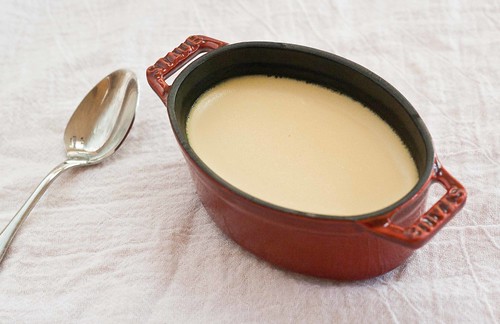
Much as some of us buy new gym clothes to encourage us to work out (with not always stellar effect) I not-so-recently bought some miniature cocotte pots at Williams Sonoma’s (ahem) Christmas clearance sale (ahem) last January. (Another takeaway from this is to never doubt the power of the words “50% off already reduced prices.” Please note I was only seduced by very deep discounting: I don’t want you to think I spent the originally stickered $50 each).
And while you might think the fact that I had to pull those stickers off of them last week to make this custard could be the irrefutable proof that they were an unwise impulse buy, I have no regrets. They are just too charming. You know how it goes with things in miniature. And in my defense, it could have been worse. I could have decided I needed a kitchen blowtorch for creme brulee while I was at it. (Oddly, my husband thinks this would be a sensible purchase. This seems to beg another cliché about men and fire).
Now that this preamble is out of the way, on to the custard.
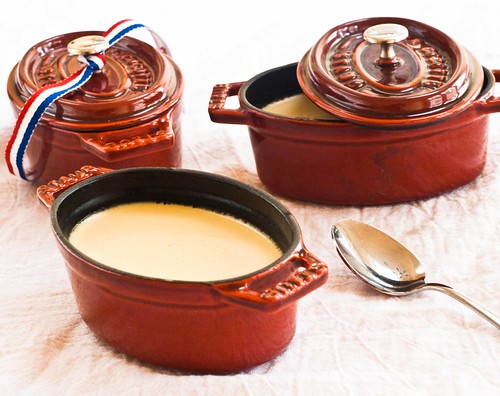
I can’t help but love this whole genre: creme caramels, pots de creme, crema catalana, flan, puddings…I went through a period where I just kept ordering creme brulees on the restaurant menu, until I realized I was becoming far too predictable and it was time to stop neglecting the other desserts out there. But one resists change: if dessert is about comfort, it’s hard to get more at that essence than this.
With just three components, using good ingredients matters, as does technique. I used my favorite local Berkshire Jersey cream and local maple syrup. (Sadly, my source for free-range eggs has dried up, as chickens don’t lay as much when the days are shorter).
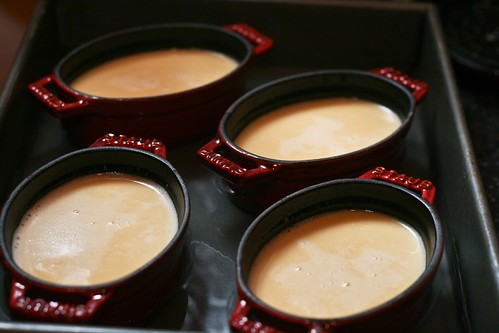
As for the technique, here’s a few comments of my own. You’ll need to place your custard cups in a water bath: set your filled cups in a large cake pan, and then fill up about an inch or so with hot water. Make sure it’s hot, or it will never finish cooking (as I learned with a bad bread pudding episode). And make sure not to add too much water, or you risk splashing yourself–ouch–or your custards–sniff–with it when you go to remove the finished product from the oven. (Again, I learned the hard way). A hot water bath ensures your custards bake gently, resulting in a creamy, gliding texture.
The other potential misstep is making a custard that more closely resembles oversweetened, runny scrambled eggs. The same principle of the water bath applies: You want to be sure you do not allow the yolks to cook too quickly when they first come into contact with your hot milk or cream. Temper the eggs by stirring only a bit of the hot cream into your eggs, whisking well to prevent lumps. Add a bit more, whisk, and then you can finally completely combine all the cream – but keep whisking! Tempering merely means bringing two items of differing temperatures to the same temperature (it’s often done with chocolate as well).
As further insurance, strain your custard mixture through a fine mesh sieve. This will strain out any large cooked egg particles, as well as those stringy fibrous bits of egg white that can cling to even a well-separated yolk. (The technical name is chalazae, but please don’t ask me how to pronounce it).
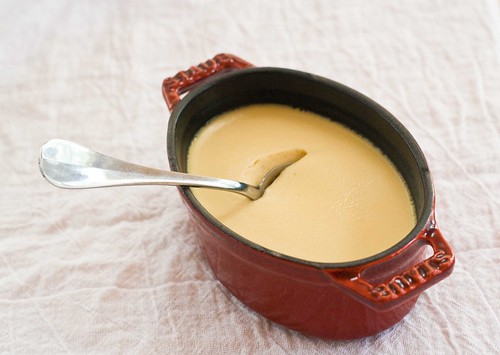
This dessert: subtle but delicious. The maple was almost a background note, floating lightly and delicately in the rich pudding. The custard tasted almost nutty to me at first, which was startling, but then made perfect sense: why else would maple pair so pleasingly with nuts, from pecans to walnuts?
Print
Maple Pots de Creme
- Total Time: 70 minutes
- Yield: 6 servings
Description
This rich and creamy Maple Pots de Creme features a delicate maple flavor that subtly enhances the luxurious custard, making it a comforting and elegant dessert.
Ingredients
- 2 cups (450mL) heavy cream (double cream)
- 1/2 cup (110mL) maple syrup
- 6 egg yolks
Instructions
- Preheat the oven to 325°F (160°C).
- In a saucepan, heat the cream until it is steaming hot but not boiling.
- In a separate bowl, whisk the maple syrup into the egg yolks. Do not allow the mixture to sit unmixed as the sugar will chemically “cook” the yolks.
- Slowly pour about a quarter of the hot cream into the egg yolk mixture, whisking constantly to temper the eggs and prevent them from cooking.
- Gradually add the remaining cream, continuing to whisk until fully combined.
- Strain the mixture through a fine mesh sieve into a clean bowl to remove any cooked egg particles or chalazae.
- Divide the custard mixture evenly among six ramekins or small ovenproof dishes.
- Place the ramekins in a large baking dish and fill the dish with hot water until it reaches halfway up the sides of the ramekins.
- Carefully transfer the baking dish to the oven and bake for 50-60 minutes, or until the custards are set around the edges but still slightly wobbly in the center.
- Remove the ramekins from the water bath and let them cool to room temperature. Then refrigerate for at least 2 hours or until thoroughly chilled.
- Serve chilled, optionally garnished with a drizzle of maple syrup or a sprinkle of nuts.
Notes
- Use high-quality maple syrup for the best flavor.
- Tempering the eggs is crucial to avoid curdling.
- Straining the mixture ensures a smooth texture.
- Serve in charming miniature cocotte pots for an elegant presentation.
- Store in the refrigerator for up to 3 days.
- Prep Time: 10 minutes
- Cook Time: 60 minutes
- Category: Dessert
- Cuisine: French
Nutrition
- Serving Size: 1 ramekin
- Calories: 350
- Sugar: 20
- Sodium: 40
- Fat: 28
- Carbohydrates: 22
- Fiber: 0
- Protein: 4
- Cholesterol: 210
If You Liked This Recipe, You’ll Love These
- Crème Brûlée: How to Make it at Home
- How to Make Perfect Pastry Cream
- Plantains Foster: A Caribbean Twist on New Orleans’ Classic Dessert
- Tamara’s Ultimate Cheesecake
Frequently Asked Questions
What is tempering, and why does this recipe require it?
Tempering means slowly bringing two ingredients of different temperatures to the same temperature. Here, you whisk a small amount of the hot cream into the egg yolks first, then gradually add the rest — this prevents the yolks from scrambling on contact with the hot liquid, which would produce scrambled-egg lumps instead of smooth custard.
Why strain the custard through a sieve if I tempered the eggs carefully?
Even well-tempered custard can contain chalazae — the fibrous white strands that cling to a separated egg yolk. Straining catches both any cooked egg particles and those stringy bits, ensuring the finished pot de crème has the smooth, gliding texture it’s known for.
Does the water bath need to be hot when it goes into the oven?
Yes — cold water in the baking dish means the custards will never finish cooking properly. Fill the pan with hot water to reach about halfway up the sides of the ramekins, and be careful not to add so much that it splashes the custards when you move the pan.
How do I know when the pots de crème are done baking?
Bake at 325°F (160°C) for 50-60 minutes. The custards should be set around the edges but still slightly wobbly in the center — they will firm up completely as they cool and refrigerate for at least 2 hours.