
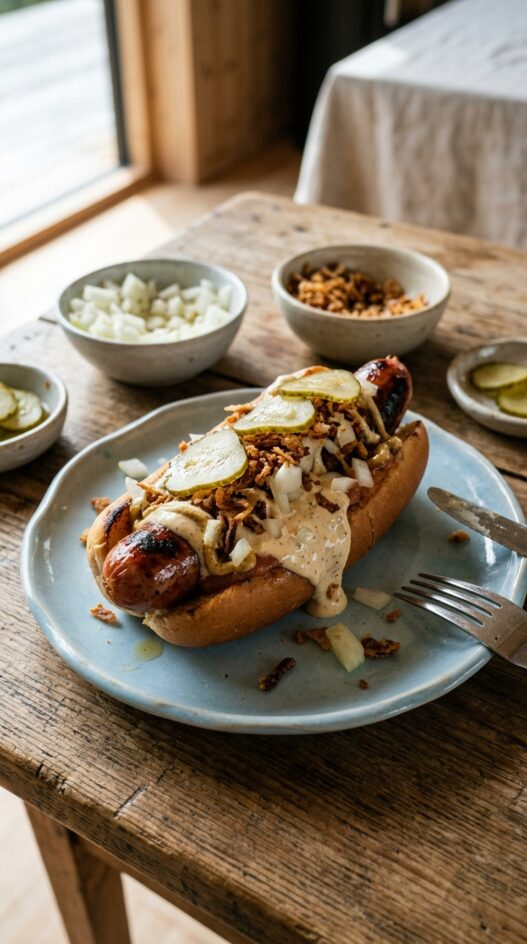
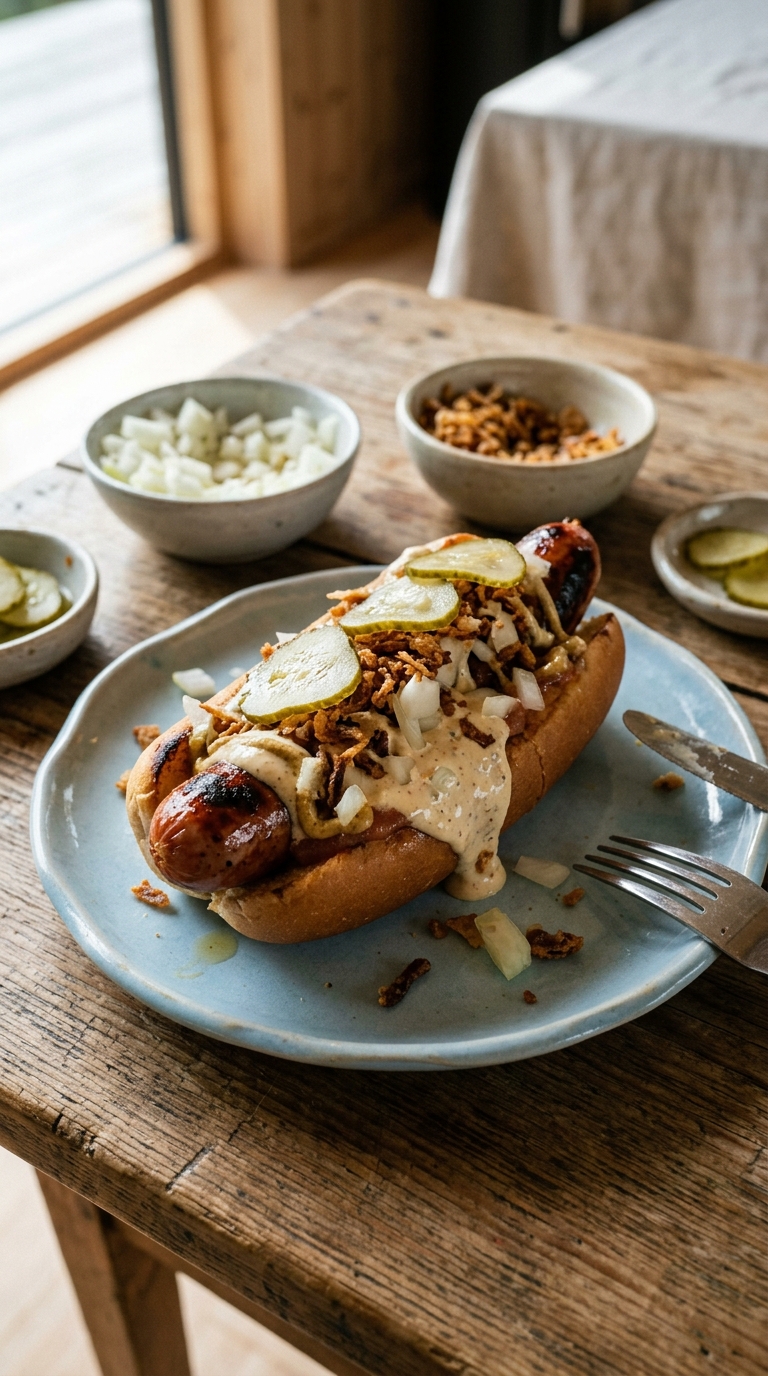
Danish hot dogs are not just a street food, but are a part of our culture. You find pølsevogne (hot dog carts) on nearly every street corner in Copenhagen, and even the most basic are more gourmet than a New York City hot dog cart. The classic pølsevogn serves hot dogs the traditional Danish way, with apple ketchup, mustard, remoulade, chopped onions, fried onions, and crisp, sweet pickles. Our passion for Danish hot dogs can be seen as similar to New Yorker’s and their pizza, with Danes taking pride in their hot dogs and making reference to their favorite pølsevogn.
Essential to the Danish hot dog is the pølse, which is an all pork, extra long beech wood smoked sausage with a natural casing and sweet and savory spices such as cardamom and nutmeg. As pølser were not available in the US, my Revolving Dansk team and I started producing them in Brooklyn to expose NYC to the Danish way of eating hot dogs. We produce the two main types of pølser found in Denmark, the classic Røde Pølse (red sausage), which is bright red in color, and the popular brown Grillpølse (grilled sausage).
Denmark has recently upgraded their hot dogs with gourmet carts serving a variety of artisanal toppings popping up around Copenhagen such as DØP and Andersen’s Bakery. Danes debate between classic toppings and gourmet creations, as exemplified by the hotly contested Best Hot Dog Award at the yearly Food Festival in Aarhus, Denmark. This contest has only two categories, traditional and gourmet, with some of Denmark’s top chefs competing.
Find the classic remoulade recipe here.
Find the traditional sweet pickle recipe here.
Print
How to Make the Classic Danish Hot Dog
- Total Time: 10 minutes
- Yield: Serves 5
Description
Snap-happy Danish pølser get a flavor upgrade with
homemade apple ketchup and crispy fried onions.
Ingredients
- 1 5-pack Copenhagen Street Dog røde pølser or grillpølser
- 5 hot dog buns
- 5 tsp of ketchup mixed with 1 tsp of apple sauce
- 5 tsp spicy mustard
- 5 tsp remoulade
- 1 small chopped yellow onion
- 5 tsp Fried Onions
- 15-20 Sweet Pickles
Instructions
- For røde pølser: Add water to a large saucepan and heat until bubbling. Add the røde pølser and boil for approximately 5 minutes.
- For grillpølser: Heat oil or butter in a pan or on a grill. Fry the pølser for approximately 5 minutes, until dark brown and crisp on two sides.
- Toast hot dog buns.
- Top the pølser with a thin layer of ketchup, mustard, and remoulade. Scatter chopped onions on top, followed by fried onions. Finally, top with thin slices of sweet pickles.
Notes
- For a richer apple ketchup, use a combination of applesauce and finely chopped fresh apples.
- If you can’t find remoulade, aioli or mayonnaise mixed with chopped pickles makes a good substitute.
- For easier assembly, prepare the toppings (chopped onions, fried onions, pickles) before cooking the hot dogs.
- Prep Time: 5 minutes
- Cook Time: 5 minutes
- Category: Main Course
- Cuisine: Danish
Nutrition
- Serving Size: 1 hot dog
- Calories: 300
- Sugar: 10
- Sodium: 600
- Fat: 15
- Saturated Fat: 5
- Unsaturated Fat: 8
- Carbohydrates: 35
- Fiber: 2
- Protein: 10
- Cholesterol: 40
Frequently Asked Questions
What is the difference between røde pølser and grillpølser?
Røde pølser are bright red, pre-cooked pork sausages that are boiled to serve, a classic Danish street food. Grillpølser are grilling sausages with a natural casing, intended for frying or grilling until browned.
What is remoulade and can I substitute it?
Danish remoulade is a tangy, slightly sweet condiment made from mayonnaise, pickles, capers, and turmeric. In a pinch, tartar sauce works as a substitute, though the flavor will differ.
What kind of bun is used for a traditional Danish hot dog?
The traditional bun is a soft, slightly sweet white bun called a ‘hot dog brød,’ which is long and narrow to fit the sausage. A standard soft hot dog bun is the closest substitute.
Can I make this without a hot dog cart steamer?
Yes. Boiling røde pølser in water for 5 minutes gives nearly the same result. For grillpølser, a regular frying pan with a little butter or oil produces a nicely browned sausage.
Is the ketchup and applesauce mixture traditional?
Yes, mixing ketchup with a small amount of applesauce is a common Danish practice that adds a mild sweetness to balance the mustard and remoulade.


you’re not supposed to boil them! just heat up water above 90 C and let them soak.
Because it’s the star of the show, not the bun. :)
Has anybody been able to find them in the states yet? I know we have a weird policy when it comes to importing meat.
I don’t think these are available anymore, but I have found a halfway decent substitute stateside. The foot-long franks from Olympia Provisions are pretty close to the real deal – they have that snap and the right flavor profile. It’s the closest thing I’ve been able to find! If you cook them in water like this article suggests, it gets the job done. They’re local to Portland, or they ship within the US.
https://www.olympiaprovisions.com/products/frankfurter
why is the wiener so far out of the buns
Where can I purchase the polser hot dogs? Please add an address and a phone number . Thanks
Can I buy you hotdogs in Omaha NE
To add some extra taste to the sausages, I always add an onion, a bullion cube and some vinegar. Let it boil, then slow boil the sausages.
I tried these on a trip to Denmark a few years back. They leave NY hot dogs in the dust.
Hi are you willing to ship and supply Danish hotdogs to the Philippines?
yeah how about wisconson these hotdogs are amazing
Took me right back to a trip to Copenhagen, the works make all the difference. So good and messy, dont skip the remoulade and crispy onions!