
For the first 40 years of a life lived in the U.S. of A, I ate hummus as a condiment. It was that garlicky dip served alongside of cardboard-y pita wedges and crudites. I liked it but, you know, it was just a condiment.
One day, shortly after moving to Israel, my husband and I were shopping at the Flea Market in Jaffa. By noon, we realized that we were hot, sweaty, and suddenly starving. My husband, a native Israeli, pointed to a tiny whole in the wall, with a line snaking around the block and asked “Do you want to get hummus?” “Get hummus?!” I scoffed. “Just hummus? Like just a bowl of hummus? Do they sell anything else?” My husband replied that yes, it was just hummus, in a large bowl and indeed that is the only thing on the menu at a hummusia, or hummus restaurant.
Well, we did not eat hummus that day and instead went off for self-righteous pasta or sandwiches, something more familiar to my fearful immigrant palate. My husband is a very patient man.
A few months later, we were traveling in the north of Israel and found ourselves once again starving. We were in the predominantly Druse village of Pekin and the closet place we could find was again, a tiny little hummisa. In hungry desperation, I consented to the strange hummus meal.
My life has never been the same since.
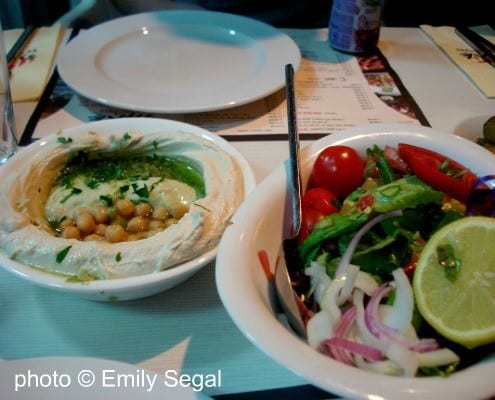
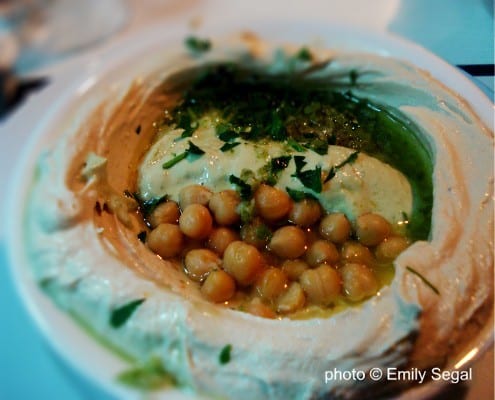
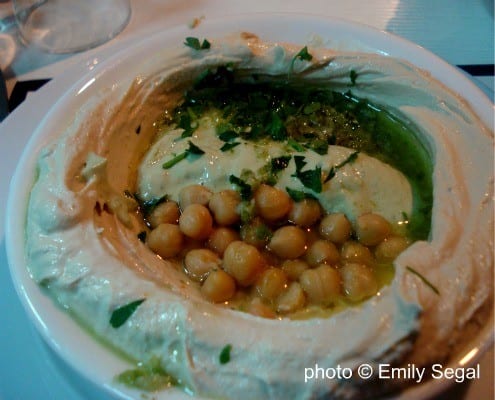
That warm, creamy bowl of hummus, drizzled generously with tahina, olive oil, and a spicy lemony garlic sauce, then topped with a pile of cooked chickpeas, a handful of fresh chopped parsley, was literally the most delicious and satisfying meal I have ever eaten! Since then, we have made it our business to seek out hummus wherever we go. If an article comes out in the paper (as they often do here) proclaiming a new “King of Hummus” off we travel to taste it for ourselves.
Hummus is my new hobby.
In a traditional hummusia, hummus is indeed often the only thing on the menu, but it comes in several variations: You can have it plain, or with tahina, cooked chickpeas, cooked fava beans (called Ful), sauteed mushrooms, or even ground beef. The dish generally comes with some raw onions, peppers and tomatoes as well as the ubiquitous plate of pickles and olives, a hard-boiled egg and a fluffy stack of freshly backed pita. Sometimes you can order a side of falafel or french fries, but who has the room for those distractions?
I have tried several times to make my own hummus at home, but I have not been able to match the delicious creaminess of the restaurant versions. One vendor told me you have to peel the chickpeas. Another told me to add baking soda to the cooking water to soften the beans. Still another swore it would require a mortal and pestle. Perhaps these are usually well-guarded recipe secrets as they probably should stay. But for those of you not lucky enough to live in a Middle Eastern country, I give you my best hummus effort to date:
Print
A Creamy Bowl of Heavenly Hummus
- Total Time: 27 hours
- Yield: 4-6 servings
Description
A creamy and satisfying hummus dish topped with whole chickpeas and a spicy lemony garlic sauce, perfect for a main course.
Ingredients
- 1/2 kg (1 lb, 2 oz) dry chickpeas
- 1 tbsp baking soda
- 1 cup (240 ml) raw top quality tahini paste
- 1 tbsp (15 ml) freshly squeezed lemon juice
- 2 cloves of garlic
- Salt to taste
- 1 cup (240 ml) freshly squeezed lemon juice (for the sauce)
- 1 cup (240 ml) fresh parsley
- 2 cloves garlic (for the sauce)
- 1-2 hot peppers
- Olive oil for drizzling
- Cooked chickpeas for topping
- Fresh chopped parsley for garnish
Instructions
- Soak the dry chickpeas in water with 1 tbsp of baking soda overnight.
- Drain and rinse the chickpeas, then place them in a pot with fresh water. Bring to a boil, then simmer for about 2-3 hours until the chickpeas are very soft.
- Drain the chickpeas, reserving some of the cooking liquid.
- In a food processor, combine the cooked chickpeas, tahini paste, lemon juice, garlic, and salt. Blend until smooth, adding reserved cooking liquid as needed to achieve a creamy consistency.
- For the sauce: Grind the parsley, garlic, and hot peppers in a food processor until very finely minced. Add the lemon juice and process until smooth and emulsified. Set aside overnight or at least 1 hour to let the flavors meld.
- To serve, spread the hummus in a bowl, drizzle with olive oil, and top with cooked chickpeas and fresh chopped parsley. Serve warm with whole hard-boiled eggs, fluffy pita, and a vegetable salad.
Notes
- For extra creaminess, consider peeling the chickpeas after cooking.
- Adding baking soda to the cooking water helps soften the beans.
- The sauce can be made a day in advance to enhance the flavors.
- Serve with freshly baked pita and a side of pickles and olives for an authentic experience.
- Prep Time: 24 hours
- Cook Time: 3 hours
- Category: Appetizer
- Cuisine: Middle Eastern
Nutrition
- Serving Size: 1 serving
- Calories: 350
- Sugar: 2
- Sodium: 400
- Fat: 15
- Carbohydrates: 45
- Fiber: 12
- Protein: 15
- Cholesterol: 0
If You Liked This Recipe, You’ll Love These
- Fennel and Sweet Potato Gratin
- Mujadara Recipe: Middle Eastern Lentils and Rice
- Mangú – Mashed Plantains
- Sicilian Caponata al Forno
Frequently Asked Questions
Why does this recipe soak the chickpeas overnight with baking soda?
I heard directly from a hummus vendor that adding baking soda to the soaking water helps soften the beans — and I use 1 tbsp of baking soda in the overnight soak. Softer chickpeas blend to a creamier consistency after the 2–3 hour simmer, which is the hallmark of restaurant-quality hummus.
Why start from dried chickpeas instead of using canned ones?
I use ½ kg (about 1 lb) of dry chickpeas, soaked and then simmered until very soft, because canned chickpeas don’t produce the same level of creaminess as freshly cooked beans in a food processor with 1 cup top-quality tahini. The cooking liquid reserved from the simmer also thins the hummus to the right consistency.
What is the green garlic sauce served alongside, and how far ahead can I make it?
I make the sauce in a food processor from 1 cup each of fresh parsley and lemon juice, 2 garlic cloves, and 1–2 hot peppers, blended until emulsified. Make it at least 1 hour ahead — and ideally overnight — so the flavors meld before drizzling it over the warm hummus bowl.
The notes mention peeling the cooked chickpeas — should I do that?
Peeling the chickpeas after cooking can produce an extra-creamy result — a tip I picked up from a vendor. It’s optional and time-consuming, but worth trying if you want the silkiest possible hummus.

I never saw this post until now. The reason baking soda is used in Israel is because the water is hard. I’ve tried cooking fresh dried chickpeas with water directly from the tap and they never softened. Another solution is using filtered water like Brita. If used in excess baking soda can degrade the vitamins. I’ve tried peeling the chickpeas and it was a tedious job- that’s why I go to Halil’s in Ramle, my favorite hummusia ;-)
Oooh! I love hearing about the hummusia(s) to explore! I love hummus and the idea of a place that only serves hummus is pretty exciting! Thanks for the recipe. I had never heard of using baking soda in the soaking, but I guess it is a mixed bag option if the beans lose nutrients.
I peel chickpeas after I saw that Sarah Melamed doesn’t–I saw it as a challenge! I don’t add baking soda since it removes vitamins. I haven’t perfected the recipe yet–will have to try this one!
Hannah, I had no idea that the baking soda leaches vitamins! You are such a great source of info. Thanks for commenting!