Sometimes one bite is all it takes for you to fall in love.
I should know. I fell head over heels the first time I tasted Floating Islands or île flottante.
I first experienced the delectable French dessert while holidaying in Paris with my dad in the early 2000s. I was working in London at the time and my dad had come to visit me. We spent 10 days travelling around the UK before taking the Eurostar to Paris.
It was my second visit to the eternal city and my dad’s first so we did all the usual tourist activities: we visited the Musée du Louvre, La Tour Eiffel, Cathédrale Notre Dame de Paris, the Arc de Triomphe, the Place Vendôme and Fauchon. We shopped and we strolled happily around the streets, loving being in such a picturesque city.
And we ate. A lot.
We ate croissants, confit de canard (duck confit), soupe de fraises (strawberry soup), foie gras, plateau de fruits de mer (seafood platter), pommes frites (French fries), bouillabaisse (fish stew),macarons, mousse au chocolat, crème brûlée, coq au vin, boeuf bourguignon, cassoulet and Niçoise salad.
One day we were sitting in a bistro, having finished yet another wonderful dish when I spotted île flottante on the dessert menu.
Île flottante. Floating island?
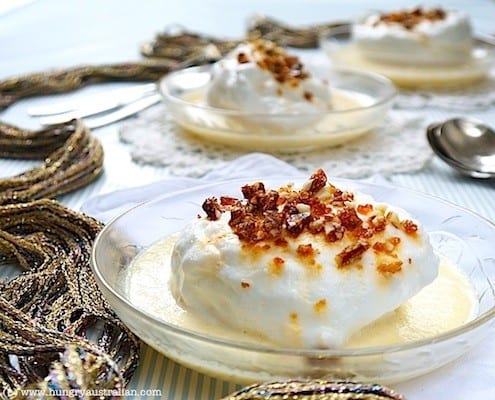
When the waiter bought the dish to the table I was immediately charmed. A large quenelle of poached meringue floated dreamily on top of a bed of vanilla custard or crème anglaise. Praline dust had been sprinkled over the top, like a pinch of magical fairy dust.
I dipped my spoon in the meringue and scooped up some custard for good measure. The contrast of textures – the lightness of the meringue, the silkiness of the custard and the crunchiness of the praline – was sublime.
After all these years, I still remember how good that very first Floating Island was. But these days, I don’t have to travel so far to fall in love all over again.
Neither do you.
Print
Dining Down Under: Floating Islands
- Total Time: 40 minutes
- Yield: 4 servings
Description
Quenelles of poached meringue dusted with praline float dreamily on a vanilla custard, offering a sublime contrast of textures.
Ingredients
- 2 cups (480 ml) milk
- 1 tsp vanilla bean paste or essence
- 5 egg yolks
- 1/2 cup (120 ml) caster sugar
- 1/3 cup (30 g) natural almonds
- 1/2 cup (120 ml) caster sugar (for praline)
- 3 egg whites
- 1/2 cup (120 ml) caster sugar (for meringue)
Instructions
- To make the custard, heat 2 cups of milk and 1 tsp of vanilla in a saucepan until it gently simmers. Turn off the heat.
- In a separate bowl, whip 5 egg yolks and 1/2 cup caster sugar for a couple of minutes until emulsified.
- Pour the hot milk mixture onto the yolks, whisking continuously. Return the mixture to the saucepan and cook over low heat, stirring constantly, until the custard thickens and coats the back of a spoon. Do not let it boil. Set aside to cool.
- For the praline, spread 1/3 cup natural almonds on a baking sheet. In a small saucepan, melt 1/2 cup caster sugar over medium heat until it turns a golden caramel color. Pour the caramel over the almonds and let it cool completely. Once hardened, break into pieces and crush into a coarse powder.
- To make the meringue, beat 3 egg whites in a clean bowl until soft peaks form. Gradually add 1/2 cup caster sugar, beating until the meringue is glossy and stiff peaks form.
- Bring a large pot of water to a gentle simmer. Using two spoons, shape the meringue into quenelles and gently poach them in the simmering water for about 3 minutes on each side. Remove with a slotted spoon and drain on paper towels.
- To assemble, pour the cooled custard into serving bowls. Place a quenelle of poached meringue on top of each bowl of custard. Sprinkle with praline dust before serving.
Notes
- For best results, ensure the custard does not boil to prevent curdling.
- The praline can be made in advance and stored in an airtight container.
- Use fresh eggs for the meringue to achieve the best volume.
- Serve immediately after assembling for the best texture contrast.
- Prep Time: 20 minutes
- Cook Time: 20 minutes
- Category: Dessert
- Cuisine: French
Nutrition
- Serving Size: 1 serving
- Calories: 350
- Sugar: 35
- Sodium: 80
- Fat: 18
- Carbohydrates: 40
- Fiber: 1
- Protein: 8
- Cholesterol: 210
If You Liked This Recipe, You’ll Love These
- Crème Brûlée: How to Make it at Home
- Strawberry and Mint Pavlova
- Tamara’s Ultimate Cheesecake
- Shiso Meyer Lemon Tart
Frequently Asked Questions
What are Floating Islands (île flottante)?
Floating Islands is a classic French dessert consisting of quenelles of poached meringue served on top of a vanilla custard (crème anglaise), finished with praline dust. I first encountered it in a Paris bistro and fell for the contrast of textures — light meringue, silky custard, and crunchy praline all in one spoonful.
How do I prevent the custard from curdling?
Do not let the custard boil. Cook it over low heat, stirring constantly, until it thickens and coats the back of a spoon — then remove from heat immediately. Boiling will cause the egg yolks to scramble and ruin the silky texture.
Can the praline be made in advance?
Yes — the praline can be made ahead and stored in an airtight container. Melt ½ cup caster sugar to a golden caramel, pour it over 1/3 cup natural almonds, let it harden, then crush to a coarse powder. Making it ahead saves time on the day of serving.
Why does the recipe specify fresh eggs for the meringue?
I recommend fresh eggs for the meringue to achieve the best volume. Fresh egg whites whip up more easily and hold their structure better when poached; stale whites can result in a flatter, less stable meringue.