
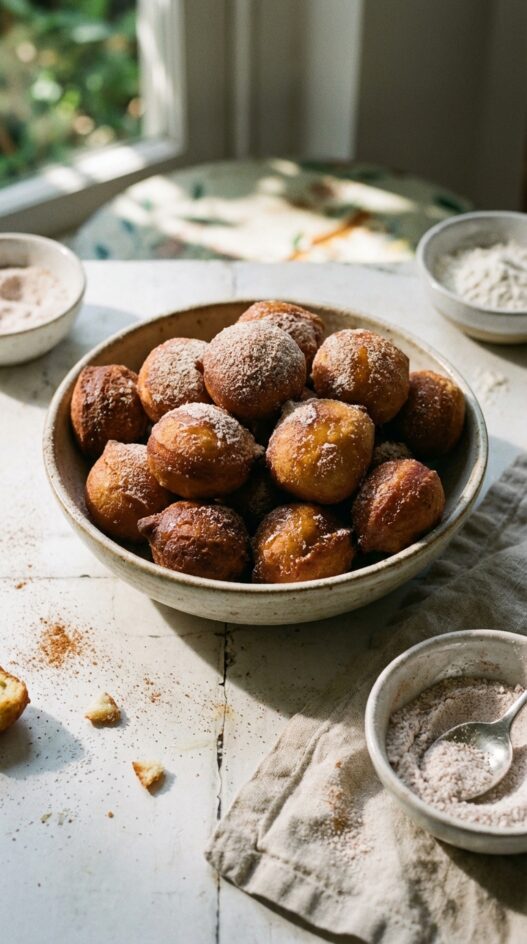
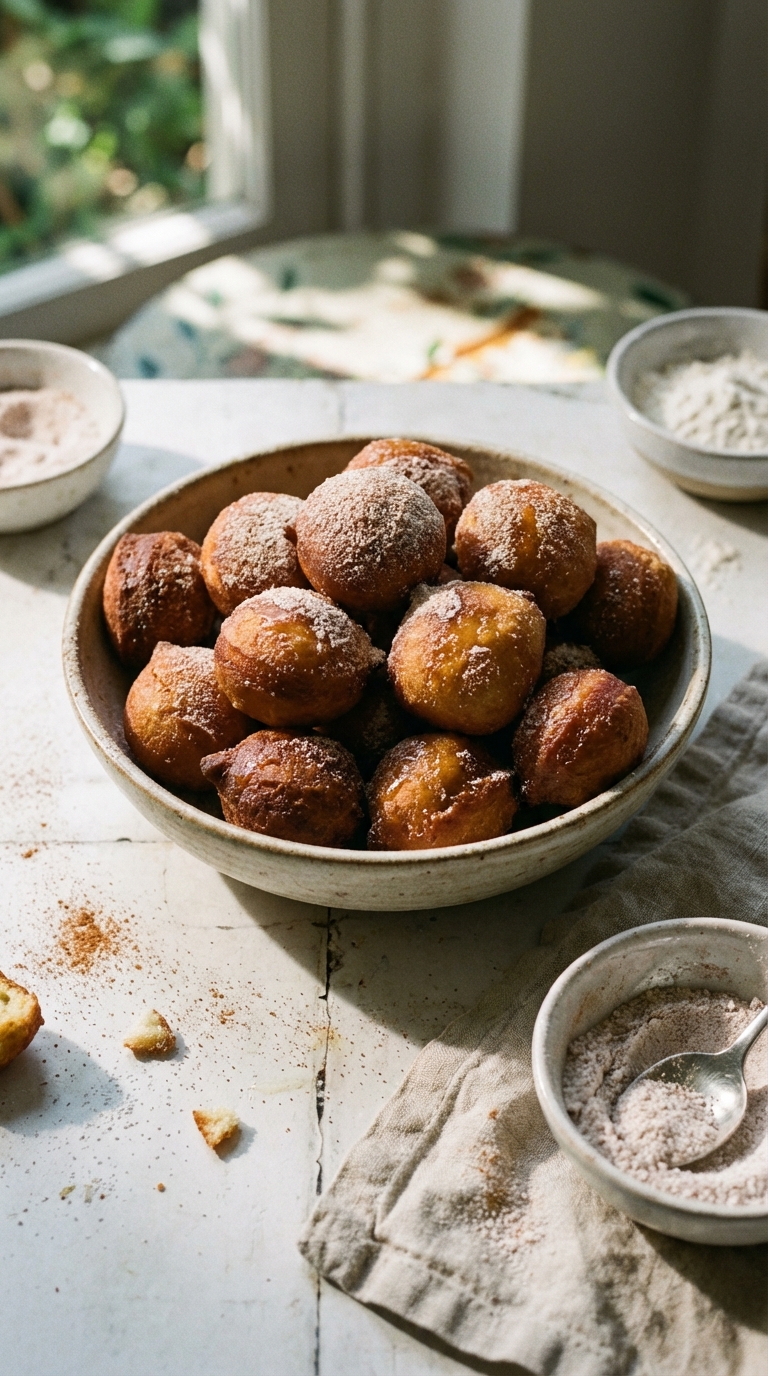
Yeasted doughnut holes, deep fried and rolled in cinnamon sugar. The dough is soft. Properly soft. Butter goes into hot milk until it melts, then sugar, then yeast once the temperature drops, then a beaten egg, and all of it gets worked into flour and salt until you have something you do not want to stop kneading.
An hour of rising, then you pinch off pieces, roll them into small balls, and drop them into hot oil. They puff up golden brown. You eat the first one before the rest are even out of the pan, and it is exactly as good as you hoped.
Tips for Making Buttery Doughnut Holes
Get the milk temperature right for the yeast
The milk and butter mixture must cool to 105-115°F (40-46°C) before you add the yeast. Too hot and the yeast dies. Too cold and it does not activate.
If you do not have a thermometer, wait until you can comfortably hold your finger in the liquid for a few seconds. That is roughly the right range.
Fry at a consistent temperature
Heat the oil to about 350°F (175°C) and keep it there. Doughnuts fried too cool absorb oil and turn greasy. Too hot and the outside burns while the inside stays raw.
Do not crowd the pan. Fry a few at a time and let the oil recover between batches.

Buttery Doughnut Holes
- Total Time: 40 minutes
- Yield: Makes 24
- Diet: Omnivore
Description
Crisp on the outside, tender inside. These yeast doughnuts are rolled in cinnamon sugar for a sweet treat.
Ingredients
- 3 cups (710 ml) Flour
- 2 oz (50 g) Butter
- 0.5 cups (118 ml) Sugar
- 0.75 cups (177 ml) Milk
- 1 tsp Yeast
- 2 Eggs
- 0.25 tsp Salt
- Oil for frying
- 0.25 cups (59 ml) Cinnamon flavored powdered sugar
Instructions
- Heat milk in a saucepan and add butter. Once it reaches boiling point (212°F/100°C), add sugar, mix well, and remove from heat.
- Allow the mixture to cool to almost room temperature. When the temperature is suitable for yeast (around 105-115°F/40-46°C), add 1 teaspoon of yeast and mix well.
- Add in a beaten egg.
- In a larger bowl, combine 3 cups of flour and salt; mix. Make a well in the center and pour the wet mixture into it. Reserve 1/3 cup of the wet mixture and add it if needed to prevent the dough from becoming too loose.
- Transfer the dough to a work surface and knead it into a soft dough.
- Put the dough back into the bowl and let it sit for 1 hour, undisturbed, until doubled in size.
- Once the dough has doubled, lightly punch it down to release the trapped air.
- Pinch off pieces of dough and roll them into small, lemon-sized balls.
- Heat oil in a pan and deep fry the balls until golden brown.
- Once all the balls are fried, allow them to cool. Dust with cinnamon-coated powdered sugar, roll in powdered sugar, or dip in melted chocolate and top with sprinkles.
Notes
- For a richer flavor, use brown butter instead of regular butter in step 1.
- To prevent the doughnuts from absorbing too much oil, ensure the oil temperature is consistently around 350°F (175°C).
- Leftover doughnut holes can be stored in an airtight container at room temperature for up to 2 days, or frozen for up to 1 month.
- Prep Time: 20 minutes
- Cook Time: 20 minutes
- Category: Dessert
- Method: Frying
- Cuisine: American
Nutrition
- Serving Size: 2 doughnut holes
- Calories: 200
- Sugar: 15
- Sodium: 100
- Fat: 12
- Saturated Fat: 7
- Unsaturated Fat: 3
- Carbohydrates: 25
- Fiber: 1
- Protein: 4
- Cholesterol: 30
Frequently Asked Questions
How do I know when the oil is hot enough for frying?
If you have a thermometer, aim for 350°F (175°C). Without one, drop a small piece of dough into the oil. It should sizzle immediately and rise to the surface within a few seconds. If it sinks and sits, the oil is not hot enough.
Can I bake these instead of frying?
You can, but the texture will be different. Baked doughnut holes are denser and do not puff up the same way. If you bake them, shape the dough into balls, place on a parchment-lined tray, and bake at 375°F (190°C) for 12-15 minutes.
Why does the dough need to rise for a full hour?
The yeast needs time to ferment and create the air pockets that make the doughnut holes light. Cutting the rise time short gives you dense, heavy balls. The dough should double in size before you punch it down and start shaping.





Kneading until the dough stops sticking to my hands and leaves a smooth wall on the bowl was the finish line I finally respected this round. Rushed it on past attempts and the holes came out dense. A proper eight minutes of patience and they puffed the way the photos promised. Cinnamon sugar went on while they were still radiating heat.
fresh doughnut holes at home = PURE JOY!!
105-115°F on the milk before yeast is the step I skip half the time when making doughnuts, and my dough usually suffers. Thermometer in hand this round and the dough puffed the way it’s supposed to. Cinnamon sugar while the holes were still hot got the coating to stick properly.
Has anyone baked these instead of frying? Wondering if you still get that buttery yeasted texture from an oven, or if the fry is essential to the feel.
I’ve tried the oven version with this kind of yeasted dough, and honest answer, the texture isn’t the same. Baked doughnut holes lean more dinner-roll-adjacent, tender but not the crisp golden outside you get from the fryer. If you want to dodge the oil, air-fryer at 350°F for about eight minutes with a brush of melted butter got me the closest match. Still not fried, but closer than the oven.