
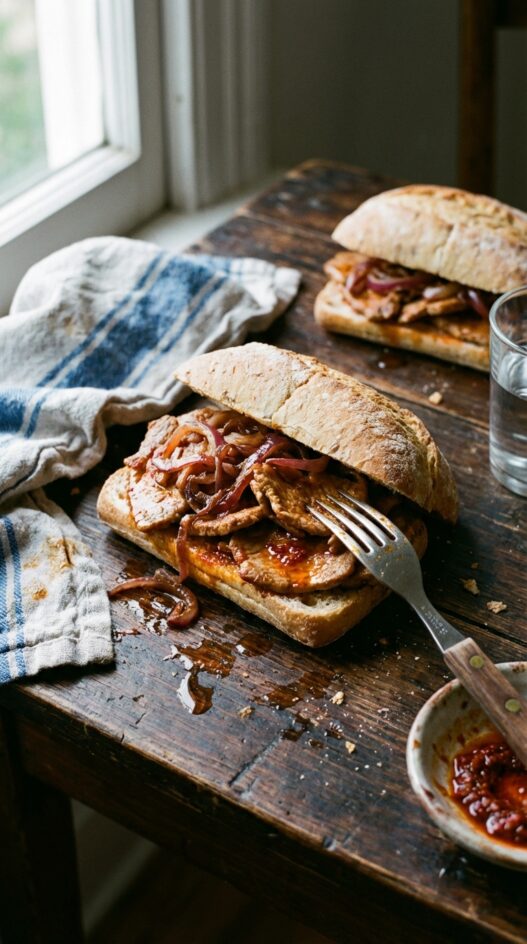
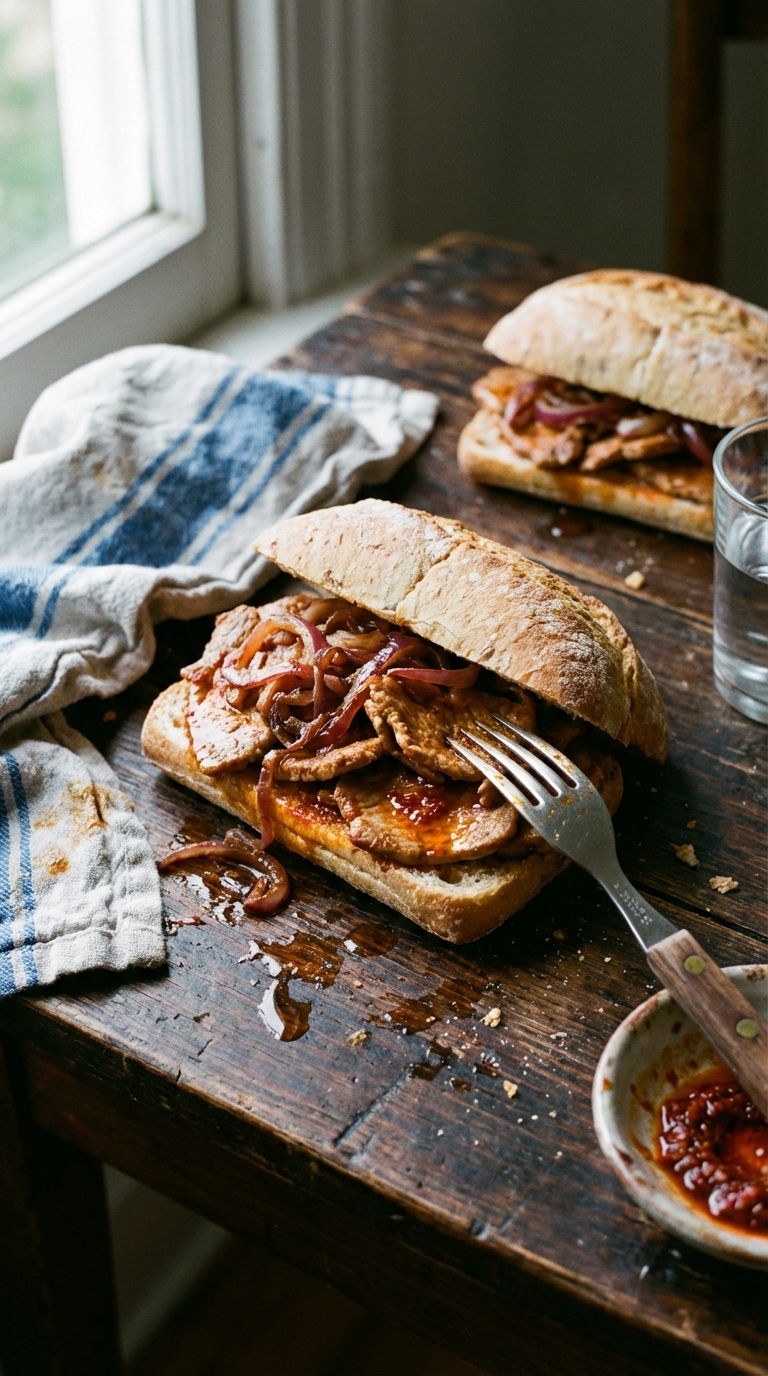
My first bifana was from a paper-wrapped street stall in Lisbon, eaten standing up near a tram stop on a rainy November afternoon. Marinated pork, paprika, a soft roll, nothing else. I’ve spent years trying to get close to that version. The marinade is simple: garlic, chili paste, paprika, and enough time. What makes it amazing is the roll. The recipe includes a homemade version that takes some effort but eats completely differently from grocery store sub rolls. If you’re going to spend the time marinating the pork overnight, bake the rolls the same day. It’s all part of the same project. The pork should be sliced thin and cooked fast on high heat so the edges catch slightly.
How to Make Bifanas – Portuguese Pork Sandwiches
Marinating time
Four hours minimum, overnight strongly preferred. The paprika and chili paste need time to penetrate. Thin-sliced pork absorbs faster than thick cuts, so keep slices around a quarter inch.
Making the rolls
Half white flour, half wheat gives a slightly denser roll that holds up to the pork without getting soggy. Don’t skimp on kneading.
Cooking the pork
Hot pan, minimal oil, quick cook. You want some caramelization on the edges from the paprika paste. Don’t crowd the pan or the pork steams instead of sears. Work in batches if needed.
Bifanas – Portuguese Pork Sandwiches
- Total Time: 50 minutes
- Yield: Serves 4
- Diet: Omnivore
Description
These savory pork sandwiches are marinated in a fiery paprika paste, then layered onto soft homemade rolls. A simple, satisfying meal.
Ingredients
- 1 1/2 pounds pork loin or pork shoulder, very thinly sliced
- 4 garlic cloves, minced or crushed to a paste
- 2 teaspoons kosher salt
- 2 tablespoons sweet paprika
- 1 tablespoon Portuguese chili paste, piri-piri paste, or mild chili paste
- 1/2 cup dry white wine
- 2 tablespoons white wine vinegar
- 2 tablespoons olive oil
- 1 bay leaf
- 1/2 teaspoon black pepper
- 1 small red onion, thinly sliced, optional
- 1 tablespoon olive oil, plus more as needed
- 4 Portuguese rolls, papo secos, crusty sandwich rolls, or homemade rolls
- Yellow mustard, optional
- Piri-piri sauce, optional
- 2 1/4 teaspoons active dry yeast, 1 packet
- 1 1/4 cups warm water, 110-115°F
- 1 tablespoon white sugar
- 2 tablespoons vegetable oil, plus more for the bowl
- 2 teaspoons table salt
- 3 1/2 to 4 cups all-purpose flour, plus more for kneading
Instructions
In a bowl large enough to hold the pork, stir together the garlic, salt, paprika, chili paste, white wine, white wine vinegar, olive oil, bay leaf, and black pepper.
Add the thinly sliced pork to the marinade and turn the slices until coated. Cover and refrigerate for at least 4 hours, or overnight.
Stir the yeast, warm water, and sugar together in a large bowl. Let it stand for 5–10 minutes, until foamy.
Add the vegetable oil, salt, and 3 1/2 cups flour. Stir until a rough dough forms.
Turn the dough onto a floured surface and knead for 8–10 minutes, adding more flour only as needed to keep it workable.
The dough should feel smooth and elastic, not stiff.
Place the dough in an oiled bowl, cover, and let it rise for about 1 hour, or until doubled in size.
Punch down the dough and divide it into 4 large sandwich rolls or 6 smaller rolls.
Shape into ovals and place on a parchment-lined baking sheet.
Cover and let rise for 30 minutes.
Heat the oven to 375°F.
Bake for 18–22 minutes, until the rolls are browned and sound hollow when tapped.
Cool before splitting.
Remove the pork from the marinade, letting excess marinade drip back into the bowl.
Reserve the marinade.
Heat 1 tablespoon olive oil in a large skillet over medium-high to high heat.
Add the pork in batches so the slices sear rather than steam.
Cook for about 1–2 minutes per side, depending on thickness, until cooked through and browned in spots.
Transfer cooked pork to a plate as each batch finishes.
If using red onion, add it to the same skillet after the pork is cooked.
Cook for 2–3 minutes, stirring often, until it softens slightly.
Pour the reserved marinade into the skillet and bring it to a full boil.
Boil for 2–3 minutes, scraping up the browned bits from the pan, until the sauce reduces slightly.
Because the marinade touched raw pork, it must be boiled before serving.
Add the cooked pork back to the skillet and turn it in the sauce until coated and hot.
Split the rolls.
Add the pork and spoon some of the pan sauce over the meat.
Add cooked onions, mustard, or piri-piri sauce if using.
Serve hot.
Notes
Pork loin gives leaner sandwiches. Pork shoulder has more fat and a deeper pork flavor, but it should still be sliced very thin.
Partially freezing the pork for 25–30 minutes makes it much easier to slice thinly at home.
The marinade is used twice: first to season the pork, then boiled hard in the skillet to become the pan sauce. Do not spoon raw marinade directly onto the sandwiches.
Portuguese chili paste is often salty. Taste the paste before adding the full amount of salt.
The homemade roll recipe is optional. Store-bought rolls are fine here.
Look for papo secos, crusty Portuguese rolls, ciabatta rolls, or small French-style sandwich rolls.
- Prep Time: 30 minutes
- Cook Time: 20 minutes
- Category: Sandwich
- Method: Baking
- Cuisine: Portuguese
Nutrition
- Serving Size: 1 sandwich
- Calories: 450
- Sugar: 5
- Sodium: 800
- Fat: 25
- Saturated Fat: 8
- Unsaturated Fat: 12
- Carbohydrates: 50
- Fiber: 5
- Protein: 30
- Cholesterol: 80
Frequently Asked Questions
What cut of pork works best for bifanas?
Pork loin or pork shoulder sliced very thin is traditional. Ask your butcher to slice it thinly, or partially freeze the meat at home for about 30 minutes so you can cut clean, thin slices yourself.
How long should I marinate the pork?
At least 4 hours, and ideally overnight in the refrigerator, for the best flavor. The garlic, paprika, and chili paste need time to penetrate the thin slices.
Can I use store-bought rolls instead of making my own?
Yes. Look for Portuguese papo secos, crusty ciabatta rolls, or a good French baguette cut into sections. The bread should have a firm crust and soft interior to soak up the pan juices.


Bifana are made from pork NOT beef as you show in the recipe
Hey there, you are absolutely correct. An early version of the recipe had beef listed as an ingredient by mistake – that’s not what this should be made with. Also, the recipe instructions were not clear. We have updated to make them much more understandable. Thank you for bringing to our attention!
I love bifanas, thank you!!
The beef thing is weird, but I made them with the pork that was also recommended and they turned out perfectly!
Beef?
I would never make this with beef, but the recipe is absolutely delicious!
I also suggest you separate the steps for the bread and the filling, i already have my own bread so i’ll just use that. ;)