





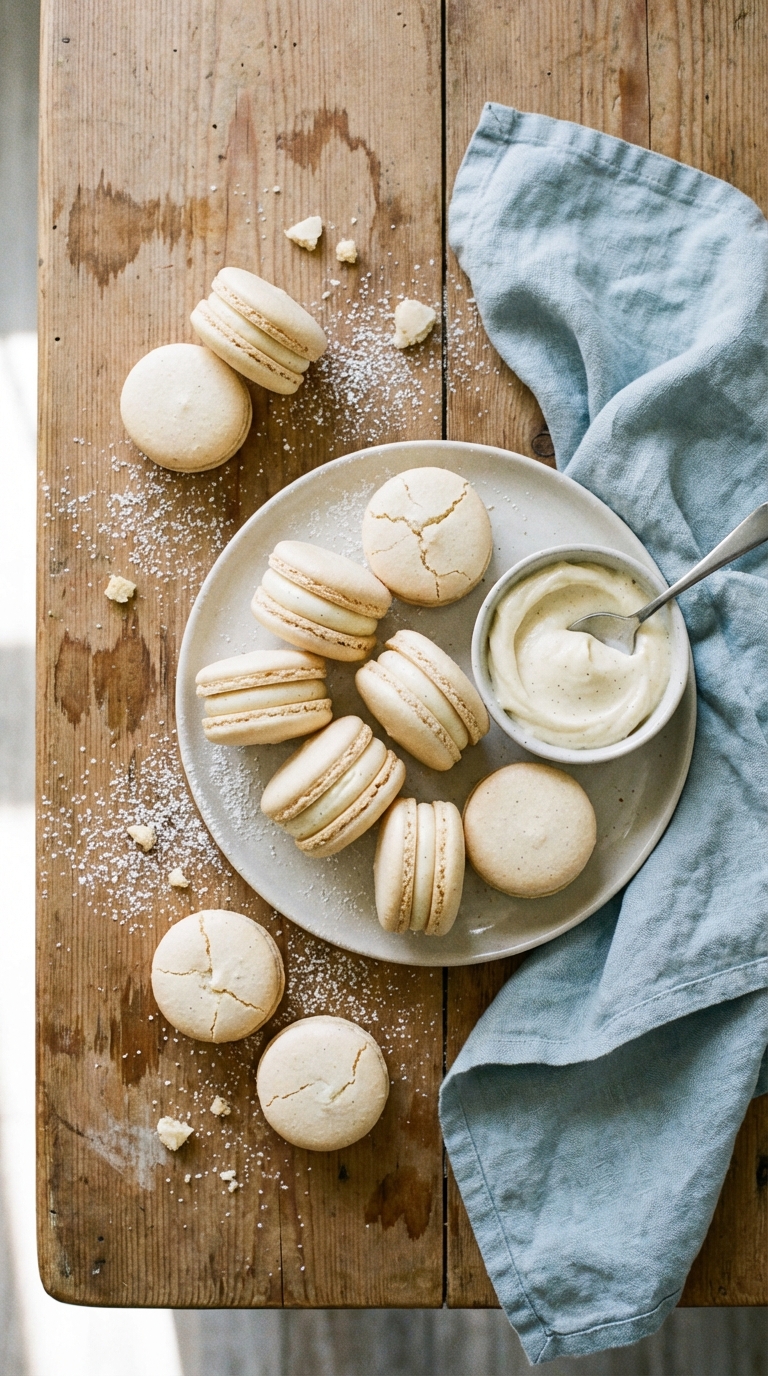
Macarons are delicate, finicky, and absolutely worth the effort. These classic French almond meringue cookies are made with just ground almonds, egg whites, and sugar, yet achieving the perfect texture and presentation can feel like an impossible challenge.
I had my first taste of macarons in Paris, at the original Ladurée store—where they claim to sell 12,000 macarons a day—and I was instantly hooked. Naturally, I had to try making them myself.
It took seventeen failed attempts and countless hours of research before I finally produced a batch I was happy with. They always tasted great, but macarons are 50% flavor and 50% presentation (as many French desserts seem to be). 
So, what did I learn from all those failed batches?
- Macarons are not impossible—despite what some recipes insist, not every step has to be followed perfectly to get great results.
- Success depends on macaronage (the folding technique) and oven temperature accuracy—these two factors make or break a batch.
- Practice is essential—every oven is different, humidity plays a role, and no two kitchens are the same.
There are many macaron recipes online, all claiming to be the best. Some recommend different methods, baking temperatures, or resting times. The only way to master macarons is through trial and error. Fortunately, they are fun, challenging, and incredibly satisfying to make (not to mention, absolutely adorable).
I can be impatient in the kitchen and always look for shortcuts or tricks to simplify baking, especially when it comes to macarons. Over the past year, I’ve made more than ten variations, refining my process each time. Hopefully, my top tips will help make your macaron journey a little easier!
Note: A kitchen scale is extremely useful for macarons since precise ingredient ratios produce the best results. However, I’ve successfully made macarons using cup measurements, so a scale is not a deal-breaker. That said, I highly recommend a silicone baking mat—it’s reusable, easy to clean, and helps ensure evenly shaped macarons.
This guide provides 10 essential tips for getting your macarons right every time, plus troubleshooting advice and answers to common reader questions.
1. Age Your Egg Whites for Better Stability
- Separate your egg whites at least 24 hours before baking and let them sit in the fridge uncovered.
- This removes excess moisture and helps create a stronger, more stable meringue.
- Bring them to room temperature before using for the best results.
2. Weigh Your Ingredients – No Guesswork
- Macarons require precise ratios, so always use a kitchen scale instead of measuring cups.
- A small difference in almond flour or sugar can throw off the entire texture.
3. Sift Your Dry Ingredients Twice
- Almond flour and powdered sugar should be sifted at least twice to ensure a smooth, lump-free batter.
- This step prevents grainy or lumpy shells and ensures a delicate, melt-in-your-mouth texture.
4. Master the Macaronage (Mixing Technique)
- Under-mixing = grainy, lumpy macarons that don’t bake evenly.
- Over-mixing = flat, cracked shells with no feet.
- The batter should be flowy but not runny, forming a ribbon-like consistency when lifted with a spatula.
5. Pipe with Precision
- Use a round piping tip and hold the piping bag vertically to ensure even circles.
- Pipe onto a silicone baking mat or parchment paper for best results.
- Tap the baking sheet firmly on the counter a few times to remove air bubbles.
6. Let the Shells Rest Before Baking
- After piping, let the macarons sit for 30-60 minutes until they form a slight skin on top.
- This is crucial for forming feet—skipping this step often leads to cracked or uneven macarons.
7. Bake at the Right Temperature
- Too hot? Macarons will crack and brown unevenly.
- Too cool? They’ll be undercooked and won’t develop feet.
- Ideal temperature: 300-325°F (150-160°C).
- Use an oven thermometer—many home ovens aren’t accurate.
8. Avoid Humid Conditions
- Humidity is the enemy of macarons! If your kitchen is too humid, the shells won’t dry properly.
- If needed, place them near a fan or in an air-conditioned room to help them set before baking.
9. Cool Completely Before Removing
- Macarons should be completely cool before attempting to remove them from the mat or parchment.
- If they stick, they may need a few more minutes of baking.
10. Match Shells Before Filling
- Before adding fillings, pair up shells of similar size for the best presentation.
- Let filled macarons rest in the fridge for 24 hours—this enhances flavor and texture.
Common Macaron Mistakes & How to Fix Them
Q: Why are my macarons cracked?
A: Either the oven temperature is too high, or they weren’t rested long enough before baking.
Q: Why don’t my macarons have feet?
A: Under-mixed batter, humid conditions, or skipping the resting step could be the cause.
Q: Why are my macarons hollow?
A: Over-mixed batter or an oven temperature that’s too high can create hollow centers. Try reducing mixing time or lowering the oven temp slightly.
Q: Why are my macarons sticky and soft?
A: They are undercooked or need more drying time before baking. Try baking for a few extra minutes.
Final Tips for Success
- Be patient—macarons improve with practice.
- Keep detailed notes of what works for your kitchen and oven.
- If a batch fails, don’t throw it out! Crushed macarons make a great topping for ice cream or yogurt.
More Must-Try Baking Recipes for Your Kitchen Adventures
Sea Salt Peanut Butter Cookies
Maritozzi con la Panna: Cream Filled Italian Buns
Nutella Cinnamon Buns and White Chocolate Sauce
10 Cookie Baking Tips to Make you a Master Cookie Maker

Classic Vanilla Macaron with Buttercream Filling
- Total Time: 48 minutes
- Yield: Makes 24 1x
- Diet: Omnivore
Description
Delicate vanilla macarons, perfectly crisp and chewy, filled with a luscious vanilla buttercream. A truly irresistible treat!
Ingredients
- 1 cups (237 ml) powdered sugar
- 1/2 cups (118 ml) almond flour
- 1 teaspoon vanilla bean powder
- 2 large egg whites
- 5 tablespoons (65 g) granulated sugar
- 1/2 cups (118 ml) unsalted butter
- 1 1/2 cups (355 ml) powdered sugar
- 1 teaspoon vanilla extract
- 1-2 tablespoons (15-30 ml) heavy cream
Instructions
- Preheat the oven to 300°F (150°C).
- Line two baking sheets with parchment paper.
- Prepare a pastry bag fitted with a plain round tip (about 1/2-inch or 2 cm wide).
- For the Soup:
- In a food processor, grind together the powdered sugar and almond flour until super fine.
- Sift the mixture through a fine-mesh sieve into a bowl to remove any large bits.
- In the bowl of a stand mixer (or using a hand mixer), beat the egg whites until soft peaks form.
- Gradually add granulated sugar and continue beating for 2 minutes, until stiff, glossy peaks form.
- Mix in the vanilla extract or vanilla bean powder.
- Gently fold the sifted almond flour mixture into the beaten egg whites using a rubber spatula.
- Fold until the batter is smooth, shiny, and flows off the spatula in thick ribbons (about 40-50 folds).
- Transfer the batter into the piping bag.
- Pipe 1-inch (3 cm) circles, spaced 1 inch apart onto the lined baking sheets.
- Tap the baking sheet firmly on the counter a few times to release air bubbles.
- Let the piped macarons rest at room temperature for 30 minutes until a thin skin forms on top.
- Bake in the preheated 300°F (150°C) oven for 15-18 minutes until the macarons develop feet and are set.
- Let them cool completely before removing from the baking sheets.
- For the Vanilla Buttercream Filling:
- In a bowl, beat the softened butter until smooth and fluffy (about 2 minutes).
- Gradually add the powdered sugar, continuing to beat.
- Mix in the vanilla extract and 1 tablespoon of heavy cream/milk.
- Beat until the frosting is smooth and creamy.
- If needed, add an extra tablespoon of heavy cream/milk to adjust consistency.
- Match similarly sized macaron shells into pairs.
- Pipe or spread a small amount of vanilla buttercream onto one macaron half.
- Gently press another macaron shell on top to form a sandwich.
- Refrigerate for 24 hours to allow flavors to meld (optional, but recommended).
Notes
- For perfectly smooth macarons, ensure your almond flour and powdered sugar are finely ground and sifted. A food processor is key!
- Age your egg whites for 24-48 hours in the refrigerator before making meringue for a stronger, more stable meringue. This is important for the macaron’s shape.
- If your buttercream is too thick, add heavy cream, one tablespoon at a time, until you reach desired consistency. If it’s too thin, add more powdered sugar.
- Prep Time: 30 minutes
- Resting Time: 30 min
- Cook Time: 18 minutes
- Category: Dessert
- Method: Baking
- Cuisine: French
Nutrition
- Serving Size: 2 macarons
- Calories: 150
- Sugar: 20
- Sodium: 25
- Fat: 8
- Saturated Fat: 5
- Unsaturated Fat: 2
- Carbohydrates: 20
- Fiber: 1
- Protein: 2
- Cholesterol: 20
Frequently Asked Questions
Why do my macarons come out without feet?
Flat macarons without feet usually mean the batter was overmixed or the meringue was not stiff enough. Also make sure you let the piped shells rest until they form a dry skin on top before baking.
How long should I let macaron shells rest before baking?
Let them sit at room temperature for 30 to 60 minutes, or until the surface feels dry and not sticky when you lightly touch it. This step is essential for getting those signature ruffled feet.
Do I need to use aged egg whites for macarons?
Aged egg whites, separated and left uncovered in the fridge for 24 to 48 hours, tend to whip up more easily and produce a more stable meringue. It is not mandatory, but it does improve consistency.




How to make the ‘feet’ of macaron? My macaron is chewy but they had no ‘feet’?
In 1 recipe I had seen that I was supposed to melt the sugar and mix it into the egg whites .Is this step necessary?
measurements would be cool..Hello!
There are no recipe amounts shown. How much sugar, almond flour & egg white?
Was there a recipe for the macaron? I am not seeing any recipe…
I cannot seem to make macarons that don’t brown in the cooking. I have a fan oven and heat it to 150C – having used hotter temperatures before which of course was even worse. How low a temperature can I use before it’s too low, giving other problems? I’m pretty sure the temperature is accurate.
the sugars are not mentioned to the point as says powdered sugar here are 3 of them icing sugar, powdered sugar confectionary sugar, powdwered sugar(with out corn starch) i have tried all these sugars but they all melted away. to get that blob of macaroon batter to remain still when piped what is the correct ratio of dry ingredients to liquid. (almond flour to egg white) from according to your ration its seem like liquid is less than dry and can i bake them in an ordinary domestic oven which has a max 250c
I thought they were invented in Italy? Lol
The shells were invented in Italy, I believe Medici brought them to France and they sandwiched them together with a filling, making them macarons :)
Hi there, sounds great and I definitely will try it! Could you use honey or other alternative to granulated sugar perhaps?
i always add liquid gel colors, but small amts (less than a tsp) should not affect it. Humidity can really ruin them though, after piping I would leave them to dry for at least 3-4 hours, if not overnight. The tops should be perfectly dry before baking!
Hey Amrita,
I have been trying to get perfect macarons but this are not coming good when I add colors. I am using IBC powder colors. I am also controlling the humidity as humidity is much higher in Mumbai.
What can be done ? Kindly, help me out. I will be grateful.
Prangi jain
Hi Putri,
You can swap some of the almonds for cashews, I wouldn’t do all of it since cashews may have more oil than almonds and it may not turn out like it should. But you can swap out up to half. I would also use a spatula to fold the egg whites in, just because you have to do it very gently. If you’re going to use a hand mixer, just try to be very gentle (but nothing beats doing it by hand)!
Thanks
Amrita
Hi!
Can I use cashew nut?
And,can I use hand mixer to fold the egg whites with almond and sugar?
Thanks!
can you please tell me on what temperature the oven must be and on what setting like the fan on or off, or just roof heating or both roof and floor? made it the first time and it was a success and then after, every time a flop.. please im desperate
thank you
Hey, i have been trying to make macaroons correctly for AGES, These tips really helped me! Can u please check out my blog its
http://www.fashionmakeupandme101.blogspot.com.au thanks