

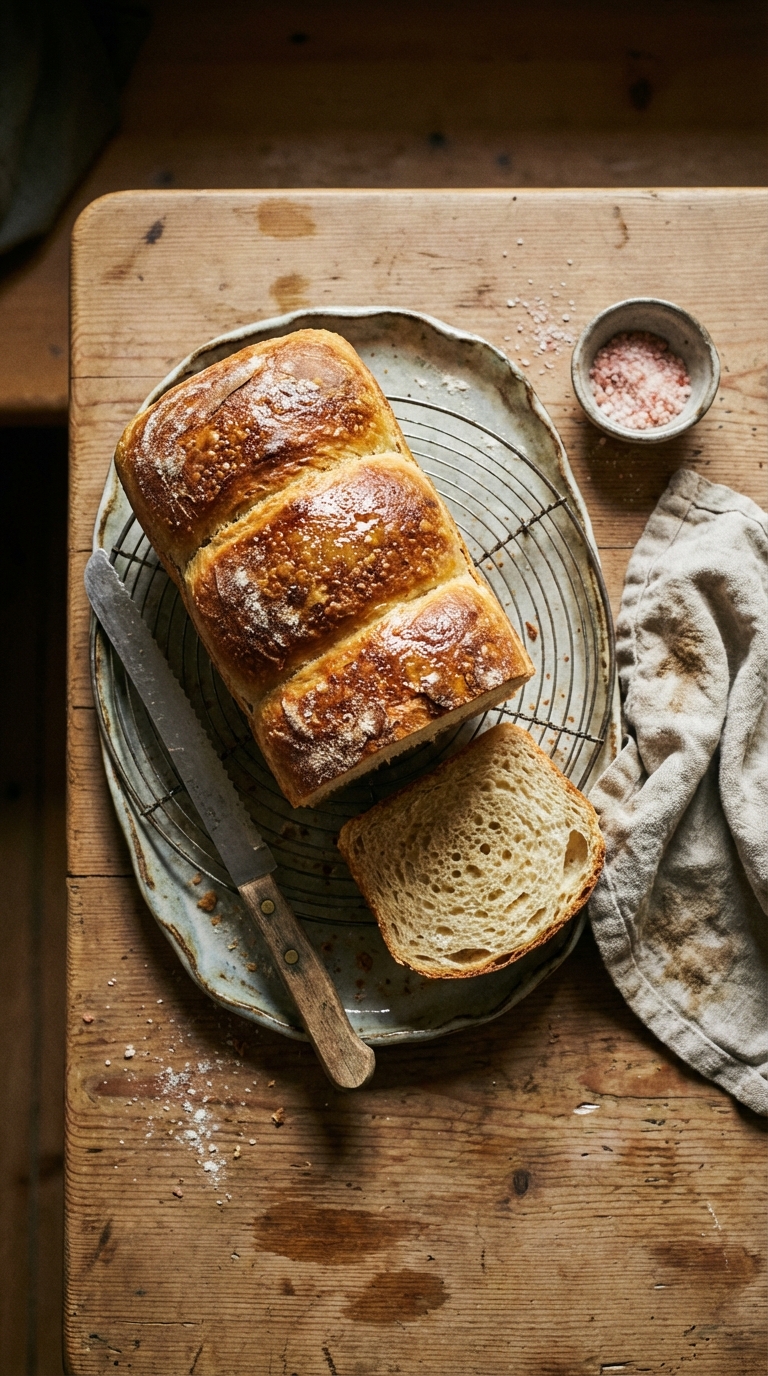
Soft, fluffy sourdough bread made for sandwiches and toast. Unlike rustic artisan loaves with their large air pockets, this one has a tight, even crumb that slices cleanly and holds up to whatever you put on it. The butter runs straight through your toast instead of dripping out the bottom, and sandwiches don’t require tearing with your teeth. So, we’re talking actual, delicious sandwich bread here folks!
This loaf uses a levain mixed specifically for the recipe, made with milk and bread flour instead of the typical wet sourdough starter. The dough itself contains eggs, butter, and milk, which give it that soft sandwich bread texture. The process takes time, with an overnight rise in the fridge and a long final proof, but most of that is hands-off.
Quick note on shaping method – rolling the dough into ovals, then rolling them up like jelly rolls twice creates layers that give the loaf structure and help it rise evenly in the pan.
The result is bread that’s light, tender, and perfect for everything from PB&J to fancy grilled cheese.
How to Make Soft and Fluffy Sourdough Sandwich Loaf
Make the Levain
Mix together the sourdough starter, milk, and bread flour in a jar. Cover loosely and let sit at room temperature to mature and rise, about 8 hours.
The levain should double in size and smell slightly tangy.
Mix the Dough
Place all of the dough ingredients (including the levain) except the salt and butter in the bowl of a stand mixer fitted with the paddle attachment.
Mix on low speed until it comes together in a shaggy dough. Cover and let rest for 30 minutes (autolyse).
Knead and Add Salt
Switch to the dough hook. Sprinkle in the salt and knead for 3-5 minutes until the dough starts to come together and becomes smoother.
Add Butter
Add the softened butter gradually, a tablespoon at a time, mixing well after each addition. The dough will look greasy at first, but the butter will eventually absorb.
Continue kneading until the dough passes the windowpane test, about 10 minutes total. (To test: stretch a small piece of dough. If it stretches thin enough to see light through without tearing, it’s ready.)
First Rise
Place the dough in a lightly greased bowl and turn to coat all sides with grease. Cover tightly and allow to rise at room temperature for 2 hours.
Transfer to the refrigerator to rise overnight (8-12 hours).
Shape the Dough
The next day, remove the dough from the refrigerator. Divide it into 3 equal pieces and form each into a ball.
Place on a lightly floured surface, cover with a damp tea towel, and let rest for 1 hour.
Roll each ball into an elongated oval. Roll each oval up tightly like a jelly roll. Let rest for 10 minutes.
Roll each piece out into an oval again along the seam, then roll up like a jelly roll once more. This double rolling creates layers and structure.
Transfer the three rolls to a buttered 9×5-inch loaf pan, placing them seam-side down. Cover with a damp tea towel and let rise at room temperature for about 6 hours. The dough should puff up and fill the pan about 2/3 to 3/4 of the way.
Bake
About 20 minutes before baking, preheat the oven to 400°F.
Place the risen loaf in the hot oven and bake for 20 minutes. Lower the oven temperature to 350°F and continue baking for 15-20 minutes more, until the loaf reaches an internal temperature of 195-200°F.
Transfer to a wire cooling rack and let cool completely before slicing.
Recipe Notes
A 100% hydration starter means equal weights (not volumes) of water and flour. Feed your starter, let it rise until doubled (6-12 hours depending on kitchen temperature), then measure out 23 grams for the levain.
The levain uses milk instead of water, which makes it stiffer and adds richness to the final loaf.
All the mixing can be done by hand if you don’t have a stand mixer. Expect to knead for 15-20 minutes by hand to develop the gluten.
The windowpane test is important. It tells you when the gluten is developed enough. Underdeveloped dough won’t rise as well.
The sugar is optional but recommended. It adds a slight sweetness and helps with browning. The bread is still good without it.
If you don’t have bread flour, use all-purpose flour for the entire recipe. The texture will be slightly less chewy but still good.
The overnight cold rise develops flavor and makes the dough easier to shape.
The final 6-hour rise seems long, but it’s necessary for sourdough. The wild yeast works more slowly than commercial yeast.
Roll it twice when shaping. It creates structure that helps the loaf rise evenly.
Let the bread cool completely before slicing. Cutting into warm bread releases steam and makes the crumb gummy.
This bread keeps well for 3-4 days wrapped tightly at room temperature, or freeze slices for up to 3 months.

Sourdough Sandwich Loaf Recipe
- Total Time: 65 minutes
- Yield: Makes 1 loaf
- Diet: Omnivore
Description
Homemade sourdough bread, perfect for sandwiches. Soft, fluffy crumb and delicious flavor.
Ingredients
- 23 g (1 oz) 100% hydration sourdough starter
- 38 g (1 oz) whole milk
- 70 g (2 oz) bread flour
- all of the levain/starter
- 173 g (6 oz) all-purpose flour
- 173 g (6 oz) bread flour
- 1 whole egg
- 1 egg yolk
- 168 g (6 oz) whole milk
- 43 g (1 oz) sugar
- 8 g (0 oz) Himalayan pink salt
- 43 g (1 oz) butter
Instructions
For the Levain/Starter
- Mix together all of the levain ingredients in a jar. Let sit at room temperature to mature and rise for about 8 hours.
For the Final Dough
- Place all dough ingredients (except salt and butter) in a stand mixer bowl with the paddle attachment. Mix on low speed until a shaggy dough forms. Let rest (autolyse) for 30 minutes.
- Switch to the dough hook. Sprinkle in the salt and knead for 3-5 minutes, or until the dough starts to come together.
- Add the butter gradually, mixing well after each addition. Continue kneading until the dough passes the windowpane test, about 10 minutes.
- Place the dough in a lightly greased bowl, turning to grease all sides. Cover tightly and let rise at room temperature for 2 hours. Then, place in the refrigerator overnight.
- The next day, divide the dough into 3 pieces and form into balls. Place on a lightly floured surface, cover with a damp tea towel, and let rest for 1 hour.
- Roll each ball into an elongated oval, then roll each one up jelly-roll-fashion. Let rest for 10 minutes. Roll them out into an oval again along the seam, then roll each one up like a jelly roll once more.
- Transfer the rolls to a buttered 9×5-inch loaf pan. Cover with a damp tea towel and let rise at room temperature for about 6 hours, or until the dough is 2/3-3/4 full.
- Preheat oven to 400°F (204°C). Place the risen loaf in the hot oven and bake for 20 minutes.
- Lower the oven temperature to 350°F (177°C) and continue baking for 15-20 minutes, or until the loaf reaches an internal temperature of 195-200°F (91-93°C).
- Transfer to a wire cooling rack and let cool completely before slicing.
Notes
- For a richer flavor, use a high-quality, aged sourdough starter.
- To achieve a crispier crust, brush the loaf with milk or egg wash before baking.
- Store the cooled loaf in an airtight container at room temperature for up to 3 days, or freeze for longer storage.
- Prep Time: 30 minutes
- Cook Time: 35 minutes
- Category: Baking
- Method: Baking
- Cuisine: American
Nutrition
- Serving Size: 1 slice
- Calories: 250
- Sugar: 5
- Sodium: 300
- Fat: 10
- Saturated Fat: 6
- Unsaturated Fat: 3
- Carbohydrates: 35
- Fiber: 2
- Protein: 8
- Cholesterol: 50
If you liked this, you are going to love these favorite loaf-recipes:
Easy Homemade Banana Loaf – The Ultimate Classic Recipe
Kubaneh – Yemenite Jewish Loaf
Frequently Asked Questions
What should I do if my levain doesn’t double in size after 8 hours?
If your levain hasn’t doubled in size, it may need more time at room temperature or your starter may not be active enough. Try letting it sit longer or feeding your starter before using it.
Can I substitute the milk in the dough with a non-dairy alternative?
Yes, you can use a non-dairy milk like almond or oat milk, but it may slightly affect the texture and flavor of the bread.
How important is the rolling technique when shaping the dough?
The rolling technique is crucial as it creates layers in the dough, which contribute to the structure and even rise of the loaf, ensuring a soft and fluffy texture.
If You Liked This Recipe, You’ll Love These
- How to Make “Lussekatter”: Traditional Swedish Lucia Buns
- Panmario: Italian Rosemary and Olive Oil Bread
- Jalapeño Cheddar Cornbread Recipe
- Jalapeño-Cheddar Sourdough Bread










I have baked this loaf three times now and it slices clean every single time. The overnight rise fits my schedule perfectly. Best sandwich bread I have made!
Best loaf ever. Bread turns out perfectly!!!
So happy to hear that Maisie!
My lands is bread is incredible. I’m already feeding to make more Levanin.
Wow! Well done on a brilliant recipe. This is by far one of the best breads I have ever baked. I used all baker’s flour as that’s all I had and I also doubled the recipe and made 2 loaves. Will definitely make this more often. The family loved it.
That’s awesome to hear – hooray!
Fantastic. It didn’t really rise in the first two rises, but by the time I got it into a leaf pan and waited 10 hours, it finally rose and was delicious.
Huzzah, so happy to hear that!
Interested in making this sandwich bread but I just want to clarify that I am feeding my 100% hydrated starter that was in the fridge for days with MILK and flour… I have never seen a starter fed with milk before so I just wanted to check!
Yes, that’s exactly right – it’s a little untraditional, but it turns out really great! :D
Lovely soft loaf. I used all bread flour and it’s worked out well. Best loaf I’ve made! Well worth the time.
There is no salt mentioned in the recipe!