
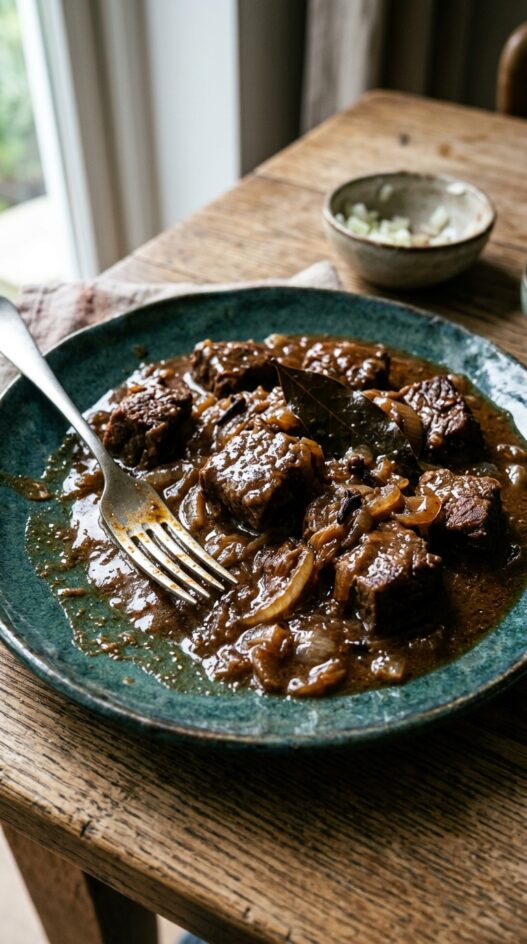
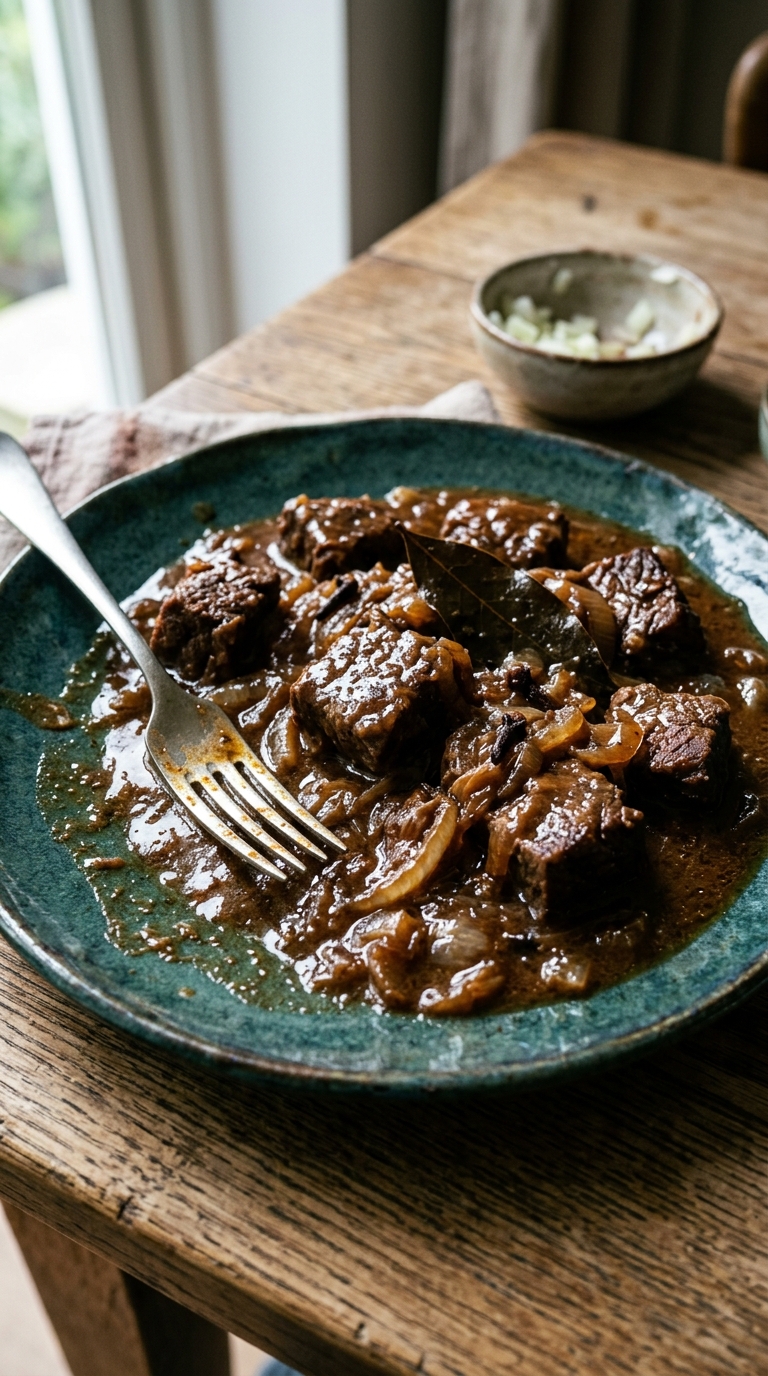
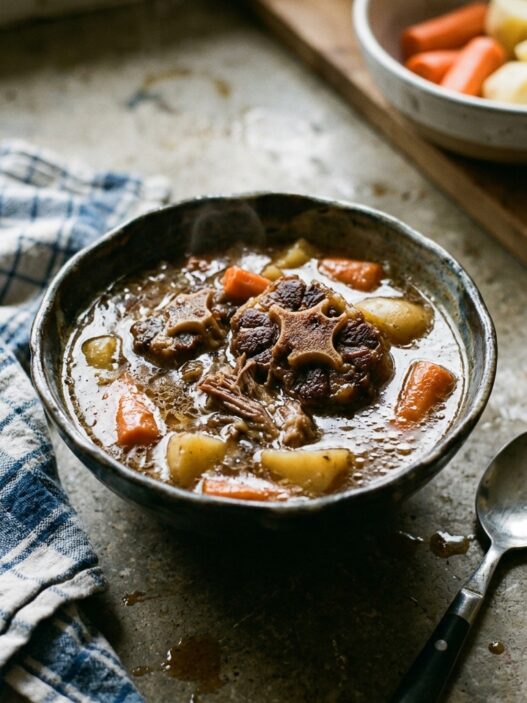
Hachee has been around since the middle ages. It was originally invented to use up all kinds of leftover (already cooked) meat and vegetables, with an acid (usually vinegar) added to tenderize everything. It is mentioned often as a banquet dish, but the exact recipe was never documented. Later on people started to use cheap beef cuts, only suitable for eating after cooking them a long time and tenderizing them with an acid, and cheap vegetables like onion. With great results: super-tender meat, a thick and rich sauce (the onion adds both sweetness and binding) and a mellow warmth from the spice… and therefore, hachee is still a much loved dish which is eaten a lot. People like it so much that there are ready-made varieties available for the people that don’t have time or don’t like slow-cooking. But for me nothing beats the real thing, making it at home following the traditional method. The actual time involved is very little, and while doing other things, I can enjoy the delicious smell. Hachee is traditionally eaten with potato puree, but serving it with plain cooked rice also works very well. Braised red cabbage with sour apples is usually served on the side. I’m not a big fan of red cabbage, so I serve my hachee usually with Brussel sprouts.
Some people like to jazz up hachee and give it an extra something, so they add for example ontbijtkoek (Dutch spiced breakfast cake), beer, mustard, appelstroop (apple syrup/dark apple butter), speculaas spices (similar to pumpkin spices), sambal (a spicy Indonesian red pepper paste) or red wine. A lot of these additions originate from regional varieties of hachee, depending on what was available in the region.
Hachee (like most stews) freezes well, so double up the recipe, freeze halve and enjoy the second portion another day, when you don’t have the time to cook a slow dish.
Print
Hachee – Dutch Beef Stew
- Total Time: 3 hours 30 minutes
- Yield: 4
Description
Satisfying, rich, warming beef stew, a Dutch classic.
Ingredients
- 50 g butter
- 600 g beef (suitable for stewing), cubed
- 3 large onions, chopped
- 2 tbsp flour
- 1 beef stock cube
- 3 tbsp red wine vinegar
- 3 bay leaves
- 4 cloves
- salt and pepper
Instructions
- Melt the butter in a Dutch oven.
- Add the beef, brown well.
- Take out the beef, set aside.
- Add the onions to the remaining fat, cook until translucent and slightly browned.
- Add the beef back in, mix with the onions.
- Sprinkle over the flour, cook 1-2 minutes on low heat, stirring regularly.
- Add warm water until the beef is barely covered.
- Add the stock cube, red wine vinegar, bay leaves and cloves.
- Cover, simmer on a low heat for at least 3 hours. If you like a thick sauce, take of the lid for the last 30 minutes to evaporate some of the moisture of the sauce.
- Taste, adjust seasoning with salt and pepper if necessary.
- Serve with potato puree or rice.
Notes
- Originally white vinegar was used, but I find that this gives a harsh flavour to the dish.
- Red wine vinegar is has a much more rounded flavour.
- Alternatively, white wine vinegar or other vinegars with a well-rounded flavour can be used.
- Prep Time: 30 mins
- Cook Time: 3 hours
- Category: Stew
- Cuisine: European
Nutrition
- Serving Size: 1 serving
- Calories: 380
If You Liked This Recipe, You’ll Love These
- Slow Cooker Korean-Style Beef Stew
- Traditional Milanese Ossobuco with Gremolata
- Red Wine and Rosemary Braised Short Ribs
- Stove Top Boeuf Bourguignon
Frequently Asked Questions
What makes hachee taste different from other beef stews?
Hachee uses a large amount of onion — 3 large onions for 600 g beef — which both thickens the sauce naturally and adds sweetness. Vinegar is the other defining element: I add 3 tbsp of red wine vinegar for acidity and tenderizing. This dates back to the Middle Ages when vinegar was used to tenderize cheaper, tougher cuts of meat.
Why does the recipe use red wine vinegar instead of white vinegar?
White vinegar was the original choice, but I find it gives a harsh flavor. Red wine vinegar (or white wine vinegar) has a more rounded, mellow taste. Regional variations also use beer, mustard, apple syrup, or speculaas spices — all of which round out the acidity in different ways.
How long does hachee need to simmer, and what should I serve it with?
Simmer it covered on low heat for at least 3 hours; for a thicker sauce, take the lid off for the last 30 minutes to reduce. Hachee is traditionally served with potato puree, though plain rice also works well, and braised red cabbage with sour apples is the classic side dish.
Can hachee be frozen?
Yes — I’d recommend doubling the recipe and freezing half. Like most stews, hachee is freezer-friendly and this is an easy way to have it ready for another night.






Just like my momma used to make it!
Thank ypu
Brings back wonderful memories. Sadly never was taught all the lovely Dutch recipes and now in my 60s I am enjoying exploring these recipes from my past. Many thanks!
Interesting want to see more dutch recipe thank you
Thank you for your recipe. Since my mam is gone, who lived in Hoorn, I have to rely on recipes like this.
I will keep an eye on your news letter.
Traditionally you would also use a dark ale (10 oz or 300 ml) and at least 8 hours gently simmering.You should be able to cut the meat with a spoon.
Serve with red cabbage and a potato mash and you got a typical winter dish.
Wat leuk!
As above
Wij zijn een Nederlands Oma kookboekje aan het schrijven voor onze kinderen kleinkinderen en aangetrouwde austrlische kleindochters op verzoek van onze Australische aangetrouwde familie. Uw recepten, omdat ze in het Engels zijn maken het gemakkelijk voor ons, daarvoor onze hartelijke dank.
Lenie Bierman, Hastngs Vic Australie