
The Adelaide Hills is a landscape that asks to be read with attention. Eucalyptus forests folding into gullies, stringybark and gum rising over tablelands that turn gold in summer and green again with the winter rains. Lightning has burned through this country for as long as it has stood, and the hollow red gums still carry the scars. For at least two and a half thousand years these hills have been read with by the Peramangk, who hunted kangaroo and possum and emu across the ranges, gathered the cream-fleshed moth grub from the decaying gums as a delicacy, painted in red and yellow and white ochre across rock shelters that still survive, and traded with the river people of the Murray for flint and spears. They knew which plants fed and which healed. They knew the seasons of this place in a detail no guidebook has ever matched, and their descendants are here still.
It is worth beginning here, because Justin James begins here too.

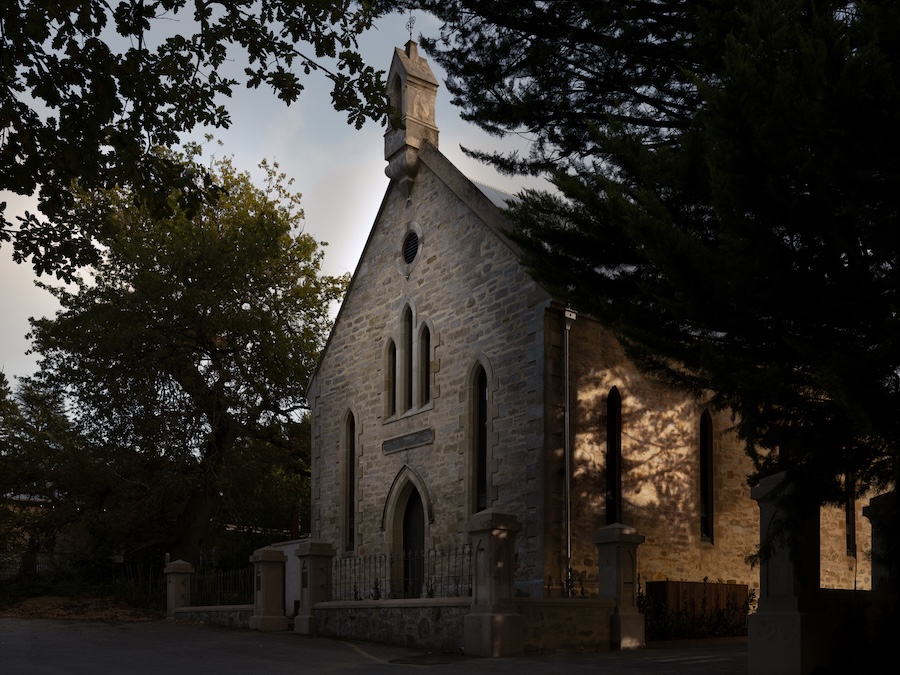
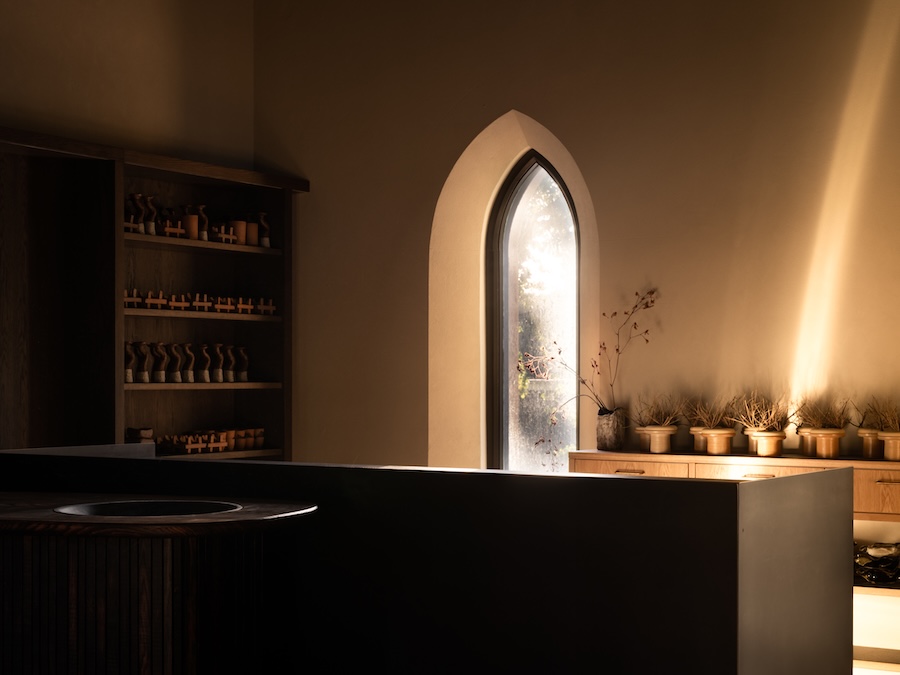
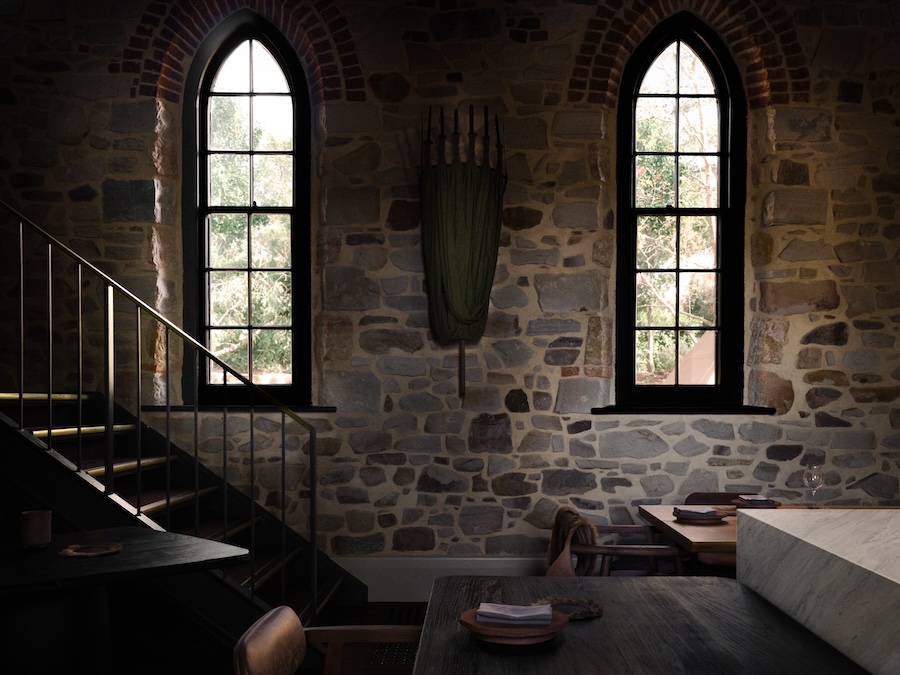
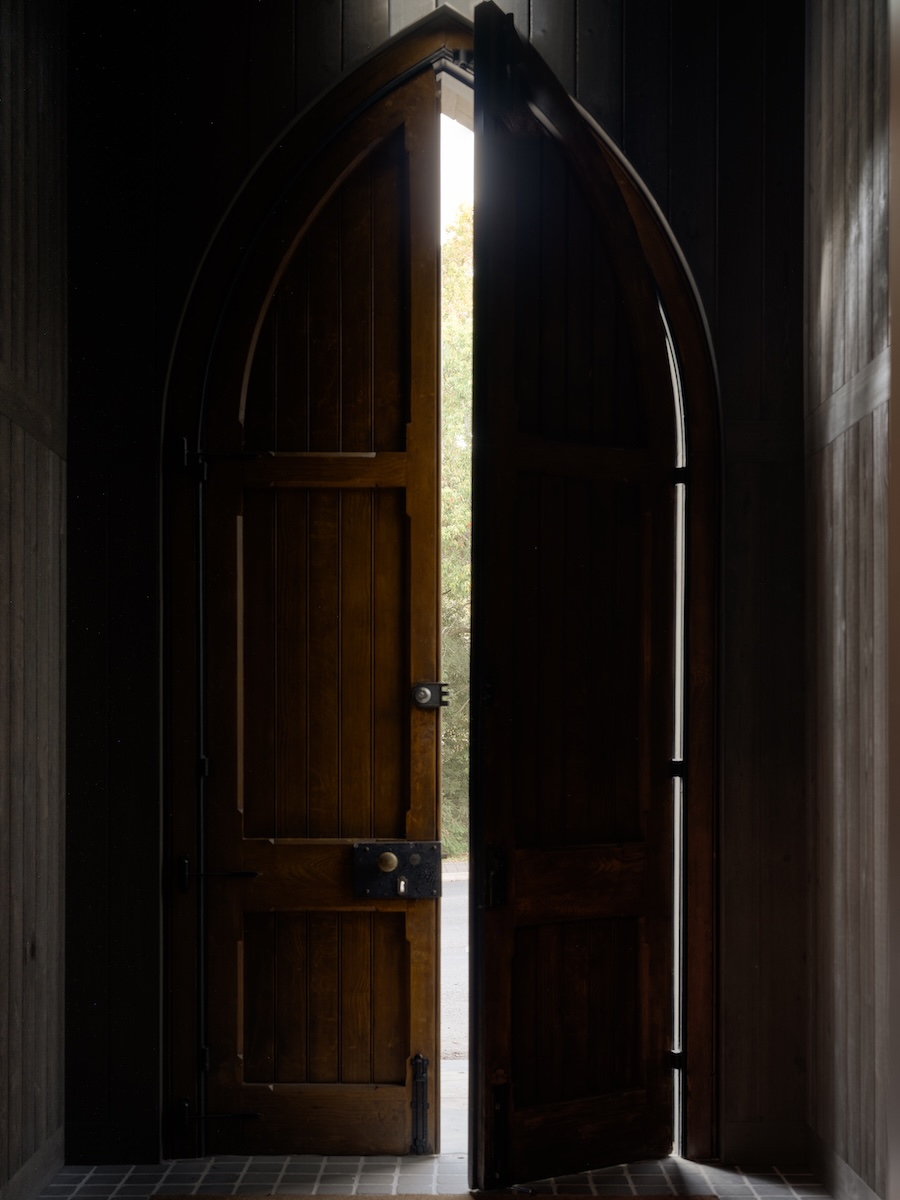
At 147 Mount Barker Road, in the village of Stirling, stands a church built in 1878. It was raised as the Ashton Memorial Bible Christian Church, designed by the well-known Adelaide architect Daniel Garlick in random coursed stone, its Gothic openings topped by a small belfry, named for the Devon-born preacher who first ministered the Mount Lofty Circuit. It held worship for more than a century, became a Uniting Church, closed its doors in 1983, and lived a second life as an art gallery. Now it holds something its builders could not have imagined: a 14-seat restaurant that has set out, with no apparent modesty, to redraw the map of what dining in Australia can mean.
One Continent In Three Rooms
Restaurant Aptos opened on 8 May 2026, the first of three connected venues sharing the old church. Bar Cruz, named for the Aptos Cruz Galleries that occupied the building before it, will follow in winter with cocktails and a separate dining room. Bar Mary, a single eight-seat room devoted to whisky, comes after. Together they form a triptych, but Aptos is the apex: sixteen courses for fourteen guests, a staff-to-guest ratio of one to one, a kitchen team drawn from Japan, Sweden, Canada and Sydney, and a price of AU$495 that makes it the most ambitious table on the continent.
Justin James does not flinch from that ambition. He took his previous restaurant, Botanic, to the number one spot in Gourmet Traveller’s national awards. This time, he says, he is aiming further: he wants to make history.
The Long Way To The Hills
Justin James is American, with more than two decades behind him in some of the most serious kitchens in the world: four years at Eleven Madison Park, time at Noma, at Blue Hill at Stone Barns, at Vue de Monde. He landed in Australia in May 2014 on no firm plan to stay. He became executive chef at Vue de Monde, where his predecessor had left a few native ingredients on the menu (kangaroo, muntries, lemon myrtle, finger lime) and something caught.
When that chef left, James began calling suppliers and asking them to send whatever they had. “I just started eating my way through all these ingredients,” he says. It is a deceptively simple sentence. What it describes is years of work: not the trying of an ingredient, but the harder labor of turning it into a dish, and the harder labor still of making sixteen such dishes flow as a single story. “A tasting menu,” he says, “should make sense from start to finish. What you’re eating now has to make sense with what you had before and what comes after.”
Aptos is his first venture as an owner. He is candid that he could not have done it sooner. “If I was ten years younger, I’d fall on my face.”
The Australian Pantry
The idea at the center of Aptos is the one James returns to most often, and it is the idea that makes the restaurant more than a collection of clever dishes. Australia, he points out, is a young country. The great cuisines of the world rest on deep foundations, repeated ingredients that give a national table its grammar. Australia, he argues, has not yet written that grammar. So he is writing one.
His “dry goods”, as he calls them, are native. Wattleseed appears four or five times across the menu for earthiness and texture, never dominant, always there. Finger lime brings acidity. Native herbs bring the green high notes. And green ants; which most kitchens deploy as a novelty garnish, a look-what-we-found flourish; James uses as seasoning, often without telling the guest. “If we want acidity, we use green ants,” he says. The ant is not the point. The acidity is.
He is careful, and humble, about where this knowledge comes from. “I’m not inventing it,” he says. “The Aboriginal people have been here, one of the longest-living civilisations in the world, eating off this land” for millennia. James understands that he is building on ancient ground, not claiming it.
Too Sour, On Purpose
The other inheritance Justin James carries are bold flavors, and it comes from Eleven Madison Park, where the brief during his years was nothing less than to become the world’s best restaurant, a goal the kitchen reached in 2017, three years after he left. The principle he took from it is counter-intuitive but, once experienced, undeniable. “If it tastes good by itself, it’s not good enough,” he says. A component must be pushed almost too far and become too acidic, too salty or too bitter so that when the elements of a dish come together, each can still be tasted individually rather than blurring into a pleasant nothing.
He talks about the palate the way a physicist talks about a system. Five taste receptors (sour, salty, sweet, umami, bitter) that can be saturated one by one until the tongue, having had its fill of sourness, begins to register everything else. A dish must throw “fireworks” the instant it lands, then still be lingering on the palate three minutes later. Beyond the five tastes he counts other registers the brain reads rather than the tongue: texture, temperature, freshness, rawness, and a little heat, which he believes belongs in nearly everything. Around sixty per cent of the dishes carry a whisper of chilli. You may not always notice it. That is the idea.
Justin James has a masterful control of how flavors develop inside the mouth. He is daring enough to open with powerful acidity and let it resolve slowly. He doesn’t play it safe. He puts you on a rollercoaster, which is, after all, the honest way to travel through wild country.
The Journey Through The Rooms
Aptos is not served from a single dining room. The evening opens in a lounge with an aperitive drink, and moves into a library for the first third of the menu. Then, by pushing against a faux Phaidon-copy of Where Chefs Eat, the bookcase opens onto a hidden door, and guests are led, ironically, into the kitchen itself. There the rest of the savory menu unfolds before a final room receives you for dessert.
What moves the guests through these rooms is a bold dining experience. There is, for example, an absence of cutlery. James has stripped away the fork and the knife almost entirely, and the reasoning is sharp. “If everybody’s serving things with a fork and a knife,” he says, “I’m not going to.” In a world of distracted diners glancing at phones, the instruction to lick, to suck, to peel, to dip forces presence. “If I get you to lick a stick in front of your three friends, you’re going to laugh.” You laugh, you take a photograph, and a memory is made. “All I want,” he says, “is to spark a memory that you remember coming to Aptos. Full stop.”
Sixteen Steps Through The Australian Wild Pantry
Not one standard plate crosses the table all evening. Every vessel was drawn from nature or from the animal itself, and the meal moved like an atlas turning its pages: each course a new latitude of a country to explore.
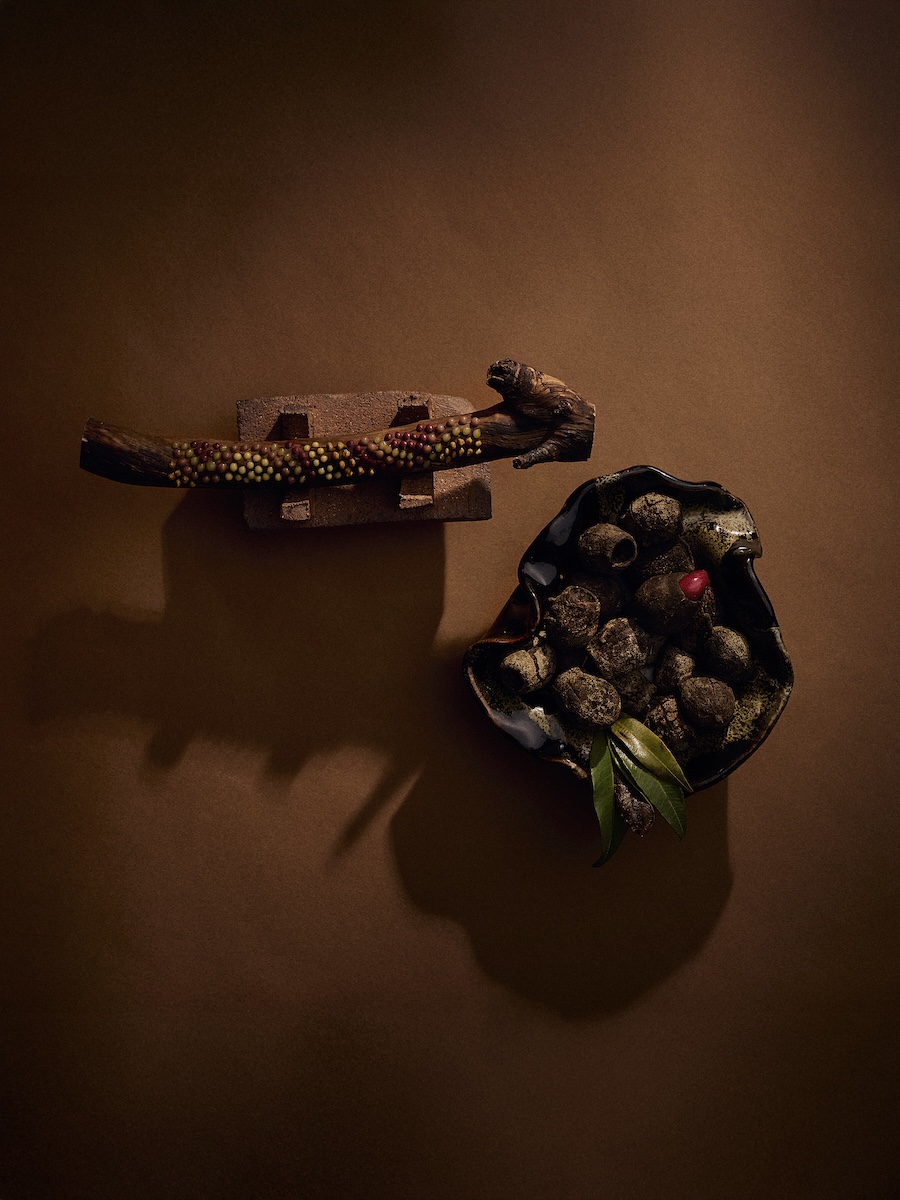
It opens, in the library, with a branch. “Five Australian fruits” is a bold opening: muntries, Illawarra plum, desert lime, quandong and sunrise lime lifted with fermented chilli. You lick the branch from left to right. Then you suck a gumnut, filled with grilled quandong, salted Kakadu plum and pickled muntries, bound with lemon myrtle, horseradish, parsley and the richness of unexpected feta underneath that James likens, with a straight face, to a Greek salad made Australian. Then you peel a soft, wild leather of muntries, desert lime and grilled strawberry, dried on lemon myrtle leaves. Acidity, heat, herbaceousness, a whisper of sweetness, all in the first minutes to awaken the palate and to set the evening’s terms: this will be quite a ride.
The slow-cooked abalone follows. Green-lip abalone, marinated in miso and kissed over charcoal, glazed in grilled desert lime, skewered with pickled desert lime, touched with green ant, finished with a breath of lime and parsley. The flavors don’t arrive together but in a sequence: the acidity opening the palate first, then the smoke, and behind it the deep marine sweetness. Few chefs can choreograph the inside of a mouth like that.
Then the wild venison from the Adelaide Hills, presented on the deer’s own jaw and dressed with a paste of chilli and green ants, macadamia and turnip over a deep umami; it’s plated inside what might remain a bush and presented with the warning to watch for sticks and teeth. The fourth course, warayaki-smoked tuna and water buffalo, is a surf and turf you must unwrap: tuna and buffalo touched by burning paperbark, glazed with lilly pilly, sealed between sheets of kombu with sandalwood nut and a sauce of camel milk and river mint. You peel back the kombu, layer by layer, to find what is hidden inside.
The fifth course, simply titled “jelly”, brings smoked tomato, charred muntries, a fudge of bee pollen and a trace of mountain pepper leaf. If you wish, your waiter will answer the question worth asking: what the jelly was in the first place. Then scallop and lemon aspen, a study in cold: an ice bowl crowned with a scallop shell, the shell holding lime-cured scallop and fermented heart of palm over lemon aspen granita, finished with smoked cream, kombu, a thread of jalapeño and a pinch of anise myrtle. It is, they admit, the most classical plating in the menu and yet delicious.
“Sea & river” is the hinge of the meal, thae dish that greets you in the kitchen once the bookcase has swung open. It comes in three pieces: a warm, rich fish soup; a tartare wrapped in kombu with karkalla and Davidson plum; and Murray cod, marinated in kombu, grilled, finished with a paste of saltbush and pepitas, with a sauce made from marron coral that you dip at your own pleasure. It’s the country’s fresh water and its salt brought to the same table.
Prawnya (prawn meets bunya nut) arrives on a branch made from the bunya tree: South Australian prawn marinated in native basil and bunya nut at one end, to eat first; then bunya-nut tofu fried with the prawn legs, in a single bite; then the sauce of grilled prawn shells and native basil, to slurp.
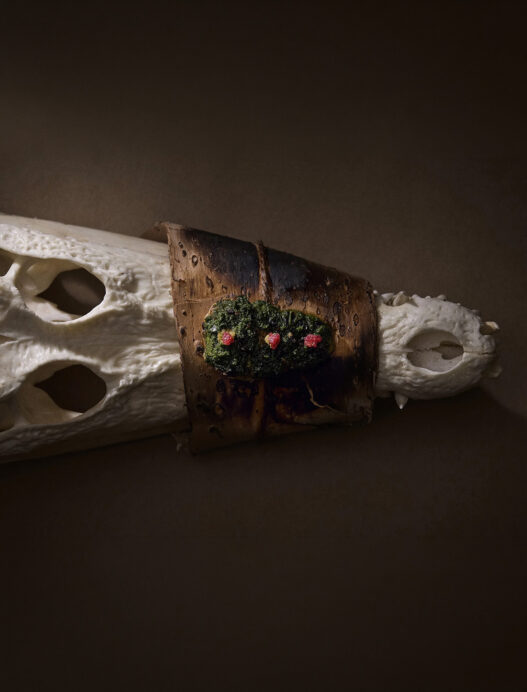
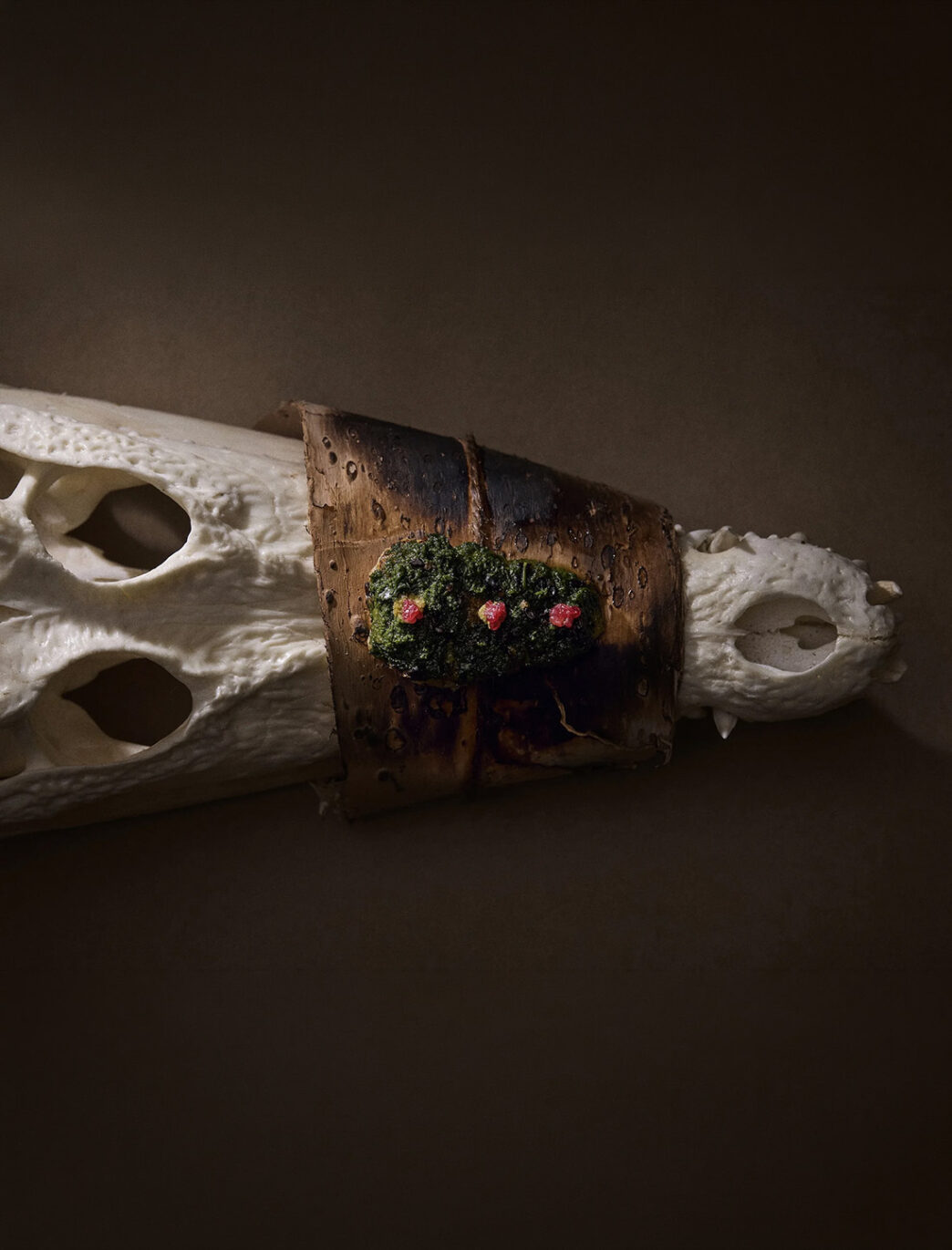
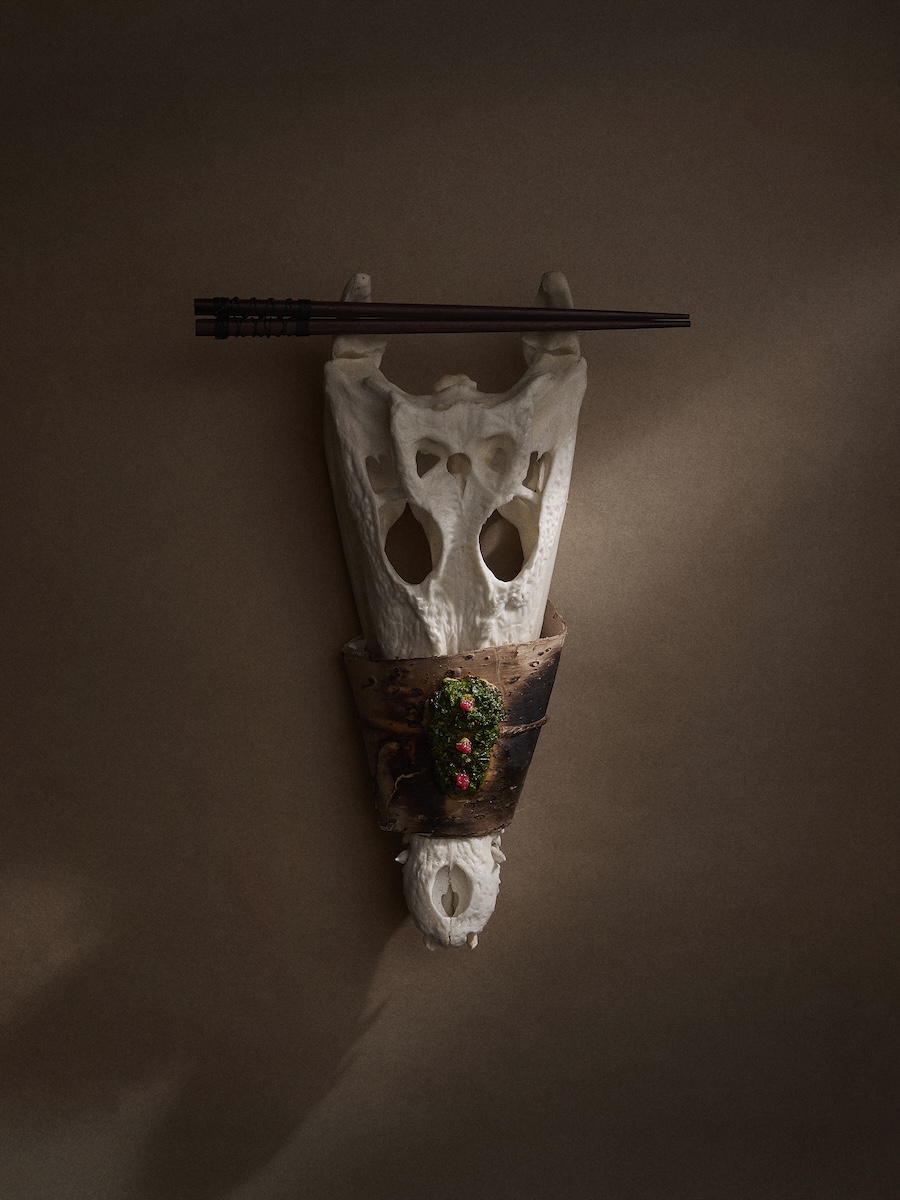
“Crocodile tears” is a course that marks a summit. It took thirty attempts, thirty recipes, for Justin James to succeed at it. Crocodile tongue, slow-cooked in Geraldton wax, grilled, dressed with Geraldton wax chimichurri and wax kosho, served on its own skull. It’s wild and beautiful, almost looks dangerous, and it is also delicious and refined.
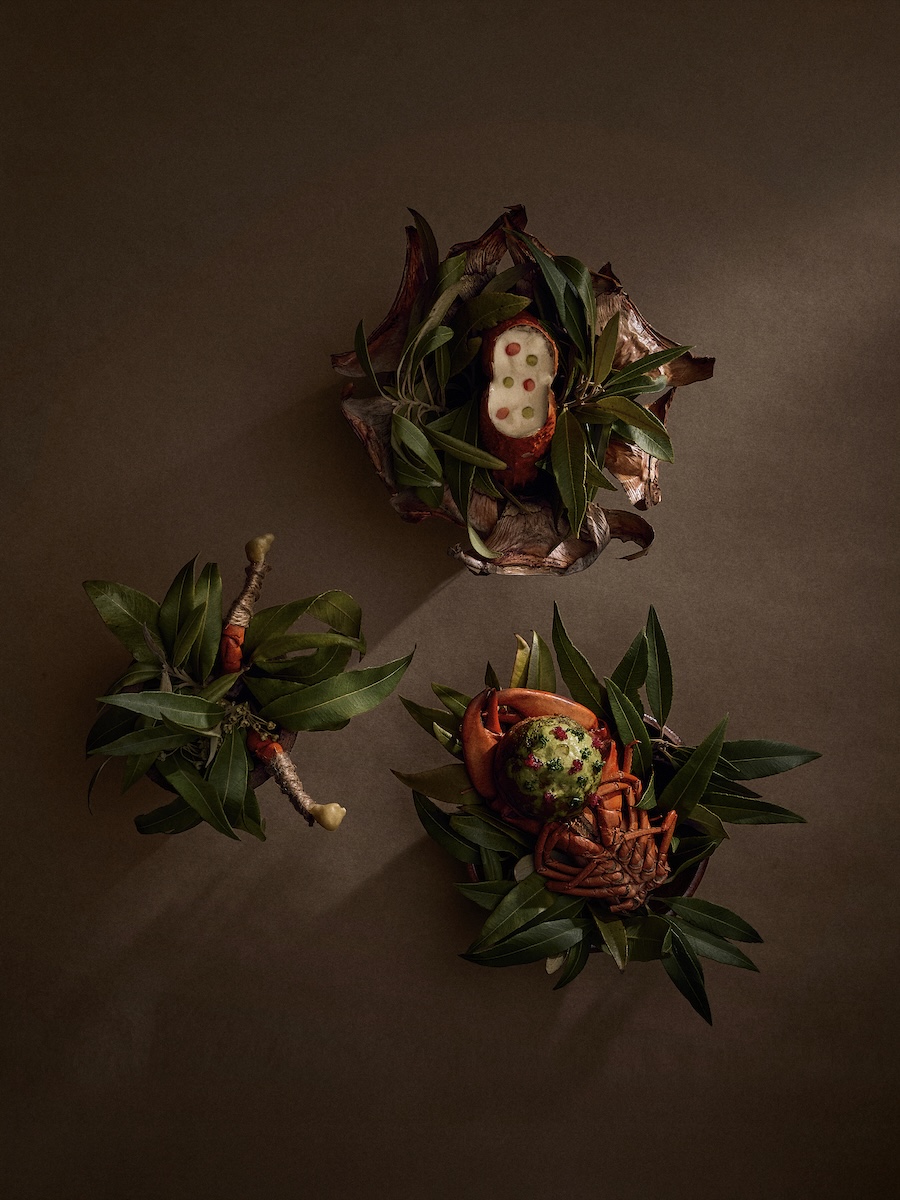
The savory journey peaks with the “coat of arms”, a witty, generous tribute to the animals on Australia’s national emblem. South Australian red-hair kangaroo, marinated in mountain pepper, brushed with burnt macadamia butter and seasoned with a Davidson plum spice; emu glazed in a sticky emu sauce with mushroom spice and pickled wild garlic; wallaby finished with charred warrigal paste and preserved lemon myrtle buds; and the kangaroo meatball, wrapped in a rosella flower. A native currant and brown-butter kangaroo jus waits alongside, for dipping the lot, shabu-shabu style. “Marron and myrtle” closes the savory arc: the marron tail, brushed with a macadamia salsa macha, hidden among lemon myrtle leaves and skewered on its own claws, with a warm lemon myrtle béarnaise, followed by a doughnut filled with marron and glazed with curry leaf and lemon myrtle.
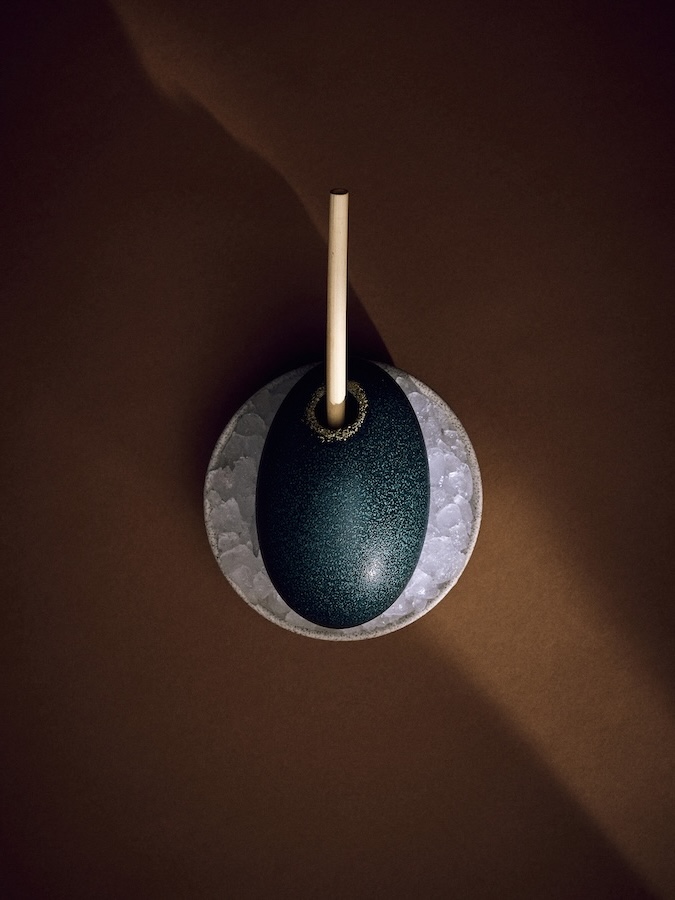
Dessert moves you again, into the final room. The emu egg milkshake (wattleseed, smoked banana and cinnamon myrtle) is served cold, inside the emu egg itself. “The forest floor” is the most theatrical of all the desserts: a paperbark waffle torched with fermented honey, a whiskey-and-honey syrup you brush on with a sprig of lemon thyme, a custard made of fallen branches and seasoned with roasted bunya, and an Adelaide Hills pine cone dressed with pine nuts, Geraldton wax, mushroom fudge and the rare scented emu bush. You dust it, lick it, and finally dig into the cracks with finger or stick. For one happy stretch I ate the way our most distant ancestors must have, and felt entirely civilised doing it.
Two final sticks bring the meal home. Gum: gums on a stick, dipped in buttermilk and frozen, dipped in strawberry gum and frozen, dipped in lemon gum and frozen again, coated in ginger syrup and rolled in granita. And then the close: the “native grape ice cream sando, nitre bush turned to ice cream, wrapped in parsley and a scatter of walnuts. And here the architecture reveals itself: the meal opened on the seed notes of a licked branch and ends on a different seed in the sando. Sixteen courses, not one of them eaten the way you expected to eat it, and the circle shuts.
Not a Wine Pairing, But Five
Five different wine pairings are offered, and at a table of five, all of them can be chosen at once. From a non-alcoholic menu that builds on some of the same ingredients as the cuisine (infused, fermented, or blended into juices) to an exclusive Champagne pairing, the drinks reach across the old world and the new to match and enhance the food.
Every pairing is generous; glasses are refilled, serious bottles are opened. But the one that best matches the story of the evening might be the pairing that explores the impressive array of varietals found in the Adelaide Hills itself. From Pinot Noir to Nebbiolo, from a sparkling Chardonnay to a skin-contact multi-varietal, the breadth of this wine region reveals itself one glass at a time.
Serious, Never Solemn
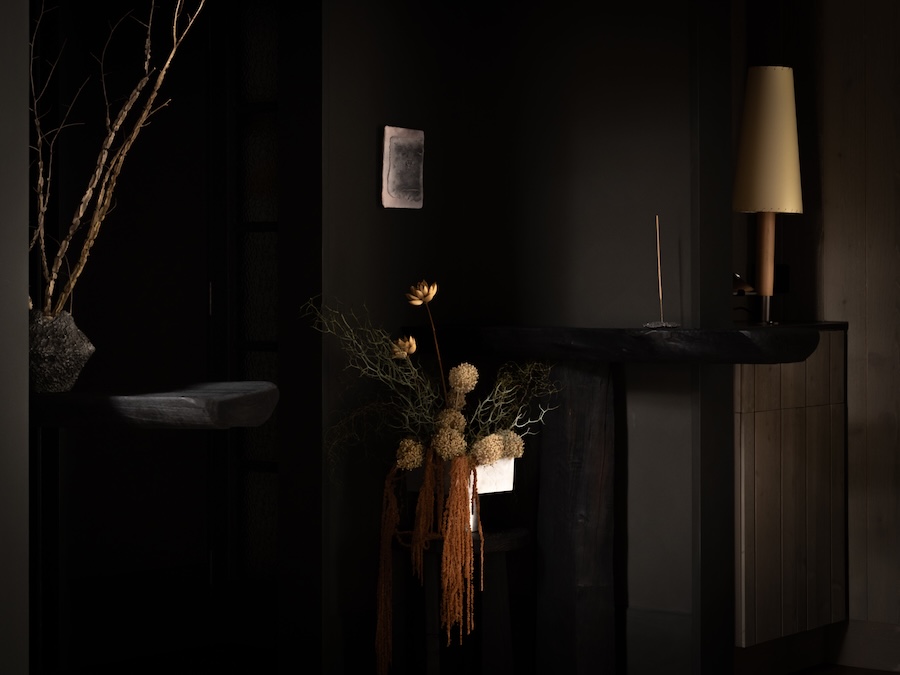
The interiors are elegant, warm and contemporary, and threaded through them is an art collection that James, a devoted gatherer, has hung for irony as much as beauty: a general with his face spray-painted and his eyes cut out, a piece that instructs you to turn your phone off and get therapy and have good sex, a collection of 1950s boomerangs. It is the work of someone very serious about what he does who declines to take himself too seriously.
That tension of rigour wearing the mask of play is the whole restaurant. Justin James measures himself against some of the best restaurants in the world, he has built a room as exacting as any of them, and then filled it with laughter, sticks and skulls. It’s a seriously good restaurant, and a seriously fun one too.
When you leave the old church, what stays is not a single dish but the shape of the whole: an expedition through a continent’s larder, narrated by a chef who has chosen to spend the rest of his career mapping this part of the world.
Restaurant Aptos. 147 Mount Barker Road, Stirling, South Australia
restaurantaptos.com
Oh my, this seems incredible!
Dream destination!
This goes straight to the TOP of my travel list, the way it reads I would happily fly across the world and drive into the Adelaide Hills just for one dinner. Native ingredients I have never even heard of, mapped out like this, sounds unforgettable.