
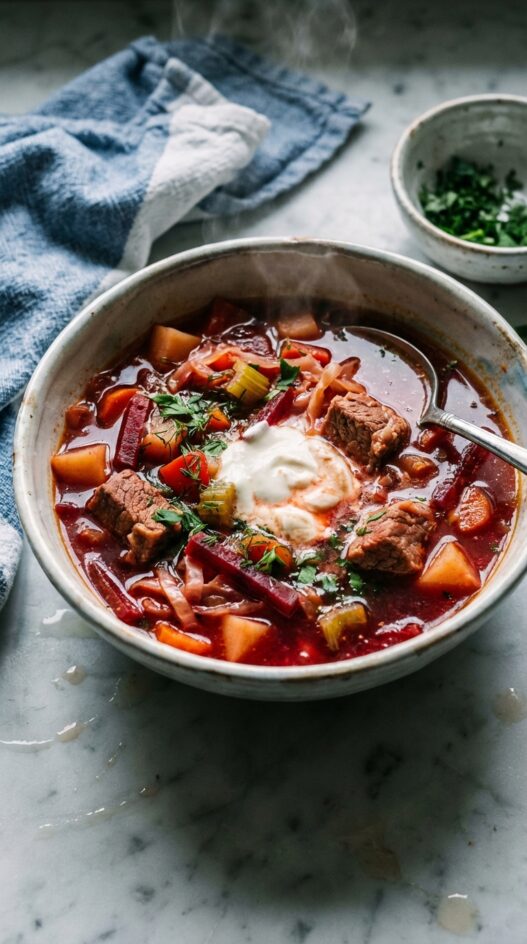
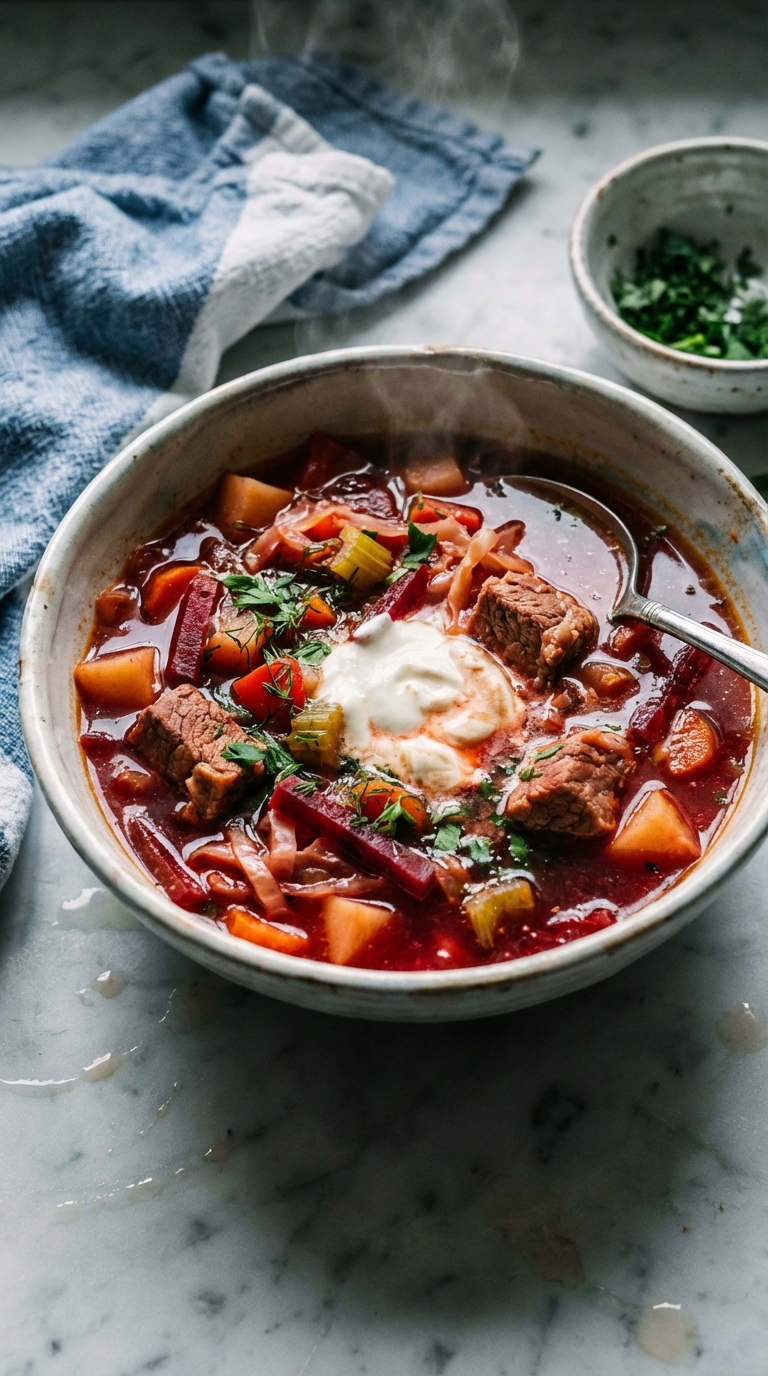
If there is one item that puts Ukrainian cookery on the map of International Deliciousness, it would be borscht. Now, I would love to tell you that poems and songs have been written about it, that borscht cook-offs and Borschtfests are held around the world, but sadly, I can’t. Russian and Ukrainian literature, however, has no shortage of borscht mentions. In Bulgakov’s “The Master and Margarita“, a corrupt Soviet bureaucrat gets arrested right before he can dig into a bowl of “fire breathing borscht” with a knuckle bone nestling in its thickness.
Another famous scene appears in “The Little Golden Calf” by Ilf and Petrov. A husband on a hunger strike to win back his departing wife is caught sneaking borscht straight from the pot at night, greedily consuming it and producing whistling and slurping noises. When he unearths a chunk of meat with his bare hand, his wife reveals herself and he drops it back, producing a “small fountain of cabbage and carrot stars.”
Though these writers are Russian, all have Ukrainian roots, as does Nikolai Gogol, whose works are peppered with borscht-isms. So borscht found its way to fame through classic literature.
But what is borscht? It’s the ancient Slavic word for beetroot, and it’s a hearty soup with vegetables (and meat for non-vegetarians) that must contain beetroot. A soup without beetroot cannot be called borscht. In Russian and Ukrainian cultures, borscht is the epitome of home cooking, the ultimate comfort food. It has as many recipes as there are cooks, and whether meaty or vegetarian, it reigns supreme over any other soup (according to me).
My favorite method is cooking properly seasoned meat to yield rich broth, then dealing with vegetables separately, connecting them at the end. Beetroot is mandatory. So is green cabbage, and tomato paste or chopped tomatoes, which lend borscht its tartness and bright red tint. The major difference between Ukrainian and Russian borscht is the omission of potatoes and salt pork in the latter.
Ukrainian Borscht Components
Meat choices. I’ve had borscht made of beef, lamb, duck, goose, and chicken. I never had borscht made of pork, but that doesn’t mean it can’t be done. Meat must have some bones and fat in it, for best flavor. Fat could be skimmed off if you are afraid of it, after the broth is done.
Root Vegetables. Any root vegetable is going to work. Beets, as was mentioned before, are a must, and they have to be red beets. Beyond that, carrots, parsnips, turnips, celeriac, rutabagas, etc. will all work beautifully. All root vegetables must be cut in as uniform way as possible. Julienne is the best way to cut them (think thin french fries). Refer to pictures for thickness and length.
Other Vegetables. Green cabbage is a must. Best kind is the winter cabbage, which is harder, has stiffer leaves and is crunchy. For potatoes, I use Yukon Golds or Idaho, the yellow varieties. Baking potatoes such as Russet won’t work, and red potatoes will do quite well, but they tend to take longer to cook, so keep that in mind. I personally like bell peppers in my borscht. Their flavor is unmistakable and they are very fragrant. Green and red varieties are best. Celery stalks are great if you can’t get a hold of Chinese celery (leafy kind).
Tomatoes. Tomato paste is the most convenient and consistent in flavor, so that’s the easy way. Canned or fresh diced tomatoes with juice will work nicely, yielding somewhat thinner coloring and more subtle flavor, which may or may not need adjustment in the end.
What You Need to Know About Borscht
- Second day borscht is better. Completely true. Flavors continue to develop after borscht is fully cooked, yielding better borsch on the day after cooking.
- Always make a large batch, you will thank me later. Borscht freezes beautifully, your friends, both healthy and ailing, will love the borscht giveaway, and you will want to eat it more than once, guaranteed.
- Potatoes in the borscht must be fully cooked. Cabbages, on the other hand, should be translucent, but still somewhat crunchy, not mushy.
- Classic borscht is best consumed with crusty sourdough bread slathered with butter, fresh garlic clove dipped in coarse salt and rubbed against the crust. Think of it as a Ukrainian version of garlic bread.
- If this version sounds a bit too savage to you, look up pampushki recipe. Pampushki are small yeasted soft rolls baked in a pan pressed snugly against each other and then separated and drizzled liberally with garlic and dill infused melted butter. First class delicacy if you ask me, but you wouldn’t want to mess with that on a regular weeknight, so save these for a special dinner.
- The final borscht should be quite thick, as Russians put it, to make the spoon stand straight up in it. Don’t be surprised if your borscht comes out thick as stew.
- Borscht must be served piping hot, with a dollop of sour cream served in each bowl.
- Slurping is encouraged, just as in wine tasting, to get the best of the flavor bouquet. Also helps to prevent lip and tongue burns from piping hot borscht.
- And no, for the hundredth time, store bought jar borscht has absolutely nothing to do with real thing. Don’t even try. Don’t even bother using it as a borscht starter. You will fail miserably and will swear off borscht forever, which will be a huge shame.

Homemade Ukrainian Borscht
- Total Time: 270 minutes
- Yield: Serves 8
- Diet: Omnivore
Description
A rich and flavorful borscht recipe, perfect for a chilly evening. Discover the history and secrets to making this classic soup.
Ingredients
- 3 lbs (1361 g) soup bones, knuckle bones, neck bones, or breast bones
- 2-3 lbs (907-1361 g) inexpensive roast, shoulder meat, etc, of substitute both bones and meat with a whole duck, chicken or goose, cut into manageable chunks. Skin and bones are a must on the poultry.
- 1 large onion, with skin or 5-6 dark green portions of leeks, fresh or frozen
- 1 small garlic head, with skin
- 1-2 carrots, cleaned, broken in half
- 2-3 stalks celery, cleaned, broken in half
- 10-15 peppercorns, crushed
- Salt
- 3-4 sprigs of fresh thyme (optional)
- 2 tbsp olive oil for sweating vegetables
- 2 large beet roots, leaves and stems removed, thoroughly cleaned
- 2 carrots, thoroughly cleaned
- [your root vegetable here, if desire, see suggestions above], thoroughly cleaned
- 2-3 stalks of celery, Chinese celery, or 1/2 celeriac root, cleaned
- 1 large onion, peeled
- 1 large bell pepper, cored and seeded
- 1 large green pepper, cored and seeded
- 2-3 large potatoes, peeled
- 1 small to medium cabbage head, cored
- 1 small can of tomato paste, or 1 14 oz (397 g) can of diced tomatoes with juice, or 3-4 large Roma tomatoes, diced
- 4-5 cloves of garlic, minced
- salt, fresh ground pepper to taste, a dash of Paprika or cayenne pepper, up to you
- juice of 1 lemon
- 2 large handfuls of fresh chopped herbs or your choosing.
Instructions
- Combine meat bones and chunks of uncooked meat in a large stock pot with at least 12 cups of cold water. Water should cover all the meat and vegetables completely.
- Bring water to a boil, reduce heat immediately to very low.
- Skim the surface of the water with a skimmer, removing all gray foam and impurities.
- Add the vegetables and seasoning all at once.
- Let the stock slow simmer, uncovered, for at least 2 hours, or until meat is very tender. Remove the meat when fully cooked, and continue simmering the bones for another 2-3 hours for a heartier stock.
- Remove meat from the soup bones. Discard the bones and vegetables. Cut cooked meat into bite-size chunks. Reserve the meat.
- Strain the stock. Reserve the stock.
- Rinse the stock pot completely.
- Chop onions finely, celery stalks medium, and all root vegetables into thin french fry shapes. Cut bell peppers in half and slice crosswise into strips. Cube potatoes. Cut cabbage head into quarters, remove cores and slice each quarter crosswise thinly.
- Return the stock pot to the stove, bring the heat up to medium-low and add the vegetable cooking fat of your choice.
- Add chopped onions, carrots, celery, and root vegetables. Let them sweat for 4-5 minutes, stirring occasionally.
- Add chopped bell peppers (if using). Sweat for another minute.
- Add cubed potatoes.
- Pour hot stock over vegetables. Add water if needed to cover vegetables.
- Bring soup to a boil and reduce heat to medium-low. Stir once and cook for 15 minutes.
- Add shredded cabbage. Bring to a boil and cook until cabbage is translucent but still somewhat crunchy.
- Add the reserved meat chunks and stir the soup to distribute meat evenly. Naturally, vegetarians will omit this step.
- Add minced garlic, tomatoes or tomato paste, and lemon juice. Stir until tomato paste distributes evenly.
- Season to taste, adjusting salt if necessary. Add 1-2 tbsp of sugar if needed to brighten the flavor.
- Add almost all of the fresh herbs, reserving some for garnish.
- Serve borscht piping hot, with a dollop of sour cream and a sprinkle of reserved fresh herbs.
Notes
- For a richer broth, use a combination of beef and pork bones.
- To reduce cooking time, use pre-cut vegetables.
- Leftover borscht can be stored in the refrigerator for up to 4 days and freezes well.
- Prep Time: 30 minutes
- Cook Time: 240 minutes
- Category: Soup
- Method: Braising
- Cuisine: Eastern European
Nutrition
- Serving Size: 1.5 cups
- Calories: 350
- Sugar: 10
- Sodium: 700
- Fat: 15
- Saturated Fat: 5
- Unsaturated Fat: 10
- Carbohydrates: 40
- Fiber: 8
- Protein: 20
- Cholesterol: 80
If you liked this, you are going to love these favorite Eastern European recipes:
Pampushky – Ukrainian Garlic Bread
Rustic Hungarian Potatoes: Tócsi
Cheese and Potato Pierogi with Fried Leeks
Olivier Salad – Classic Russian Salad
Kalács – Traditional Hungarian Sweet Braided Bread
Frequently Asked Questions
What type of meat should I use for the borscht?
You can use beef or pork, as both will add rich flavor to the soup. A knuckle bone is traditional for depth in the broth.
Can I substitute any vegetables in the borscht recipe?
While beets are essential, you can add or replace vegetables like cabbage, carrots, and potatoes according to your preference or availability.
How do I achieve the right balance of flavors in my borscht?
Make sure to season the soup with salt and pepper throughout the cooking process, and consider adding a splash of vinegar or lemon juice at the end for brightness.
If You Liked This Recipe, You’ll Love These







Thank you for sharing this super authentic Ukrainian recipe with the world!!
This was SO GOOD! I used a home made chicken stock I already had, and 10 cups was just the right amount. I had a bunch of garden-grown vegetables, and they worked well. I used bacon as my only added meat, and sweated the veggies in it. Thanks for the recipe.
As to Lisa’s comment – I used two red bell peppers, and they were they do not overpower the soup to me.
This recipe is also delicious minus the meat!
I made this borscht, it was delicious, i finally convinced my family to eat stew. She isn’t kidding about how much it makes
I can’t wait to try this, although I will be leaving out the bell pepper for sure! I like bell pepper but it’s hard to imagine it not taking over the soup.
Your Borscht gives me WINGS, among other things I am thank you! Parents from Poland . Gerald