
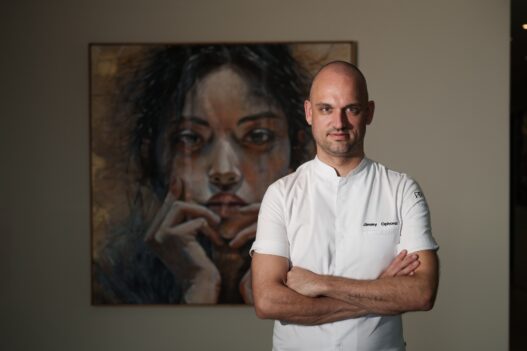
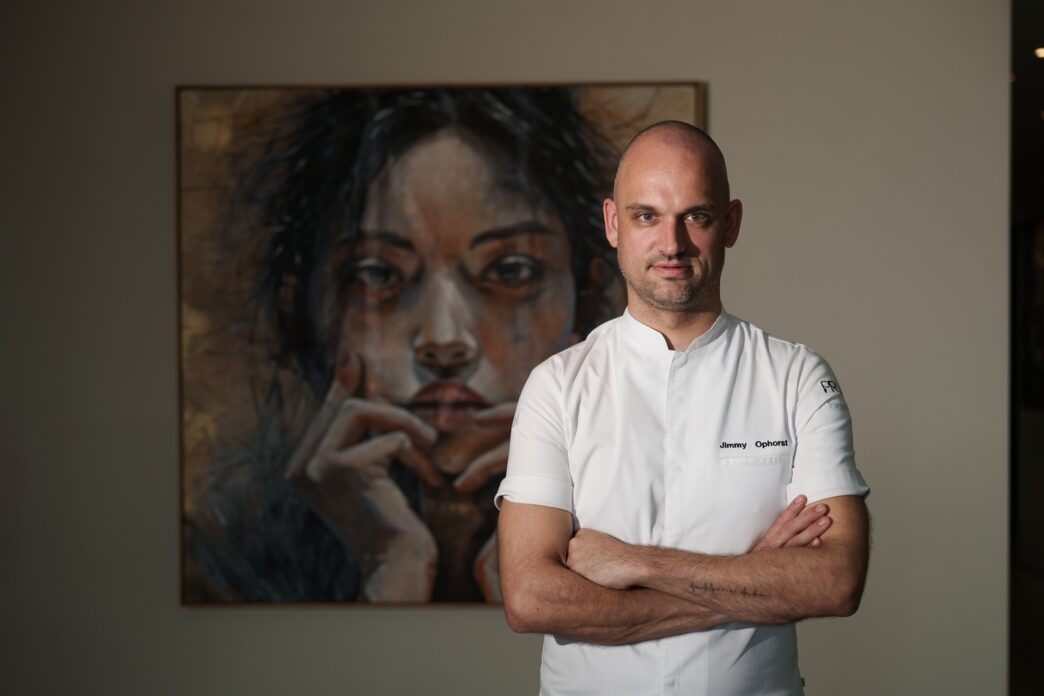
Phuket was never supposed to be a culinary destination. For decades, the island was known for the perfect curve of its beaches, the extravagance of its resorts, and the seductive pull of Pa Tong Beach at night. Nobody flew there for dinner, in fact people flew there in spite of dinner.
Then Jimmy Ophorst arrived from the Netherlands on a three-month consultancy contract, and gradually something began to shift in the way the world understood what Phuket could offer to the table.
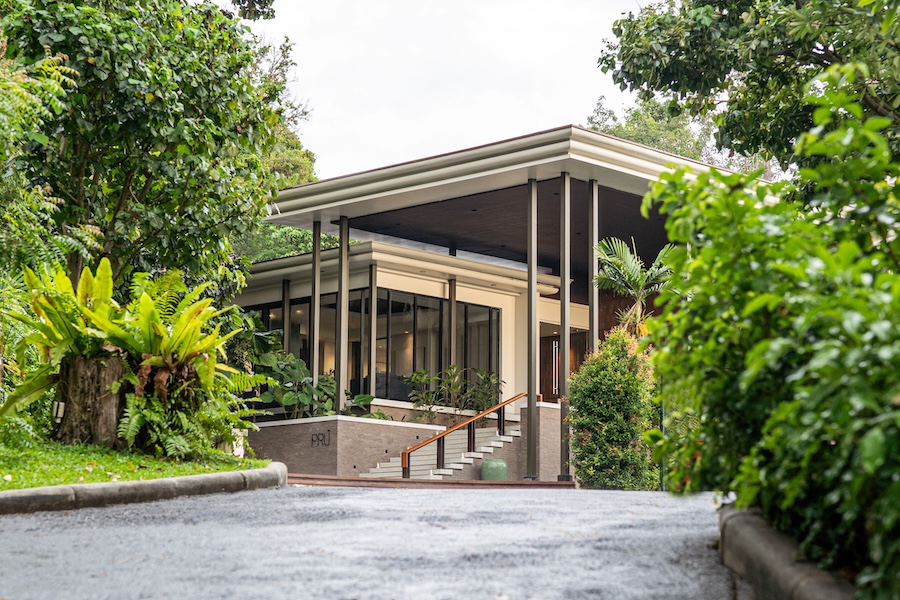
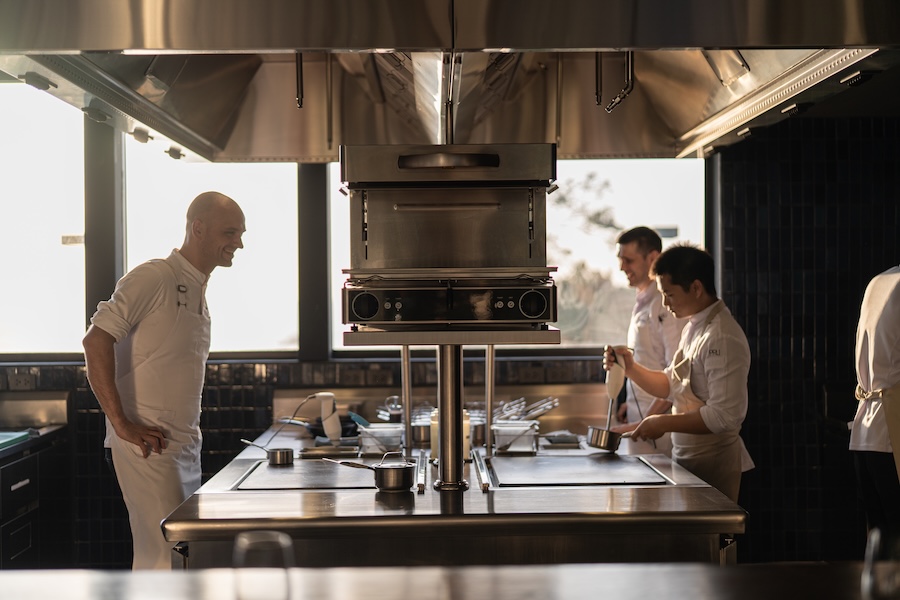
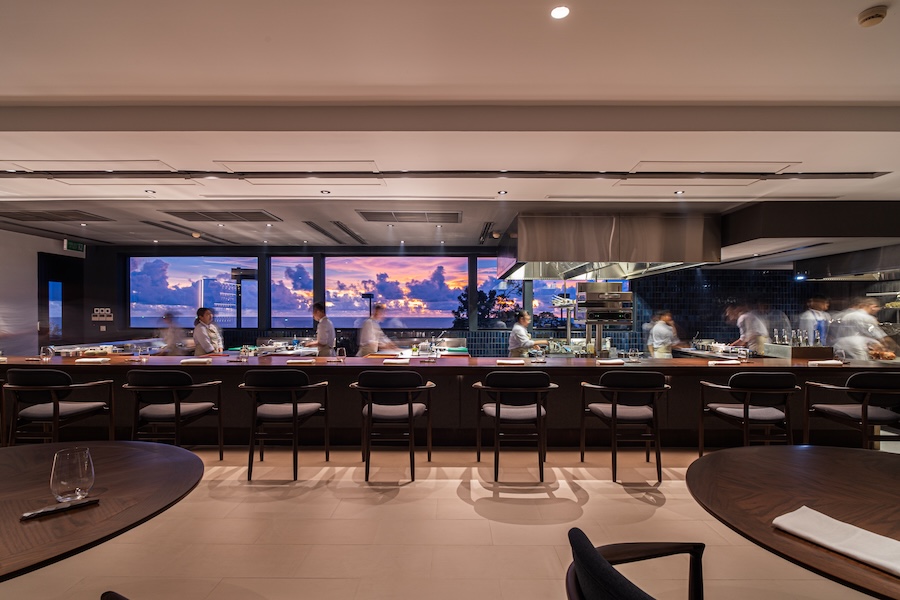
PRU (an acronym for Plant, Raise, Understand, but also a word that in Southern Thai-dialect describes the place where water and land meet and new life begins) opened in November 2016. Within two years, it had become the first and, to this day, only Michelin-starred restaurant on the island. In 2021, it added the first Michelin Green Star ever awarded in Thailand. It remains the only restaurant outside Bangkok to hold both distinctions. In 2023, it moved out of Trisara Resort entirely and into a purpose-built, solar-panelled home of its own, where the kitchen and dining room share the same air and the Andaman Sea presses against the windows like a living backdrop. A 650-label wine list. A farm four acres wide. A network of a hundred and fifty smallholder farmers scattered across the country. And at the center of all of it, a chef who never worked a day in a Michelin-starred kitchen before earning one of his own.
This is the story of a restaurant built from first principles, and a chef who understood, long before it was fashionable, that the shortest route to something truly original was the longest, hardest one.
An Accidental Beginning
Jimmy Ophorst did not grow up dreaming of kitchens. He grew up in Honselersdijk, a village in the Netherlands known for its glasshouses and its cucumbers, in a family where his mother cooked beautifully for her children but never professionally, and his father worked in IT. There was no restaurant blood, no culinary lineage, no grandmother baking bread in the kitchen. There was a boy who loved football and who, a week before a mandatory high-school internship, had arranged nothing.
“I knocked on the door of my neighbor who had a small cafeteria,” Jimmy says. “I told him: I need to do an internship, but I have nothing. Can I just help you out for a week? I come to clean the dishes. He said: okay, let’s go.”
The cafeteria became a door. Jimmy enrolled at hotel school simply because he could not decide what else to do; front of house, bartending, kitchen, he would try all of it. The first day in the kitchen was horrible. So was the second. What saved him was a teacher who demanded 200% of everything, every time. That uncompromising standard, applied to dishes that were otherwise unremarkable, was the moment cooking became something Jimmy could not walk away from.
Young Jimmy Ophorst never wanted to be a chef, but he became a Michelin-starred one. Photo courtesy of PRU.
He worked in a summer restaurant in the Netherlands until, at twenty-two, the owner announced one winter that the team was going to Thailand for three months to help set up a new restaurant at a resort called Trisara in Phuket. Jimmy had never been to Asia.
“I was up for some adventure,” he says. “Because I knew from when I was young, I didn’t really want to stay in the Netherlands.”
The three months became six, then a year back home, then a seasonal contract, then three months working for free in Bangkok at Gaggan, then a week in Geneva at the Mandarin Oriental where he felt homesick for the first time in his life. His family was in Holland, his friends and his girlfriend in Thailand, and himself in the middle of Switzerland cooking Indian food and wondering what he was doing there. The day he decided to quit Geneva, the executive chef of Trisara called him asking if he could come back full-time. He packed his luggage, took the first train to Amsterdam, collected the rest of his things, and flew to Phuket.
That was 2014. He hasn’t really left since.
A Kitchen Built By Its Absences
One of the most striking things about Jimmy Ophorst’s CV is what’s not on it.
He did not do a classical French apprenticeship. He did not stage at elBulli or Noma. He did not work in any three Michelin-starred house, nor any two-starred one, before opening his own. The closest he came to formal gastronomic pedigree was a weekend course in the Netherlands, taught by an older two-starred chef, that he needed in order to collect the professional certificates that hotel school had not given him.
This absence was strategic. “The reason I never did that,” Jimmy says, “is that when I ever had the opportunity to open something for myself, I knew it had to be something unique. If you work in a two or three-starred place for several years, you will always take something from that chef. You will be trained like him. I wanted whatever I did to come from myself.”
It’s an argument against a certain kind of cooking school-orthodoxy, the idea that greatness must be inherited through lineage, that a young chef’s value is measured by the names on his résumé, and it is made not by rebellion but by design: Jimmy chose absence the way other chefs choose mentors.
When, in late 2015, the management at Trisara asked him to help conceive a new restaurant for an empty plot on the resort’s grounds, he and the F&B director at the time began from a blank page. The Mediterranean restaurant where Jimmy had been cooking was using almost exclusively imported European produce. Guests kept asking for local fish, for local ingredients, for something that tasted like the country they had flown halfway around the world to experience. In Europe and America, the farm-to-table movement was gathering momentum. In Asia, it had barely begun. In Phuket, it didn’t exist.
“We came up with a vision,” Jimmy says. “A hundred percent local. Everything we source comes from within Thailand. And at the same time as we came up with the concept, we started to develop our farm, one year before we opened the restaurant.”
PRU opened in November 2016. The first Michelin star arrived in 2018. The Green Star followed in 2021.
The Farm That Shrank On Purpose
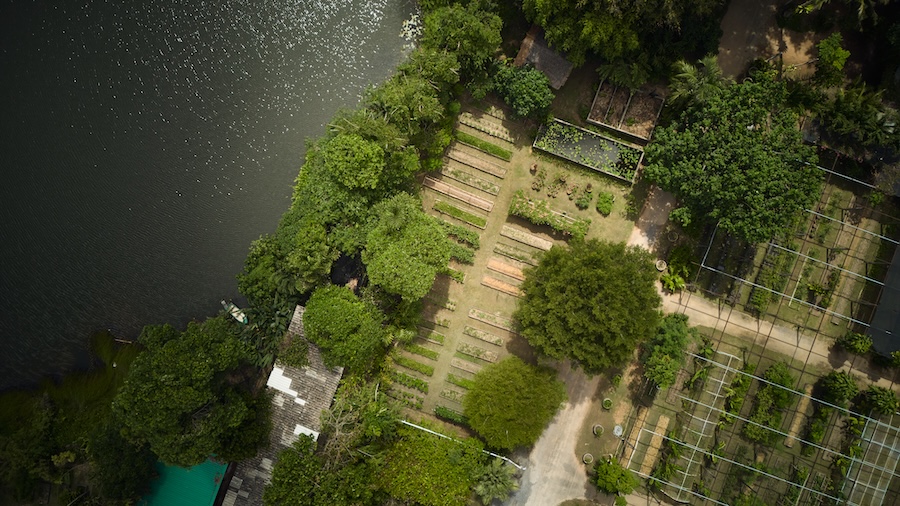
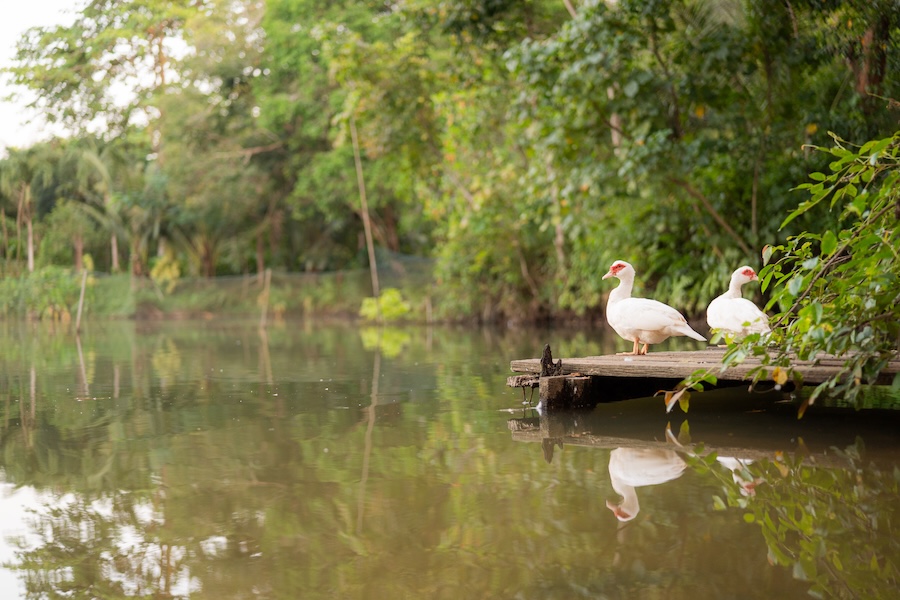
Pru Jampa, the restaurant’s farm, sits a short drive from the current dining room. It spans roughly four acres; small by industrial standards but generous for what it is asked to do. Ducks, chickens and geese live there for their eggs. Cucumbers, pumpkins, melons, zucchinis, a small orchard of mangoes and pomegranates and rose apples, and every herb and edible flower the kitchen might call for, are grown on site.
In the restaurant’s early years, Pru Jampa supplied between fifteen and twenty percent of the menu’s produce. And yet, as PRU grew, Jimmy made a counter-intuitive decision. He deliberately reduced the farm’s contribution to somewhere between three and five per cent.
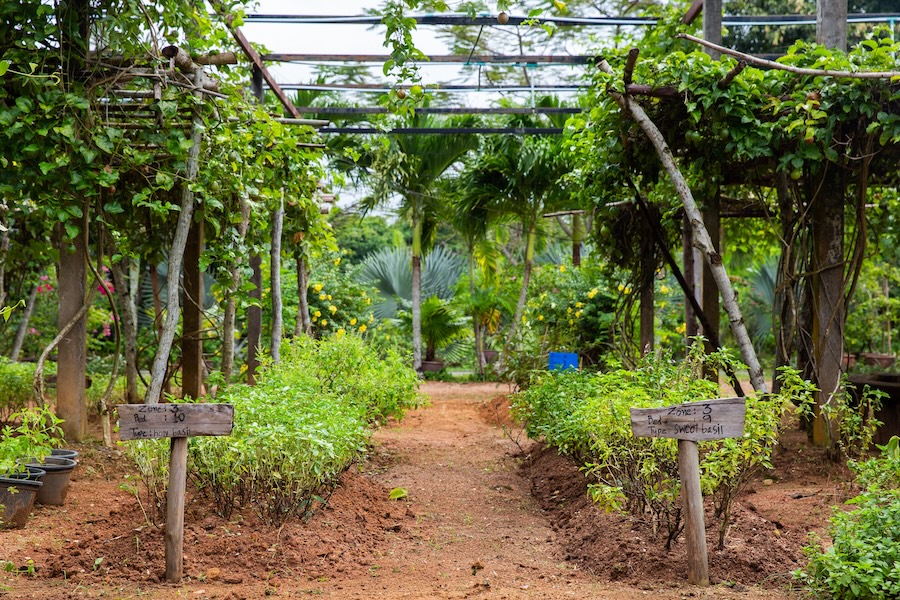
Ophorst shrank PRU Jampa to strenghten his relationship with Thai-producers and empower them. Photos courtesy of PRU.
The reasoning is revealing. Pru Jampa could, in theory, supply more. But the money that would have financed its expansion was better spent on the hundred and fifty smallholder farmers across Thailand whom Jimmy had begun to visit, one by one. He shared feedback on product quality; in his own words: “the big bold foreign guy in my best Thai, trying to talk to them.”. He encouraged them to grow organically arguing that smaller yields of higher-value produce would make them more money in the long run. When a mango grower called him in the middle of a glut, unable to sell his crop at a viable price, Jimmy would take the entire harvest: five hundred kilos, sixteen hundred kilos, whatever was there.
“By doing that,” he says, “we know that next year he can still produce. And we will be the first one he calls.”
It’s a radically different model from the closed-loop, self-sufficient fantasy that a certain kind of fine dining narrative prefers to tell. PRU is a restaurant that grew into interdependence, in service of a rural economy whose survival depends on chefs like Jimmy being willing to pay a fair price when nobody else will. It’s also, not incidentally, the mechanism by which PRU gains access to produce nobody else in the country sees. Ten kilos of a rare tropical fruit from the only two trees that bear it. A harvest of sea grapes nobody had bothered to commercialise. A sturgeon farm two hours from Bangkok, run by a Russian who raised baby Kaluga sturgeons from the Amur basin and now produces caviar young enough to carry less than three percent salt. Exactly, as it happens, the amount Jimmy needs to balance the sweetness of a durian mousse.
A Fruit That Took Six Years
The dish that greets every guest who sits down at PRU is based on durian.
This is a provocation. Durian is, for many Western palates, an almost unapproachable fruit. It is pungent, oniony, famously banned from hotels and public transport across Southeast Asia for its smell. Jimmy’s own first encounter with it, on his first day in Thailand, was “absolutely horrible.” He did not touch it again for years.
But durian is also one of Thailand’s most commercially significant exports and it sits at the center of a rural agricultural culture that Jimmy’s network of farmers depends on. A durian tree takes seven years to produce its first fruit. For those seven years, the farmer must tend the tree daily, or it dies. It is the agricultural equivalent of a vintage port: an investment so long and so fragile that only the most committed growers pursue it.
When PRU moved into its new premises, Jimmy decided the fruit had to be on the menu and that it had to be served in a way that honored it rather than hid it. The research took six years.
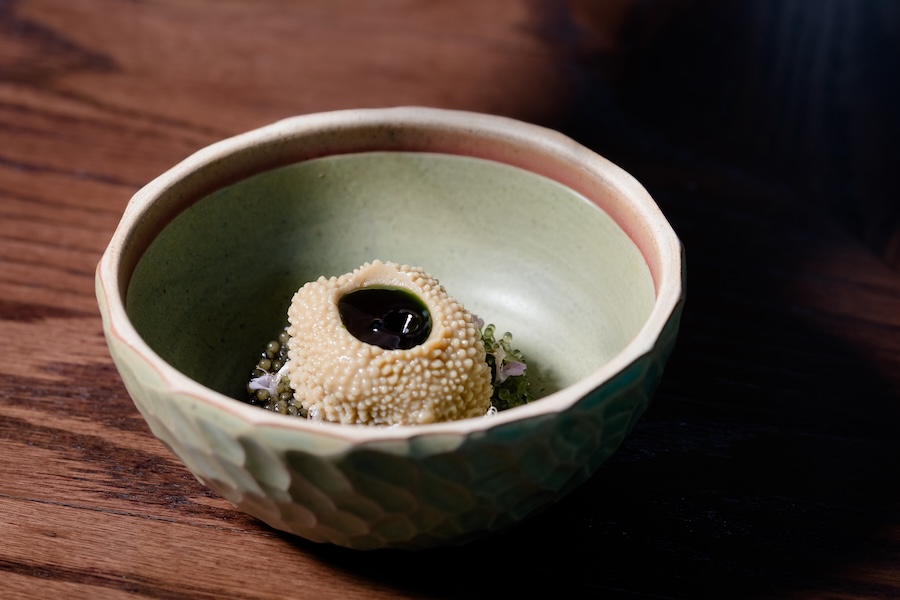
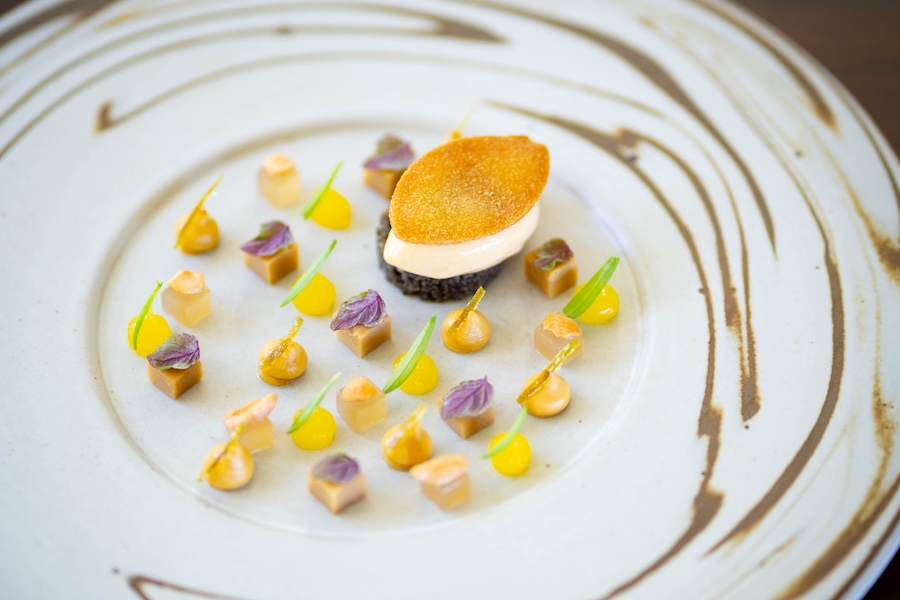
The process, finally, is elegantly elaborated. Durians are harvested underripe, then allowed to ripen indoors until they pass peak smell and enter an overripe state because, counter-intuitively, the volatile sulphur compounds that produce the famous stench dissipate once the fruit tips past its peak. The overripe fruit is then baked whole in a wood-fired oven for eight to twelve hours, smoked for a further ninety minutes, and the flesh is folded into a silky, frozen mousse. It’s served with the locally farmed Kaluga caviar and with sea grapes, a tiny marine algae that bursts with salinity, to balance the sweetness and bring the dish into dialogue with the sea that lies just beyond the window.
The flavors are intense, the ingredients unfamiliar, the combinations sometimes startling. This is not modern Thai cuisine as it is understood in Bangkok’s fine dining scene. Nor is it European cooking dressed in tropical costume. It’s something harder to name, and the chef himself doesn’t even try.
“I’m still struggling when people ask me what we cook at PRU,” he says. “We take pride in unknown and rare tiny ingredients, prepare them in our own very unique way with some modern European techniques behind it. From shrimp paste to lobster. It’s a very unique concept.”
Duck, Wine, and What Isn’t On The Menu
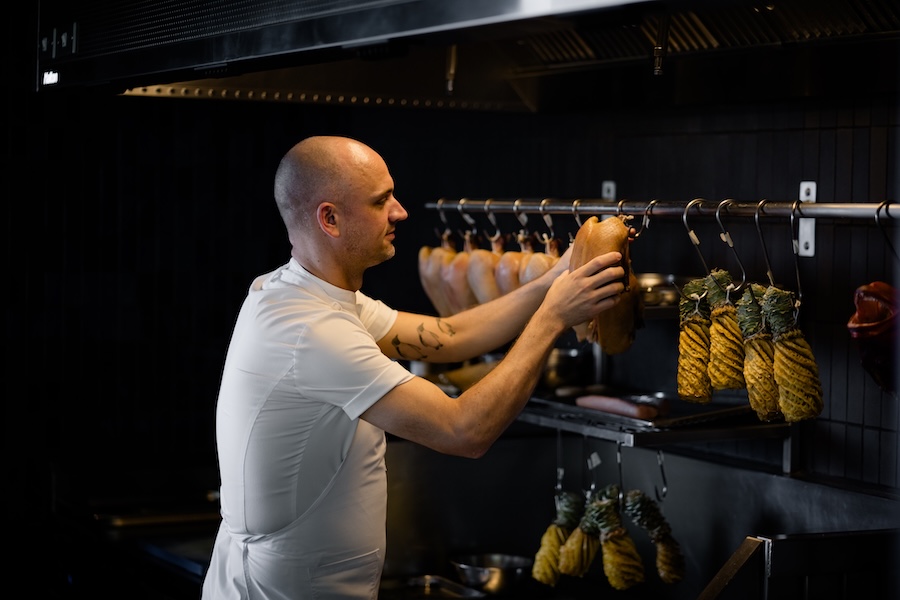
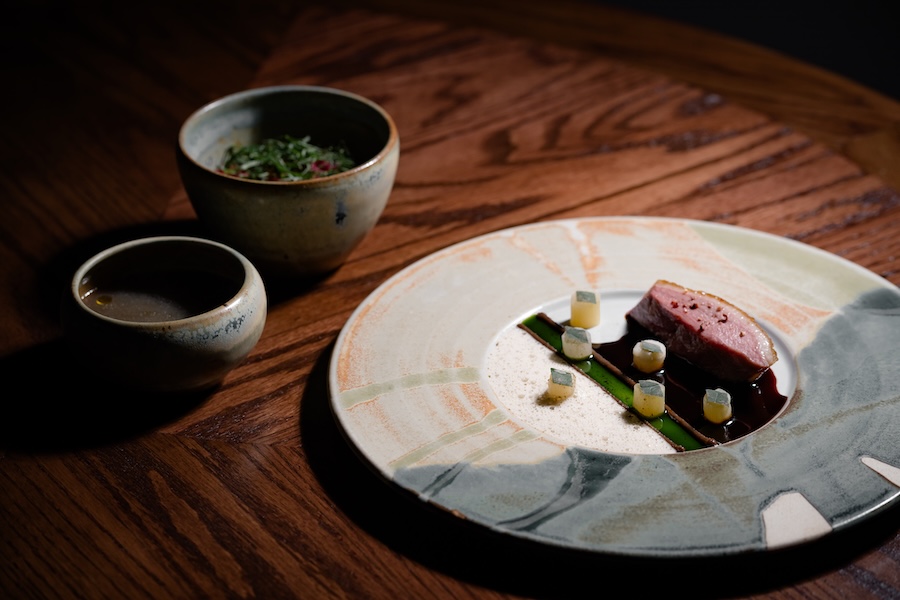
Alongside the durian, one other element of the PRU experience has remained constant: the duck. Jimmy doesn’t serve beef, because the quality of Thai beef does not meet his standards and because, in his view, wagyu is available in every fine dining room in the world. He will not serve pork, out of respect for guests whose faith precludes it. What remains, as the restaurant’s protein of choice, is a locally raised hedge duck which Jimmy considers the finest meat protein Thailand has to offer. The condiments around it change with the seasons. The duck itself stays.
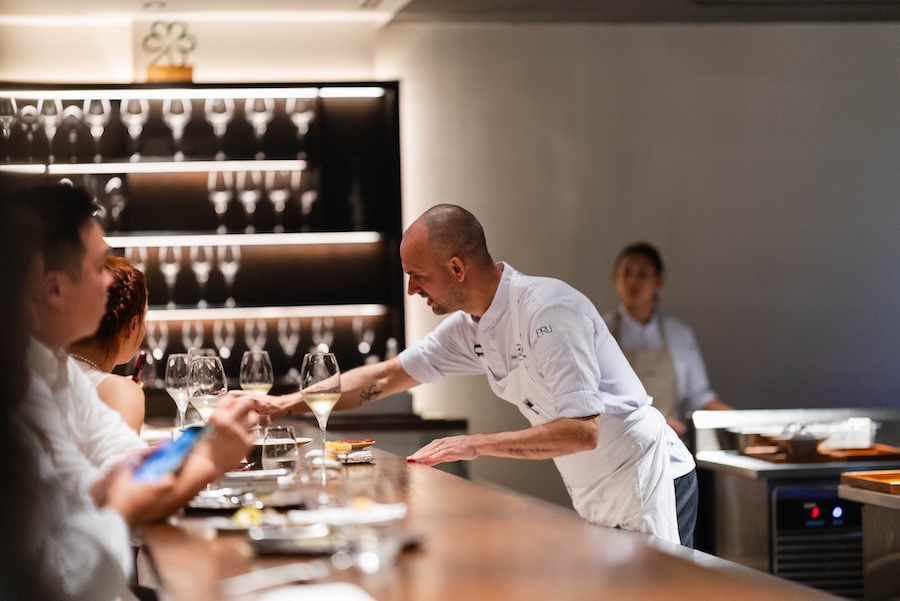
The beverage programme is where PRU’s ambition asserts itself at a different register. The wine list carries six hundred and fifty labels. Jimmy, personally, is deeply involved in curating it. Two pairings are offered. The Discovery pairing leans toward the New World and includes one of his personal favorites, a Château Musar from Lebanon that, in his telling, he lights up when mentioning. The Cellar Selection changes according to what the cellar has to offer on any given week, with a focus on back vintages and serious labels from France, Italy and Bordeaux. The non-alcoholic pairing is handled by the kitchen rather than the beverage team, therefore flavors are combined with the same technical logic as a dish, and it includes tea infusions, vegetable juices, or a zero-alcohol wine produced by a local Thai winery.
A Chef Who Stopped Moving
Many chefs travel the world before they settle, but Jimmy Ophorst left the Netherlands at twenty-two and has built his entire culinary identity inside one country, on one island, in dialogue with one network of growers and one resort umbrella.
“I always saw myself growing up outside the Netherlands,” he says. “I went to South Africa. I’ve been to the Caribbean. They were nice, but not to settle. Then I ended up in Phuket, and it was something I’d never seen before.”
What he had never seen before was a place where, in his words, “people believe that if you do good, you will get good.” Where the pace was gentler, the environment safer, the texture of daily life less harassed by the European imperative that nothing is ever enough. He met his wife there; she is Thai, originally from Surat Thani but Phuket-adopted for nearly two decades. They have a son. And the restaurant that was conceived as a platform for Jimmy’s vision has, over time, become a platform for something larger: a way of honouring the island that has given him a home.
The Next Chapter
PRU turns ten in 2026. To mark the anniversary, Jimmy is extending the restaurant’s current building to accommodate a new private chef’s table and converting an existing private room into a second one. The dining room is evolving. So is the ambition.
“My long-term ambition,” he says, “is for people across the globe to travel to Phuket specifically to dine at PRU.”
It’s a bold statement, but it is the logical next step for a restaurant that has spent a decade building the foundation beneath it. The farm. The farmer network. The wine cellar. The Michelin star. The green star.
When guests finish a meal at PRU, what they encounter is not a recognisable culinary tradition rendered at a high level. It’s something that couldn’t have been made anywhere else, by anyone else, with any other network of growers.
It’s tropical terroir at its very best.
PRU: 60, Cherngtalay, 13 Srisoonthorn Road, Cherngtalay 1, Tambon Choeng Thale, Thalang District, Phuket 83110, Thailand. www. prurestaurant.com

Worth booking the wine pairing alongside the tasting menu, or is the food strong enough on its own?
Adding it to the itinerary for the December trip. Thanks!!!
Made it on a girls’ trip to Phuket last spring and the wine list alone justified the flight, every pour pairing locally with the season.
Knowing he learned from the farm forward instead of from a brigade up tells you why the food at his restaurant tastes different. Worth the drive from Bangkok if you make it down.
My partner and I stayed at Trisara back when PRU still operated out of the resort and the tasting menu there changed the way I think about Thai fine dining for good. You can taste the four-acre farm in every course, this article gets at that. The 2023 standalone building was on my list to revisit but I haven’t made it back yet, queueing it up for Phuket next year.