
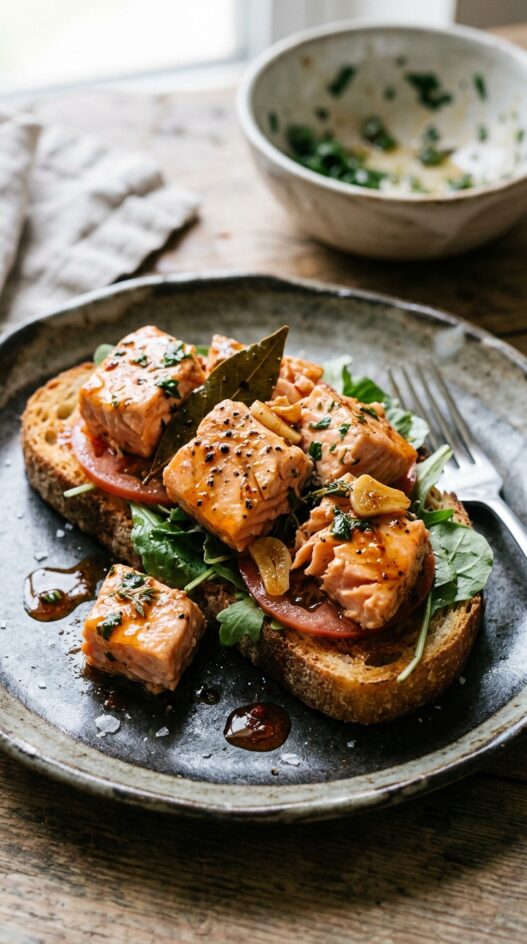
I’ve said it before, I’m a real fan of salmon. It’s a flavorful fish and very versatile, either smoked or fresh. And besides it’s an oily type of fish, brimming with healthy fatty acids. On the other hand, I love those dishes you can keep for several days and that get even better after some time, like escabeches, which by the way are incredibly easy to prepare. There are thousands of escabeche recipes, buy for salmon I always turn to the recipe by 3 Michelin starred Spanish chef Martín Berasategui, from his book Cocina en casa con Martín Berasategui. Of course it’s tweaked a tiny bit… couldn’t help myself. This escabeche is the type that includes sweet Spanish pimentón (similar to paprika, but not the same), like the recipe used for the ubiquitous canned mussels in escabeche, different from the one I use for tuna fish.
I like that this very old preservation method, said to originate in ancient Persia, from where it spread all over the Mediterranean to end up as a dish identified as genuinely Spanish, can help us to make refined tapas today. And as this salmon escabeche can be made in advance, it is perfect for a tapas party.
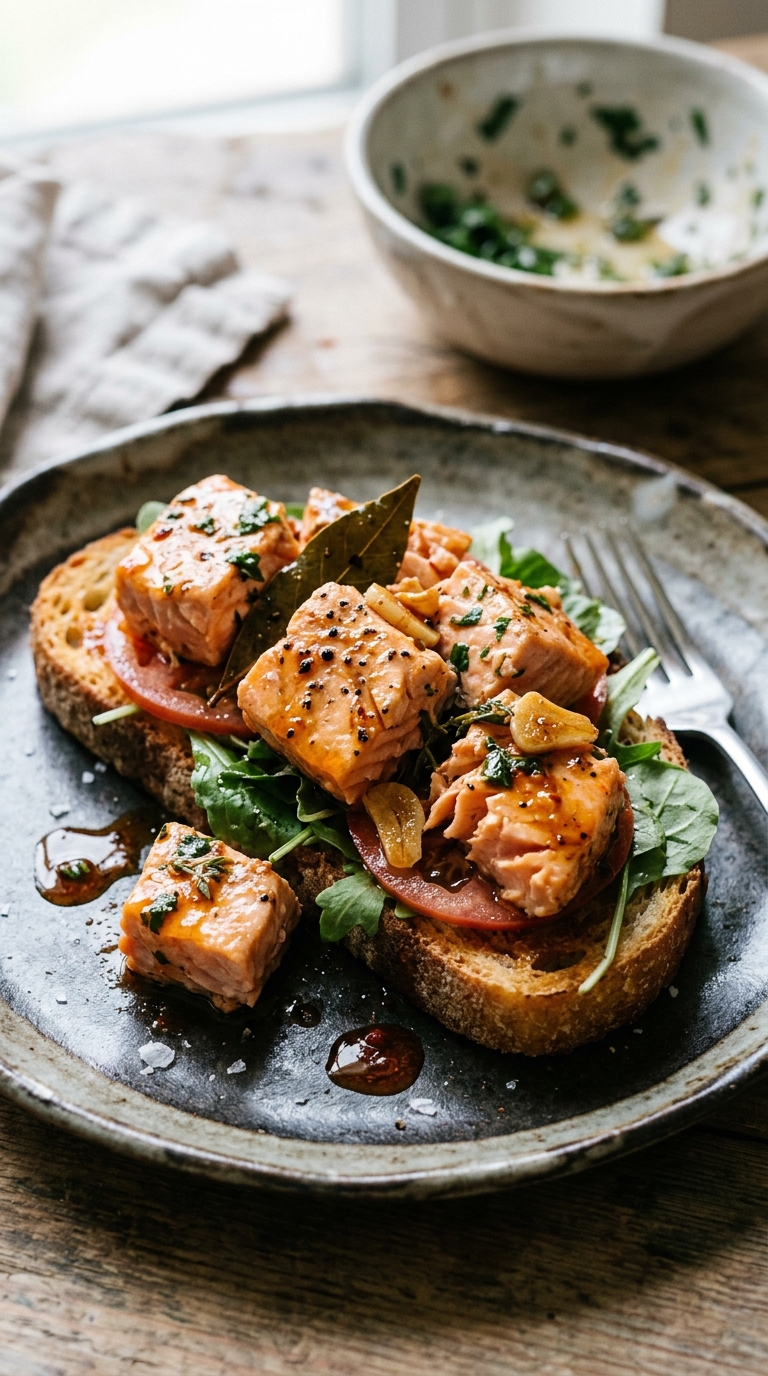
My dear Mr. Berasategui lacks restraint because he instructs to eat the salmon immediately, just after cooling. But I prefer to leave it to rest overnight, just because I have more self-control… ahem. Now seriously, I believe this type of dish needs some time for the flavors to soak into the fish. It easily keeps one week or even longer in the fridge. Escabeche is always eaten at ambient temperature, always let it warm up to ambient. This escabeche is simply delicious as a tapa or pincho on toast with some finely sliced tomato and some greens. It’s also brilliant flaked on a salad, on top of boiled and sliced potatoes… just feel free to experiment!
Print
School of tapas: Salmon escabeche
- Total Time: 35 minutes
- Yield: 8 servings
Description
Salmon cooked in wine, olive oil, vinegar, and pimentón, served on toast as a refined Spanish tapa.
Ingredients
- 2 lb (1kg) fresh salmon, cut into chunks
- 2 tbsp coarse salt
- 1 tbsp black pepper grains
- 4 bay leafs
- 10 sprigs parsley, chopped
- 2 sprigs thyme (I used plain dried leaves, a couple of pinches)
- 2 cloves
- 2 tbsp sweet Spanish pimentón (I strongly recommend you to go for the real thing, the flavor is very distinct)
- 2 cups (0.5l) virgin olive oil (please, don't use any. Other. Type. Of. Oil)
- 2/3 cup (1.5dl) cider vinegar
- scant 1/2 cup (1dl) good white wine (Berasategui doesn't include wine, but I like it!)
Instructions
- Cut the salmon into cubes (2″-3″ pieces) and lay them in a shallow pot, large enough to keep the salmon in one layer. Avoid metallic pots as they can react with the vinegar.
- Sprinkle the salmon with coarse salt, black pepper grains, bay leaves, chopped parsley, thyme, and cloves.
- In a separate bowl, mix the olive oil, white wine, cider vinegar, and sweet pimentón. Pour this mixture over the salmon.
- Place the pot over medium heat and bring the mixture to a gentle simmer. Cook for about 20 minutes, or until the salmon is just cooked through.
- Remove the pot from heat and let the salmon cool in the marinade. For best flavor, cover and refrigerate overnight.
- Before serving, let the salmon come to room temperature. Serve as a tapa on toast with finely sliced tomato and greens.
Notes
- This dish improves in flavor if left to rest overnight, allowing the flavors to soak into the fish.
- It can be stored in the fridge for up to a week.
- Always serve at room temperature.
- Try serving on toast with tomato and greens, or flaked over a salad or boiled potatoes.
- Prep Time: 15 minutes
- Cook Time: 20 minutes
- Category: Appetizer
- Cuisine: Spanish
Nutrition
- Serving Size: 1 serving
- Calories: 250
- Sugar: 0 grams
- Sodium: 600 mg
- Fat: 18 grams
- Carbohydrates: 2 grams
- Fiber: 0 grams
- Protein: 22 grams
- Cholesterol: 55 mg
Try another great Spanish recipe – Padron Peppers – here.
If You Liked This Recipe, You’ll Love These
- Soldaditos De Pavía: Spanish Codfish Fritters
- Vodka-Cured Salmon with Juniper and Rosemary
- Spanish Tapas: How to Make Crispy Roasted Patatas Bravas
- Smoked Salmon Cream Cheese Bruschetta
Frequently Asked Questions
Should I eat the salmon right after it cools or let it rest overnight?
Chef Berasategui’s original recipe says eat immediately after cooling, but I prefer to leave it overnight because the flavors need time to soak into the fish. It keeps easily for a week or longer in the fridge.
Why can’t I use a metallic pot?
Avoid metallic pots because they can react with the cider vinegar in the marinade, giving the salmon an off metallic taste. Use a non-reactive pot such as enameled cast iron, ceramic, or glass.
What is sweet Spanish pimentón and is regular paprika a substitute?
I use 2 tbsp of sweet Spanish pimentón, which is similar to regular paprika but with a very distinct flavor. I strongly recommend using the real thing. If unavailable, sweet smoked paprika is the closest substitute, though the character will differ.
How should I serve the finished escabeche?
Always let the salmon come to room temperature before serving — never serve it cold from the fridge. I love it as a tapa on toast with finely sliced tomato and greens, flaked over a salad, or on top of boiled sliced potatoes.


Would this work with trout instead of salmon?
Trout is a good swap. It has enough fat to stand up to the vinegar in a way a lean white fish does not. The fillets are usually thinner, so take a minute or two off the cooking, and start tasting after a day rather than two since it takes the flavours on faster.
Good after a couple of days in the fridge, though mine came out sharper than i expected. How long do you usually leave it before eating?
Overnight is the minimum and two days is about the sweet spot Tony. Past three it does keep sharpening, since the vinegar carries on working. Letting it come up to room temperature before serving takes a surprising amount of the edge off as well.
OK this converted me on pickled fish!
Hi Miriam, how long will this keep in the fridge once its made?
Three or four days, and it is better on day two than on the day you make it. Keep it covered in its own liquid, and take it out of the fridge half an hour before you serve it.
Is this eaten cold?\
I just put up your recipe and used leftover Dover Sole. It’s beautiful, and I didn’t taste the fish! I swear! I’m gonna let it sit for a couple of days. I use both Spanish Paprikas; the smoked and the “sweet”. I live in the bush in Alaska, so I have to rely on things I have put up in the Summer. SO! I used Dried Onion, dried carrot, and homemade Red Wine Vinegar.
Man! This is gonna be good!
I love your site…I’ll be lurking around for a bit!
Hi Andi, sometimes I really loooove globalization… just the thought of someone in Alaska making my Spanish escabeche makes me smile, to say the least, and think that all is not lost ;) Great use of a homemade vinegar, BTW.
Me ha encantado su blog, buenisimas recetas, uno de los mejores blogs de cocina que he visto ultimamente ….la pregunta, por que no en espanol tambien?
Never had pickled salmon before but so good and tangy, i am a convert. Made a batch to keep in the fridge, thanks!
I’m struck by how similar the word escabeche is to ceviche. Although the preparation is different, I wonder if there’s a connection? Looks lovely – I’m a fan of salmon too.
Both could indeed be related, according to the Spanish Language Royal Academy. The source for “escabeche” is Arabic… Check it out here: http://en.wikipedia.org/wiki/Ceviche