
I was a Ramen virgin for a long time. It wasn’t until I watched Hikaru No Go, a Japanese anime that my brains processed its existence. Who said cartoons were bad for you. They can totally give a world view of things.. in this case, of noodles.
The main character Hikaru, who loves Ramen, often goes to a Ramen place. He slurps the noodles loudly and that noise would get me every time. It always made me wonder just how good Ramen is.
However, due to the insufficient amount of space in my tummy, I never bothered to explore Ramen. Most of the space was already occupied with Malaysian, spicy food. But then, as if the Ramen Gods thought it was time, I had the most life changing conversation in my life. With my bro in law.
Ironically, we were sitting at an Udon place eating Udon noodles. At that time, I only had my eyes on Udon. He proceeded to give an inspirational Ramen speech. A speech that trumps even the greatest speech on earth. It moved me. Not to tears, but to eat my very first bowl of Ramen Noodles soon after.
I think I nearly died. I was hooked. Totally obsessed. A ramen freak.
Instant noodles were a big part of my life… until I quit. But I’ve not been able to fill that void. That chewy, bouncy noodles void. Then, there was Ramen.
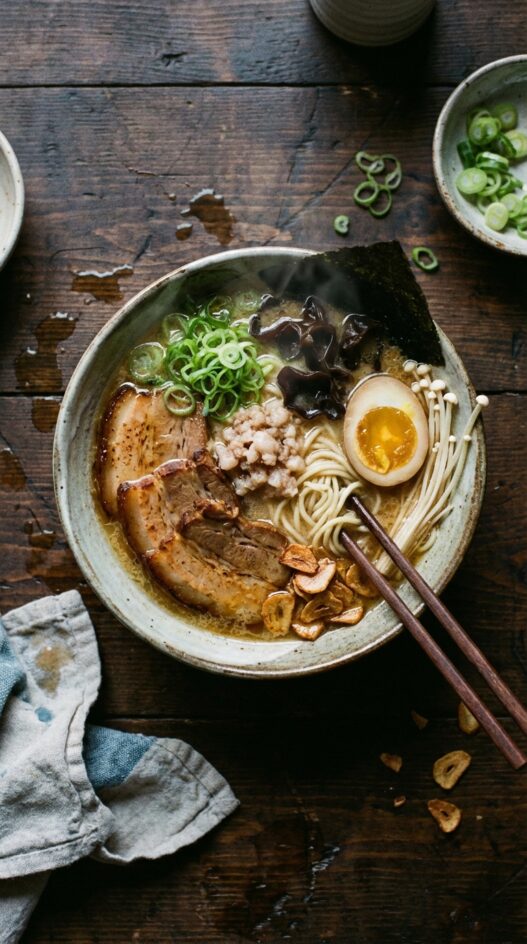
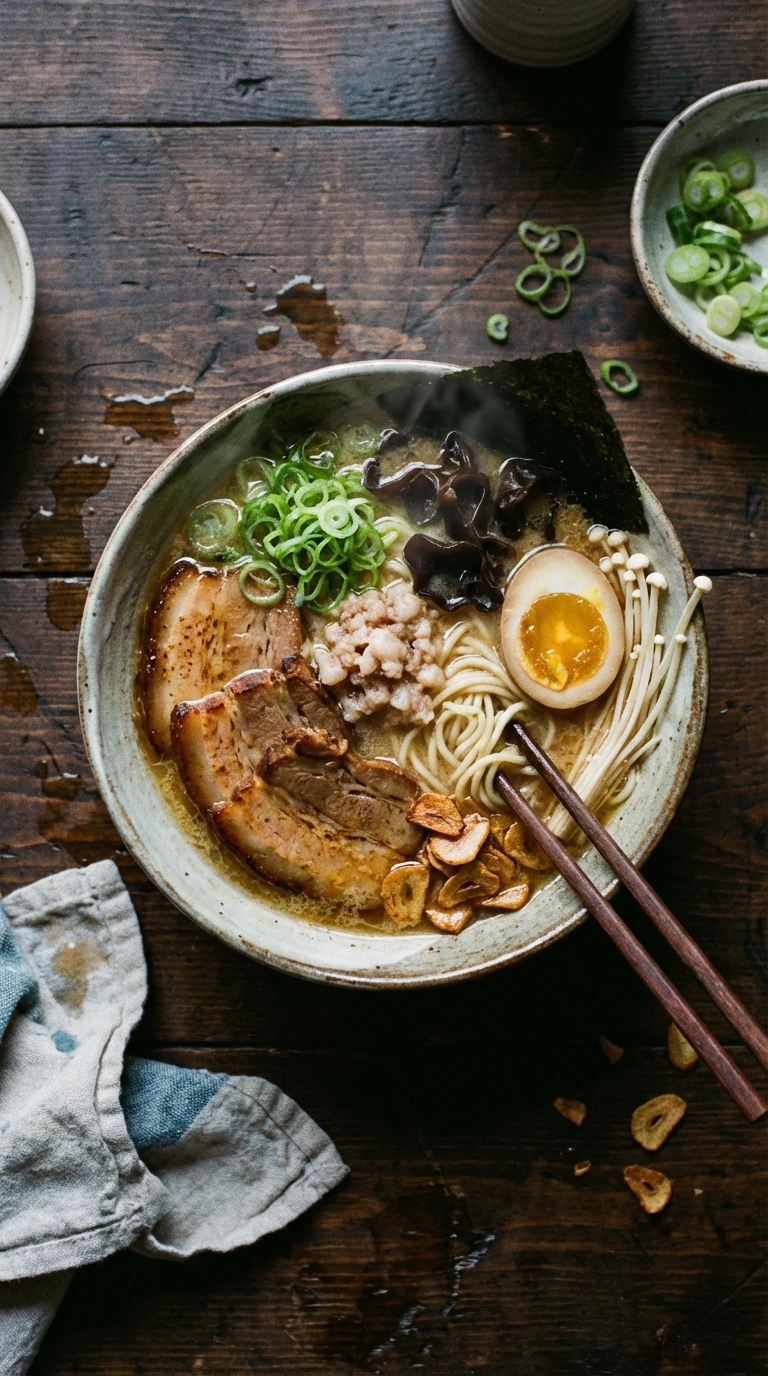
Nutrient dense rich, delicious broth made from bones, fat and marrow of both chicken and pork that leaves a sticky sheen of gelatin gloss on your lips as you devour them. Tiny fats swimming in the surface ommph the umami factor with fresh chewy and bouncy noodles, ‘soft yolk’ eggs and slices of thin, melt in the mouth pork belly.
Aaah… this is the ultimate comfort food.
The trick to a superb broth is:
1. Both chicken and pork is used along with onions, garlic, leeks and mushrooms.
2. Not only bones are used, but fats, collagen and marrows are used to make it gelatinous and give it its depth in flavor.
3. Broth has to be simmered for 6 – 12 hours. The longer the time, the more gelatin develops in the soup.
4. As for color, if you like your broth to be white, you will have to wash the bones off any bits of dark marrow or coagulated blood.
Print
Homemade Tonkotsu Ramen
- Total Time: 750 minutes
- Yield: 6 servings
- Diet: Omnivore
Description
Rich, comforting ramen, made from scratch. Learn the secrets to the perfect broth and delicious toppings.
Ingredients
Broth:
- 5 oz (142 g) pork fat
- 4 lbs (1814 g) pig hocks and/or trotters, cut into small pieces
- 2 lbs (907 g) chicken backs, cut into small pieces
- 1 lb (454 g) chicken feet
- 1 large onion, peeled and slit around the middle
- 1 whole head garlic
- 2 inches fresh ginger, sliced
- 1 leek, sliced
- 15 green onions, white parts only, cut in half
- 5-8 slices white oyster mushrooms
Pork belly (chashu):
- 1 1/2 lbs (680 g) slab boneless pork belly, rolled and secured with string
- 1 cup (237 ml) water
- 1/2 cup (118 ml) soy sauce
- 1 cup (237 ml) white grape juice
- 1 tsp lemon juice
- 2 tbsp sugar
- 5 green onions, halved
- 1 whole head garlic, bruised
- 2 inches fresh ginger, sliced
- 2 whole shallots, halved
- 1/2 tsp whole black peppercorns
Marinated eggs:
- 3 eggs
Noodles:
- 2 lbs (907 g) fresh ramen noodles, cooked according to package directions
Seasoning and toppings (to taste):
- Mayu (black garlic oil), to taste (see notes)
- Salt, to taste
- Soy sauce, to taste
- Tahini, to taste
- Miso paste, to taste
- Garlic and shallot oil, to taste
- Sesame oil, to taste
- Enoki mushrooms, blanched in hot broth
- Black fungus mushrooms, blanched in hot broth for a couple of minutes
- Green parts of the broth green onions, thinly sliced
- Nori (sushi seaweed), cut into 4-inch squares
- Garlic, sliced and fried until crispy
Instructions
Broth:
- Place the chicken, pork bones, and pork fat in a large stock pot. Add enough water to fully cover. Cover and bring to a boil over high heat.
- Drain the bones and wash off any dark marrow or coagulated blood under cold water.
- Rinse the pot, return the bones, and add the remaining broth ingredients. Add water to barely cover. Cover and bring to a boil over high heat.
- Simmer covered on low for 6–12 hours on the stove, or 12–18 hours in a slow cooker. Check the first 10–15 minutes to ensure it is barely simmering.
- During the last 30 minutes to 1 hour, place the 5 oz of pork fat in a sieve set in the broth; cover and cook. Drain the fat and finely mince it.
- Skim some or all of the fat from the finished broth (easiest after refrigeration).
Pork belly (chashu):
- Preheat the oven to 250°F (121°C). Place the pork belly in a saucepan, add water to cover, and bring to a boil.
- Drain and remove any scum.
- Return the pork belly to the saucepan with the remaining chashu ingredients. Cover and bring to a boil over high heat.
- Transfer to the preheated oven and cook for 5 hours, shaking the pan every hour to ensure even coating.
- Insert a skewer — if there is no resistance, it is ready. Cook longer if desired.
- Cool completely, then chill in the refrigerator (with the eggs) so the pork absorbs more flavor and is easier to slice.
- When ready to serve, cut the strings, slice the pork, and briefly reheat in hot ramen broth.
Marinated eggs:
- Bring enough water to cover the eggs to a boil in a saucepan.
- Reduce heat to medium, gently add the eggs, and simmer for exactly 6 minutes.
- Drain and peel the eggs under cold water.
- Place the peeled eggs in the cooled chashu braising liquid. Soak a paper towel in the liquid and drape it over the eggs to keep them submerged. Marinate for 4–12 hours in the refrigerator alongside the pork belly.
- When ready to serve, carefully slice the eggs in half and briefly warm in hot ramen broth — do not overheat.
Assembling:
- Bring the broth to a boil and add seasoning gradually to taste.
- Arrange noodles in a bowl and add sliced chashu, a halved marinated egg, minced pork fat, and your choice of toppings and garnishes. Serve immediately.
Notes
For mayu (black garlic oil), slowly cook a whole head of garlic in oil until the cloves are deeply charred, then blend smooth. The broth can be made 2–3 days ahead and refrigerates well; the fat cap that forms on top is easy to skim.
- Prep Time: 30 minutes
- Cook Time: 720 minutes
- Category: Main Course
- Method: Braising
- Cuisine: Japanese
Nutrition
- Serving Size: 1 large bowl
- Calories: 700
- Sugar: 10
- Sodium: 1500
- Fat: 40
- Saturated Fat: 15
- Unsaturated Fat: 20
- Carbohydrates: 60
- Fiber: 5
- Protein: 40
- Cholesterol: 200
Frequently Asked Questions
How long does it take to make tonkotsu broth from scratch?
The broth requires at least 6-12 hours of simmering — kept at a bare simmer rather than a rolling boil — to achieve the thick, milky texture.
Why do you need to blanch the bones first?
Blanching removes blood, dark marrow, and impurities that cause a grey, murky broth. A clean boil after blanching produces a clearer, better-tasting stock.
Can I make tonkotsu ramen broth in a pressure cooker?
Yes. A pressure cooker can achieve a similar milky consistency in 3-4 hours. The result is close to the stovetop version but the flavor is slightly less developed.
What toppings are traditional for tonkotsu ramen?
Chashu pork, soft-boiled marinated eggs (ajitsuke tamago), nori, bamboo shoots (menma), green onions, and black garlic oil are all standard toppings.
Can I freeze tonkotsu broth?
Yes. Cool completely and freeze in portions for up to 3 months. The fat will solidify on top; skim it or stir it back in when reheating.
If You Liked This Recipe, You’ll Love These
- How to Make Birria Ramen
- Fried Rice with Kimchi and Pork Belly
- 15-Bean Soup with Smoked Pork and Greens
- Homemade Egg Drop Soup




Is this a creamy soup base?
It is, and no cream in it at all!
Homemade Tonkotsu Ramen is great! This is my family’s favorite food, it’s great to be able to prepare them at home for everyone to enjoy. Thanks for your detailed tutorial, I just need to follow and everything is easy. Thank you so much
Happy to hear it, Thomas!!
I would like to make this one day
You definitely should try it!
I love to cook. I’m always looking for new recipes for my menu, which makes me always interested in my work. Today’s my lucky day, Homemade Tonkotsu Ramen is great, just follow the instructions and everything is easy, I like that. Thanks for your sharing
Thanks Williams!
Well ramen!!! One of my favorite Japanese dish, nice to see your recipe, easy to follow, will cook this for family this weekend.
Too quality for a bowl of noodles like this. I will cook for the whole family for breakfast
Thank you.
Great stuff!
Something that seems weird to me is that you don’t use salt in the stock at all. Is that correct? Why? Is just that I always use salt in any stock. Thank you!
The tare (seasoning base) and toppings bring the salt. If you salt the stock itself you lose control of the final seasoning per bowl. It’s a ramen convention — broth stays unseasoned, you season at assembly.
Thank you for the attention to detail. I can practically taste it. There is respect and love in this recipe
What do you mean by putting pork fat in the broth to boil? Pork fat from what?
Usually fatback or trimmings from pork belly. Ask a butcher for pork fat scraps — most give them away cheap or free. It emulsifies into the broth during the long boil, and that’s what makes tonkotsu creamy rather than just clear.
What ramen noodles do you use?
Have you tried to make a vegan ramen broth? Any ideas on how to go about it?
Can I replace everything pork with chicken?
Yes you can Ayman, but it will get a different flavor profile.
I cannot wait to try this!! I moved back to the states after 7 yrs in Japan, and miss ramen with every part of my soul! Thank you so much for this??
Do u put pork fat back in finished broth? It seems a little chunky. Thanks!
Can the tonkatsu broth be made in advance? And if so how long do you think it would keep in the fridge?
Yup. The broth most definitely can be made in advance. I’d say a few days in the fridge. I always make a big batch and freeze it in batches. I then thaw and reheat whenever I want. Hope this helps.
3-4 days in the fridge easily, or freeze it for months. The fat cap on top actually helps preserve it. Just skim and reheat gently when you’re ready to serve.