



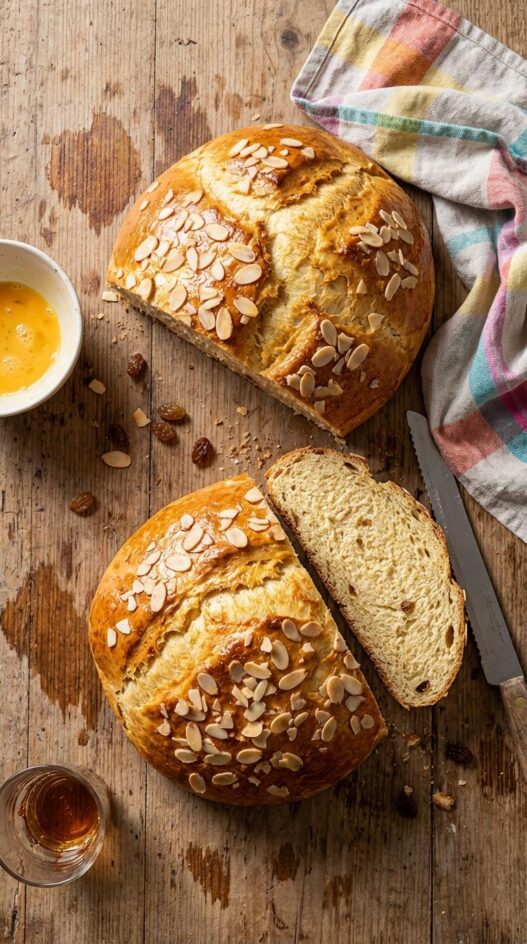
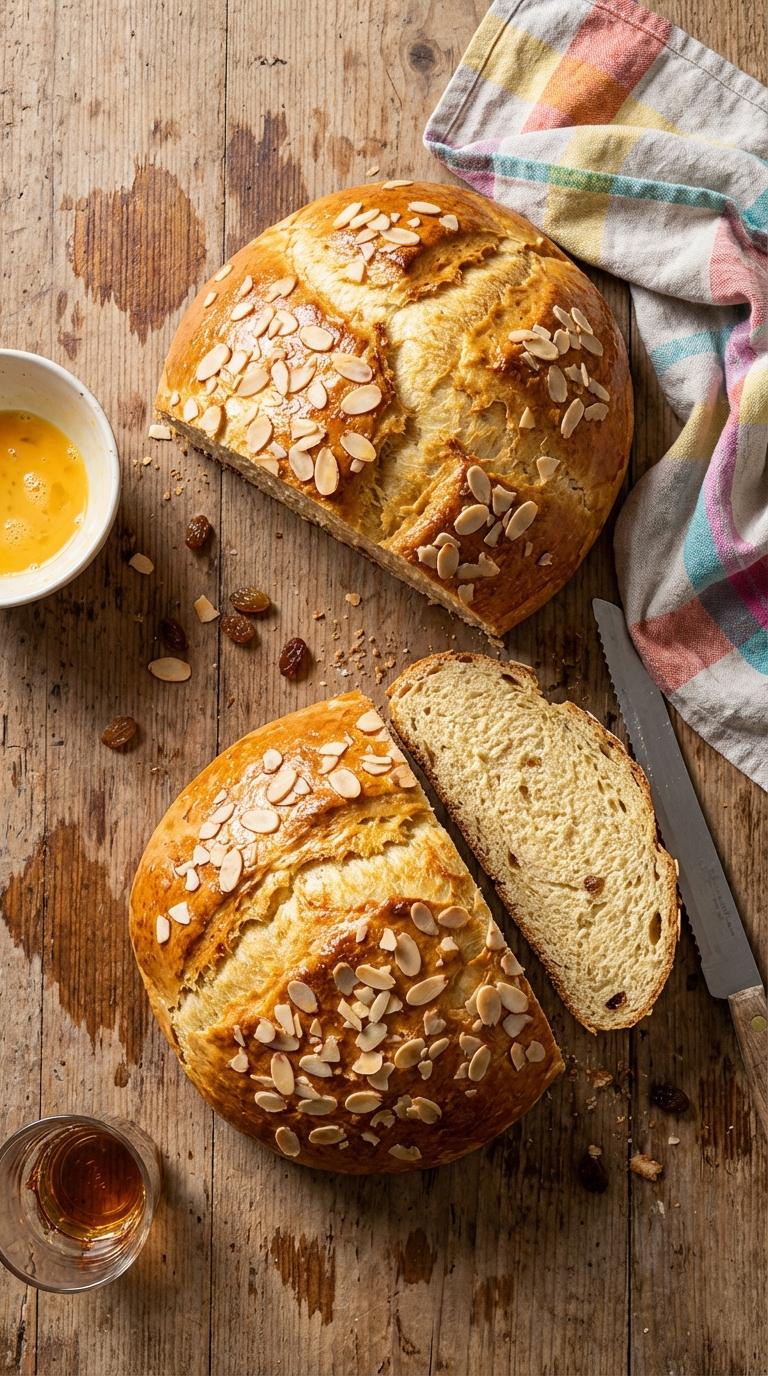
In Czech households, Easter starts with mazanec on the table. I learned this bread from a friend in Prague who was particular about one thing above all else: the raisins must soak in rum overnight. Not for an hour, not for two. Overnight. She was right. That long soak changes the raisins completely, turning them plump and fragrant with rum that bakes into the crumb of the bread.
Mazanec is a sweet yeasted dough, simpler than it looks. You shape it into rounds, brush with egg wash, scatter almonds on top, and bake until golden. It is breakfast bread, afternoon bread with coffee, or a base for leftover ham sandwiches. Two loaves come from one batch, which works out well because the first one rarely survives the day.
How to Make Mazanec: Czech Easter Bread
Soak the Raisins Properly
Pour 4 tablespoons of rum over 150 g (5 oz) of raisins and stir well. Cover and let them sit for at least 4 hours, ideally overnight. Drain any excess rum and fold the raisins into the dough gently. 
Do not skip this step.
Use Fresh Yeast If You Can
Fresh yeast gives mazanec its traditional rise and flavor. If you cannot find it, substitute 14 g (0.5 oz) of active dry yeast for the 42 g of fresh yeast called for here. Dissolve it in the lukewarm milk with a pinch of sugar and wait until it froths.
Shape Round and Score the Top
Divide the dough in half and shape each piece into a tight ball. Use a sharp knife to score a cross on the top of each loaf before the egg wash. This is a traditional marking and the bread expands more evenly in the oven.

Mazanec and Other Czech Easter Traditions
- Total Time: 55 minutes
- Yield: 2 loaves 1x
Description
Mazanec is a traditional Czech Easter bread, sweet and yeasted, featuring rum-soaked raisins and topped with almonds. It’s perfect for breakfast or as a dessert with coffee or tea.
Ingredients
- 4 tbsp rum
- 150 g or 5 oz raisins
- 42 g or 1.5 oz fresh yeast
- 400 ml or 1 3/4 cup lukewarm whole milk
- 200 g or 7 oz (1 cup) sugar
- 1 kg or 2.2 lbs all-purpose flour
- 1/2 tsp lemon zest or orange zest
- 2 large eggs
- 100 g or 3.5 oz unsalted butter, melted
- 1/2 tsp salt
- 50 g or 1.8 oz sliced almonds
- 1 egg, beaten (for egg wash)
Instructions
- In a bowl, pour the rum over the raisins, stir well, and set aside to allow the raisins to soak.
- For the yeast starter, combine the fresh yeast, lukewarm milk, and a couple of tablespoons of the sugar in a bowl. Stir and set aside until the mixture becomes frothy.
- In a large mixing bowl, combine the flour, remaining sugar, lemon or orange zest, and salt. Mix well.
- Create a well in the center of the dry ingredients and add the yeast mixture, eggs, melted butter, and soaked raisins (including any remaining rum).
- Mix the ingredients until a dough forms. Knead the dough on a floured surface for about 10 minutes until it is smooth and elastic.
- Place the dough in a lightly greased bowl, cover with a damp cloth, and let it rise in a warm place for about 1 hour or until it doubles in size.
- Preheat the oven to 180°C (350°F). Line a baking sheet with parchment paper.
- Once the dough has risen, punch it down and divide it into two equal portions. Shape each portion into a round loaf and place them on the prepared baking sheet.
- Brush the loaves with the beaten egg for an egg wash and sprinkle the sliced almonds on top.
- Bake in the preheated oven for 30-35 minutes or until the loaves are golden brown and sound hollow when tapped on the bottom.
- Allow the loaves to cool on a wire rack before slicing and serving.
Notes
You can cut the recipe in half to make a smaller loaf if desired. This bread pairs well with coffee or tea and can be enjoyed at breakfast or as a dessert. Store in an airtight container to keep it fresh for several days.
- Prep Time: 20 minutes
- Cook Time: 35 minutes
Frequently Asked Questions
Can I substitute dried yeast for fresh yeast?
Yes. Use about one third the weight: 14 g (0.5 oz) of active dry yeast in place of 42 g fresh yeast. Dissolve it in the lukewarm milk with a spoonful of sugar and wait for it to become frothy before mixing into the flour.
How long does mazanec stay fresh?
It keeps well for 3 to 4 days stored in an airtight container at room temperature. After that, slice and toast it. The bread also freezes well for up to a month; wrap the loaves tightly in plastic before freezing.
What can I use instead of rum for soaking the raisins?
Brandy or bourbon work as direct substitutes. For a non-alcoholic version, use warm orange juice or warm apple cider. The raisins still need that long soak to plump up properly.


There’s a mistake in the instructions: it doesn’t say what to do with the rest of the sugar. It should go in with the dry ingredients, I assume.
I was looking for mazanec recipe online and came across your blog.
I’ve got to say it is pretty good insider on Czech Easter traditions.
I grew up there during communist era and had done all the traditional
Easter decorating and runing from boys to avoid pomlazku. Anyways I am ready
To try this recipe and see if it tasted as good as my moms…I loved eating it
With butter on top and hot cocoa:-)
Hi Martina,
I hope this recipe was comparable to your moms. As a foreigner in Czech Republic I can only tell a little bit about your countries wonderful traditions. Butter definitely, next time I will have it with hot cocoa, sounds so warming.
I’m ready to try this Czech Easter tradition… ;)
The bread or the spanking? Just kidding :) Feliz Pascua Miriam. :)
What a great story! The traditional spanking. The bread looks delicious.
Hehe, yeah it’s very unique. Thank you it was tasty.
This Easter bread looks delicious, in Croatia we have something very similar called Pinca, but without almonds. I loved reading about Czech traditions. I visited Prague this winter and I’m still under impression, such a powerful and beautiful city. For me it’s the most beautiful city in Europe.
Hi Tamara, I’ll have to check out Pinca too. Yes Prague has a very magical aura to it that seems to stick with people. Happy Easter.
I was born in Czech republic …I like to bake also many tradition goodies from Czech …I was long time sick and a like to see my Mom in Czech after 10 years..its still not possible to go.I bake for People here Czech cookies for Christmas and Easter with love and with tradition from Czech.Today I find this page and I have wonderful Time read comments Thank You …Happy Easter and please no spanking !!!!!!!!!!!
Ahoy Jitka! I hope one day very soon you can come home to visit your mom. It is wonderful that you continued with your Czech traditions while living abroad. They are part of who we all are and something to cherish. I hope you had a lovely Easter, and no spanking :)
I am looking for a recipe my czech grandmother would make. They were small doughnuts, and were filled with prunes. I believe they were fried and then cover with sugar. Do you know what I speak of?
They are called KOBLIHY, similar to your yeast doughnuts.
Jackie, they are called buchty, one is buchta. You use sweet yeast dough – flour, milk, yeast, little sugar, butter, salt and egg yolks. Let rise, have italian pruns (fresh) ready and cut reised dough by spoonfull on floured board. Open up dough peace and close it over the dough. Have ready melted butter a lot of it, dish with higher sides amd put each pease in the dish one close to another,seam down, buttering them between ansd over and under. Fill the dish and bake. When done golden brown and it seems like they are pulling apart, put reminding butter over it, powdered sugar and enjoy.
Dear Jackie:
“Buchty” are filled yeast dough rolls, that are baked. “Koblihy”, as stated correctly below, are more like donuts, a filled, yeast dough that is deep-fried. I was born in the Czech Republic in 1922, and came to the United States as an adult in 1949. My father was a baker for the surrounding area where I grew up. I learned at his knee, and still am making buchty, koblihy and mazance today.
Happy Easter to all.