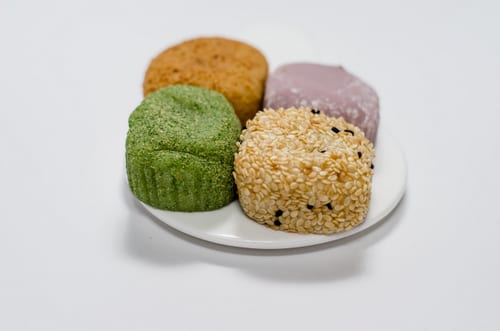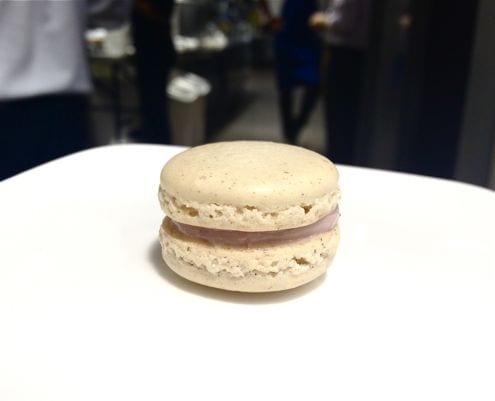
Cute, dainty, and delicious – a macaroon should have a soft and moist filling and a delicately crisp exterior. To achieve this result, understanding a few simple tricks will help you achieve your macaroon success.
- The “macoronnage” is key. The term “macoronnage” refers to the mixing of the flour and meringue to make the batter. With insufficient macaronnage the final macaroon will look course and dull, while over-mixing will lead to an oily, flat macaroon. The batter should be somewhat firm and drip slowly.
- Sift! Before you mix your dry ingredients into the meringue, sift your almond flour and powdered sugar. This pre-mixing of the dry ingredients ensures that there are no undesirable, larger particles.
- Before baking, let the piped macaroons sit out for at least thirty minutes (depending on the humidity and temperature) to achieve a dry crust on top. This helps macaroons achieve their iconic shape and “pied,” or foot.
- Bake the macaroons on two trays. When the macaroons get too hot on the bottom, they will crack, so stacking two cookie sheets help protect the little guys from too much bottom heat.
Macaroon Mysteries Solved
- Total Time: 63 minutes
- Yield: 4 dozen
Description
These French macaroons feature a soft, moist filling encased in a delicately crisp shell, perfect for impressing guests or indulging yourself.
Ingredients
- 240g almond flour
- 240g powdered sugar
- 240g granulated sugar
- Pinch of salt
- 200g egg whites
- 1/4 tsp lemon juice
- 50g granulated sugar
Instructions
- Sift together the almond flour, powdered sugar, and the first quantity of granulated sugar (240g) to ensure there are no large particles.
- In a standing mixer, begin beating the egg whites until frothy. Add a pinch of salt and continue whipping.
- Gradually add the lemon juice and the remaining 50g of granulated sugar while continuing to beat the egg whites until stiff peaks form.
- Carefully fold the sifted dry ingredients into the meringue using a spatula. This is the ‘macoronnage’ process. Mix until the batter is firm and drips slowly.
- Transfer the batter to a piping bag fitted with a round tip and pipe small circles onto a baking sheet lined with parchment paper.
- Let the piped macaroons sit out for at least 30 minutes to form a dry crust on top.
- Preheat your oven to 300°F (150°C). Stack two baking trays and place the macaroons on the top tray to prevent cracking from bottom heat.
- Bake for 15-18 minutes, or until the macaroons have risen and developed their iconic ‘foot’.
- Allow to cool completely before removing from the baking sheet.
Notes
- Ensure your dry ingredients are well-sifted to avoid lumps.
- Allowing the macaroons to sit before baking helps form a crust, essential for their shape.
- Baking on stacked trays prevents cracking.
- Store in an airtight container to maintain freshness.
- Prep Time: 45 minutes
- Cook Time: 18 minutes
- Category: Dessert
- Cuisine: French
Nutrition
- Serving Size: 1 macaroon
- Calories: 100
- Sugar: 13
- Sodium: 10
- Fat: 4
- Carbohydrates: 15
- Fiber: 1
- Protein: 2
- Cholesterol: 0
If You Liked This Recipe, You’ll Love These
- How to Make Croissants at Home
- Braided Smoked Duck Pastry Appetizer
- Gateau Saint Honoré: How to Make the French Classic
- Espresso Chocolate Chip Madeleines
Frequently Asked Questions
What is “macaronnage” and how do I know when I’ve done it correctly?
Macaronnage is the folding of the sifted almond flour and sugar into the meringue. Under-mixing produces a coarse, dull result while over-mixing creates an oily, flat macaroon — the batter is correctly mixed when it is “somewhat firm and drips slowly.”
Why do the piped macaroons need to sit out for 30 minutes before going in the oven?
The 30-minute rest (which may vary with humidity and temperature) allows a dry crust to form on the surface of each macaroon. This crust is essential for achieving the iconic shape and the “pied” (foot) that rises during baking.
Why bake on two stacked baking trays instead of one?
Too much bottom heat causes macaroons to crack. Stacking two cookie sheets insulates the bottoms of the macaroons from direct heat and protects them from cracking while they bake at 300°F (150°C) for 15–18 minutes.
What does the lemon juice do in the meringue?
The ¼ tsp of lemon juice is added to the egg whites while whipping to stiff peaks. Acid helps stabilize the meringue by strengthening the protein network in the whites, making it less likely to weep or collapse before baking.