



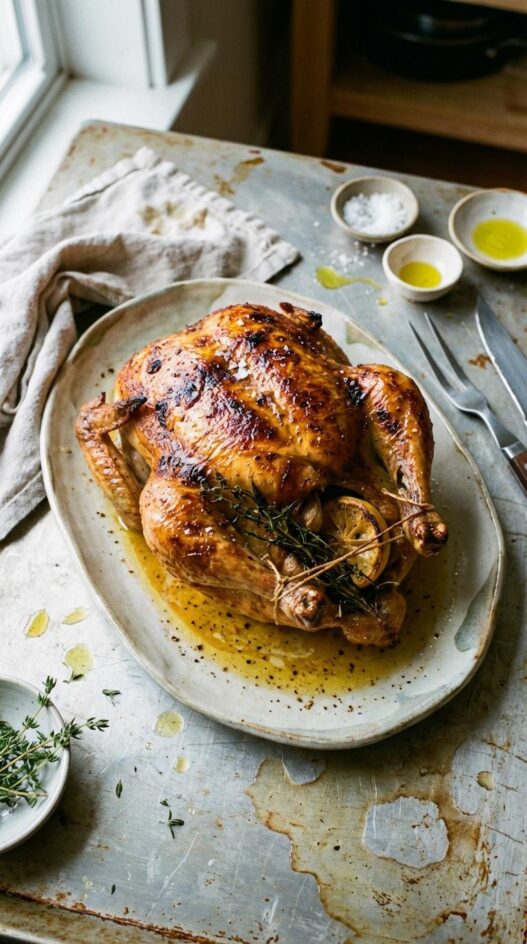
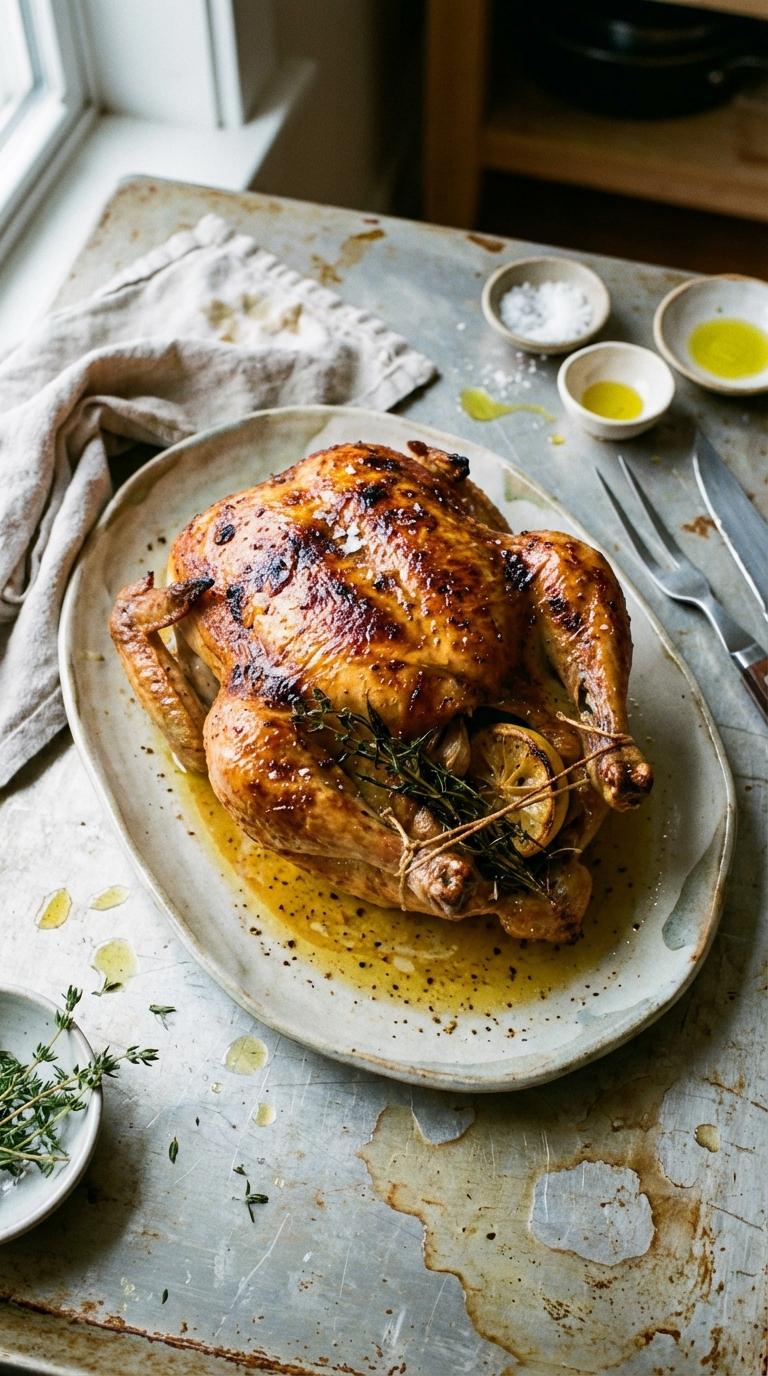
Thomas Keller once said he would rather eat a well-roasted chicken than almost anything else, and many chefs agree. Why? Because roast chicken at 425°F with dry-brined skin is one of the most satisfying things you can cook at home.
The technique here is simple once you understand what each step is doing. Patting the bird completely dry and leaving it uncovered in the refrigerator overnight does more for crisp skin than any amount of butter or oil. Salt applied the night before has time to penetrate the meat and season it from within rather than just coating the surface. The cavity stuffed with lemon, a halved head of garlic, thyme.
Rosemary perfumes the meat from the inside, and the high oven heat drives color into the skin. Resting the bird for a full fifteen to twenty minutes after it comes out of the oven matters: cut it too soon and the juices run straight onto the board. Finish with flaky salt and a spoon of pan drippings over the carved pieces. Serve with anything, or nothing. Leftover carcass goes straight into a stock pot. 
This is foundational cooking, and you absolutely will be able to master this!
How to Roast a Chicken Properly
Dry-Brine the Night Before
Pat the chicken completely dry with paper towels, season generously with kosher salt, and leave it uncovered on a rack in the refrigerator overnight. This does two things: the salt penetrates the meat and seasons it from within, and the exposed skin dries out so it roasts to a shattering crispness.
If you only have 4 hours, the dry brine still helps significantly. But overnight is where the real transformation happens. Do not wrap or cover the bird, you want air circulating around the skin.
Stuff the Cavity, Then Roast at High Heat
Take the chicken out of the refrigerator a full hour before roasting to bring it closer to room temperature. Stuff the cavity with halved lemon, a crosswise-cut head of garlic, thyme, and rosemary. Rub the outside with softened butter and olive oil.
Roast at 425F (220C). The high heat is what drives color into the skin and renders the fat underneath. A lower temperature produces pale, flabby skin no matter how long you cook it. The chicken is done when a thermometer inserted into the thickest part of the thigh reads 165F (74C).
Rest Before You Carve
Let the chicken rest for a full 15 to 20 minutes after it comes out of the oven. Tent loosely with foil but do not wrap tightly. If you carve too soon, the juices run straight out onto the cutting board and the meat dries out within minutes.
Finish with flaky sea salt and a spoonful of pan drippings over the carved pieces. Save the carcass for stock.
Classic: Roast Chicken
- Total Time: 90 minutes
- Yield: 4 servings 1x
Description
A whole roast chicken is the most honest test of a cook’s skill. There is no sauce to hide behind, no complex spice blend to distract — just chicken, salt, heat, and time. Thomas Keller once said he would rather eat a well-roasted chicken than almost anything else, and many chefs agree. The goal is burnished, crackling skin stretched tight over juicy meat, achieved through high heat, thorough drying, and restraint.
Ingredients
- 1 whole chicken (3 1/2 to 4 pounds), giblets removed
- 1 tablespoon kosher salt
- 1/2 teaspoon freshly ground black pepper
- 2 tablespoons unsalted butter, softened
- 1 lemon, halved
- 1 head garlic, halved crosswise
- 4 sprigs fresh thyme
- 2 sprigs fresh rosemary
- 1 tablespoon olive oil
- Flaky sea salt for finishing
Instructions
- The day before (or at minimum 4 hours ahead), pat the chicken thoroughly dry inside and out with paper towels. Season generously all over and inside the cavity with the kosher salt. Place uncovered on a rack set over a sheet pan in the refrigerator. This dry-brining step seasons the meat throughout and dries the skin for better crisping.
- Remove the chicken from the refrigerator 1 hour before roasting to take the chill off. Preheat the oven to 425°F.
- Rub the softened butter over the breast and thighs. Season with black pepper. Stuff the cavity with the lemon halves, garlic head, thyme, and rosemary. Tuck the wing tips behind the back. Tie the legs together loosely with kitchen twine.
- Place the chicken breast-side up on a rack in a roasting pan. Drizzle with olive oil.
- Roast at 425°F for 60-75 minutes. The chicken is done when the skin is deep golden brown, the juices from the thigh run clear when pierced, and a thermometer inserted into the thickest part of the thigh reads 165°F. The breast should register 155-160°F, as it will carry over to 165°F during resting.
- Remove from the oven and transfer to a cutting board. Tent very loosely with foil and rest for 15-20 minutes. This resting period is essential — it allows the juices to redistribute through the meat.
- Carve and serve with a sprinkle of flaky salt. Spoon the pan juices over the carved meat.
Notes
- Dry-brining overnight is the single biggest improvement you can make to a roast chicken. The salt draws out moisture, which is then reabsorbed along with the seasoning, while the exposed skin dries out for superior crisping.
- Do not truss the chicken too tightly — loose ties allow heat to circulate into the inner thigh, the area that takes longest to cook.
- Resist the urge to open the oven frequently. Each opening drops the temperature and disrupts the browning process.
- Category: Main Course
- Cuisine: French
Nutrition
- Serving Size: 1 serving
Frequently Asked Questions
How long should I dry-brine the chicken?
Overnight, 12 to 24 hours, produces the best results. The salt has time to fully penetrate the meat and the skin dries enough to crisp properly. Four hours works in a pinch but the difference is noticeable.
Why roast at 425F instead of a lower temperature?
High heat renders the fat under the skin quickly and drives browning. A lower temperature, 350F or below, produces pale skin that never gets truly crisp, no matter how long the chicken roasts. You may need to tent with foil in the last 15 minutes if the breast browns too fast.
How do I know the chicken is done without overcooking it?
Insert an instant-read thermometer into the thickest part of the thigh, avoiding the bone. It should read 165F (74C). The breast will be slightly lower, around 160F, which is fine since it continues cooking during the rest. If the juices run clear when you pierce the thigh joint, that is another good indicator.



I like to tuck a few cloves of garlic under the skin before roasting. It adds a subtle depth and keeps the meat extra juicy.
Could I use orange instead of lemon in the cavity, or would that be too sweet for this roast chicken recipe?
Yes absolutely, in fact feel free to experiment with whatever you love. Orange is great though!
I’ve tried orange before, and it gives a nice mild sweetness. Just make sure to balance it with the garlic and herbs!
Made this for my kiddos last night. They loved it! The meat was super juicy, and the skin had that perfect crispiness. A hit!
Glad to hear!
Solid roast.
Thanks for the tip, Luis! I might try that next time with a bit more thyme to see how the flavors blend.