
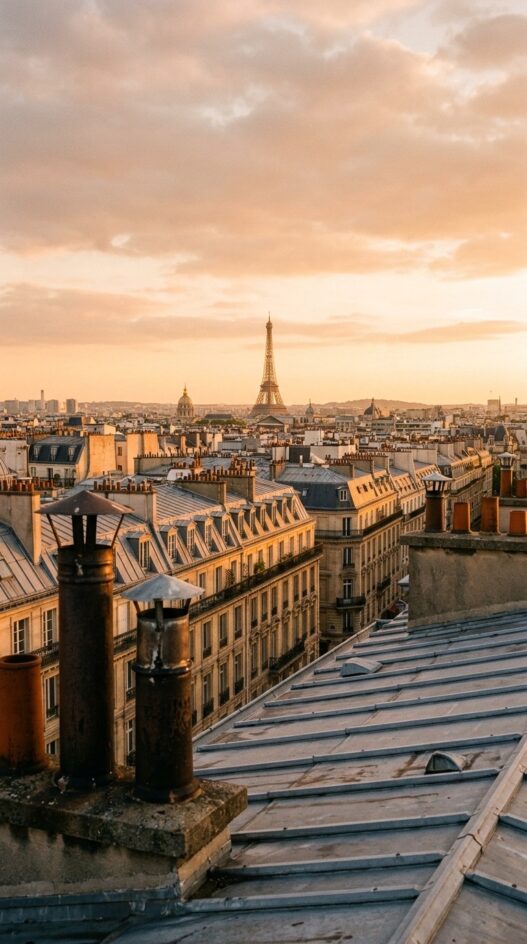
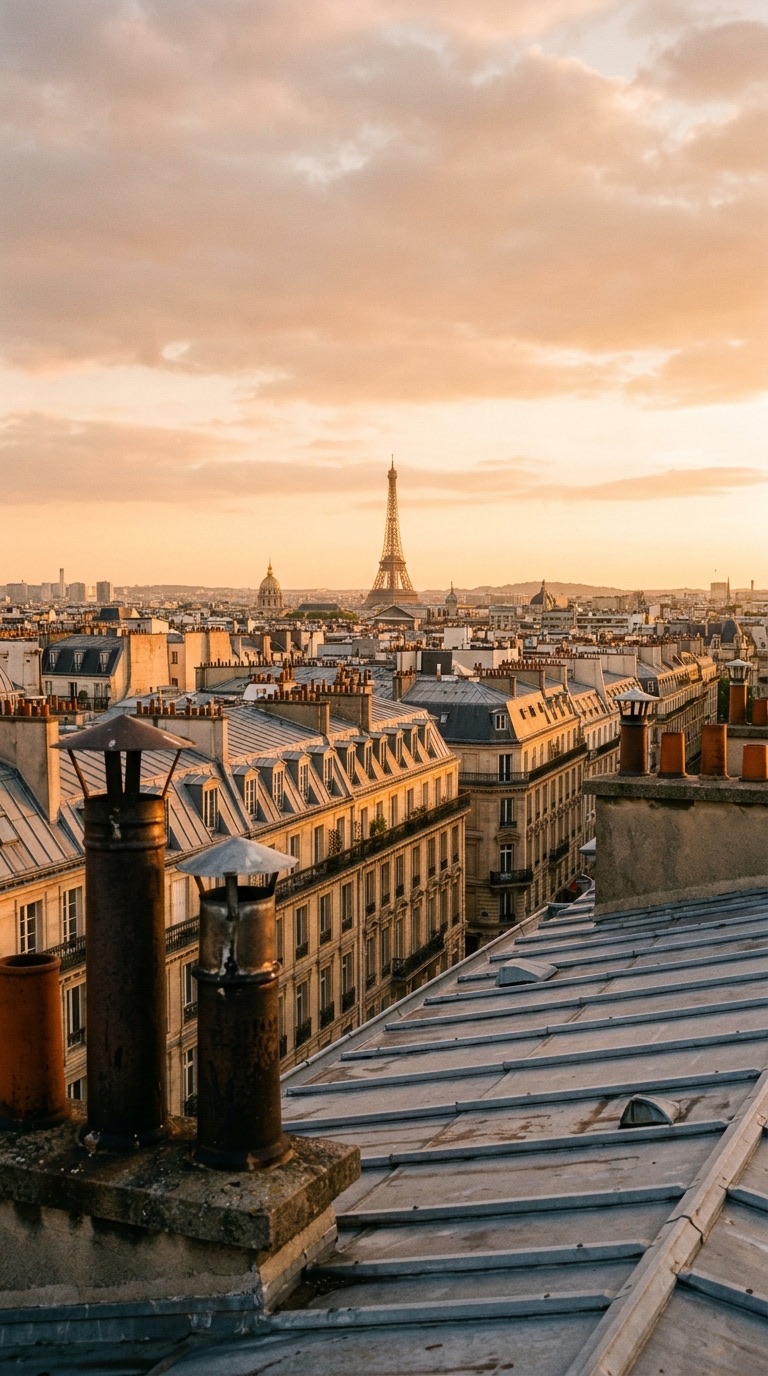
Paris has been feeding the world’s imagination for centuries, and the city’s food culture lives up to its reputation in ways that are still genuinely surprising. I’ve spent long stretches living there over the span of 20 years, and the dishes that stick with me aren’t the tasting menus or the starred restaurants (although some of them are truly incredible); they’re the things eaten at zinc bars and marble counters, ordered without looking at a menu, paid for with coins. This list covers ten of them: the Parisian canon as it actually tastes at street level, from the boulangerie queue at seven in the morning to the slow-braised pot arriving at your bistro table late on a Tuesday night.
1 · Croissant
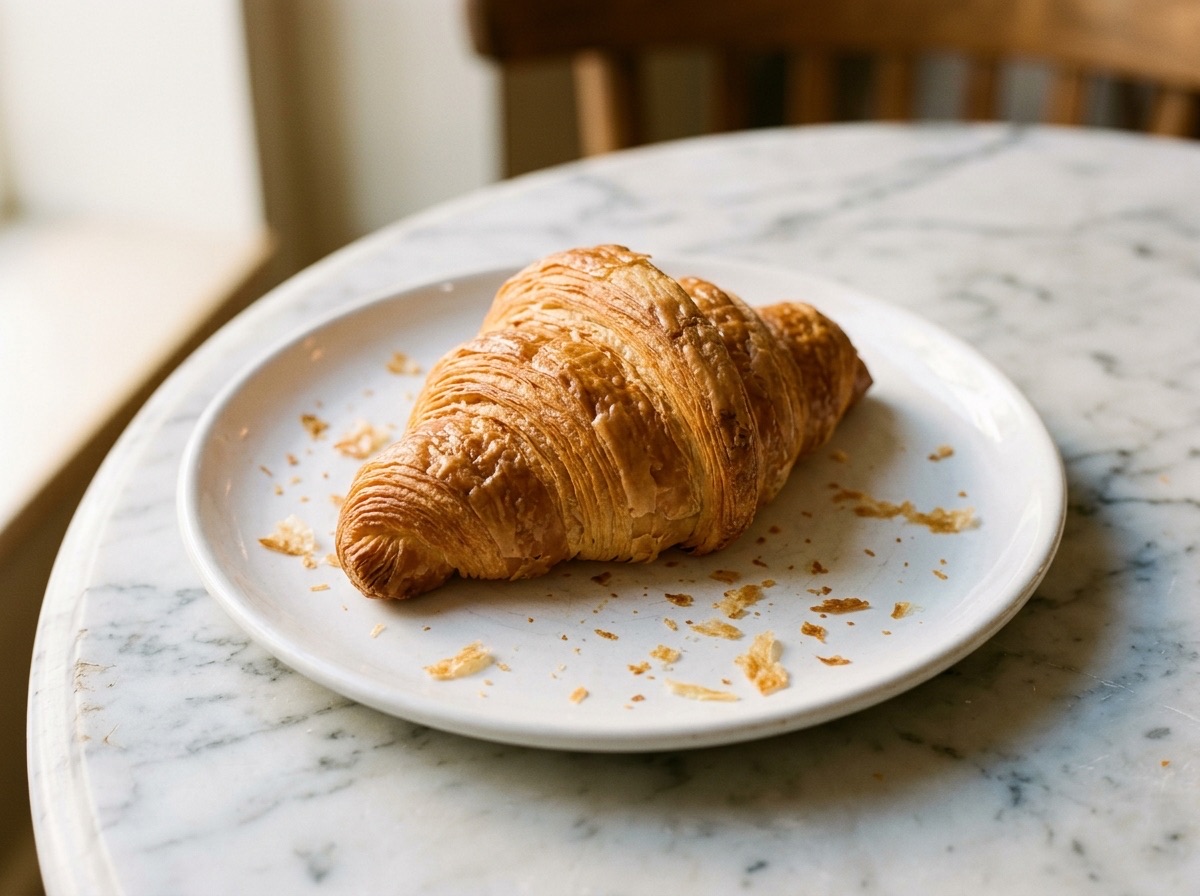
The croissant’s Parisian origin story starts in Vienna. In 1838, an Austrian artillery officer named August Zang opened the Boulangerie Viennoise on rue de Richelieu and began selling the crescent-shaped kipferl he brought from home. Parisian bakers soon adopted the shape and transformed it: they switched to a laminated butter dough, folding and rolling until the layers multiplied into the hundreds, producing a pastry that shatters when you bite it and leaves a trail of flakes down your front. That shattering quality is the tell of a proper croissant; a good one bends without cracking, which means the butter has been incorporated cold and the lamination is intact. Any honest boulangerie in Paris bakes them fresh in the small hours and sells the last of the morning batch before nine. Order one nature (plain) before you reach for the almond or chocolate versions, because the plain croissant, eaten still warm with nothing on it, is the baseline against which everything else is measured. If you find a boulangerie where the croissant is exceptional, make a note of the address.
Where to try it
- Stohrer (2ème arrondissement, Montorgueil, since 1730) — Stohrer, opened in 1730 by Nicolas Stohrer (pastry chef to Louis XV), is the oldest pâtisserie in Paris and still bakes laminated viennoiserie that draws a queue down rue Montorgueil from the morning. The croissant here has the shattering crust and clean butter flavor that makes every other version a comparison point.
- Du Pain et des Idées (10ème arrondissement, Canal Saint-Martin, since 2002) — Christophe Vasseur took over a 19th-century boulangerie on rue Yves Toudic in 2002 and restored both the wood-fired oven and the tradition of slow-fermented, cold-laminated viennoiserie. The croissant nature here is widely regarded as one of the best technical examples in the city.
2 · Jambon-beurre
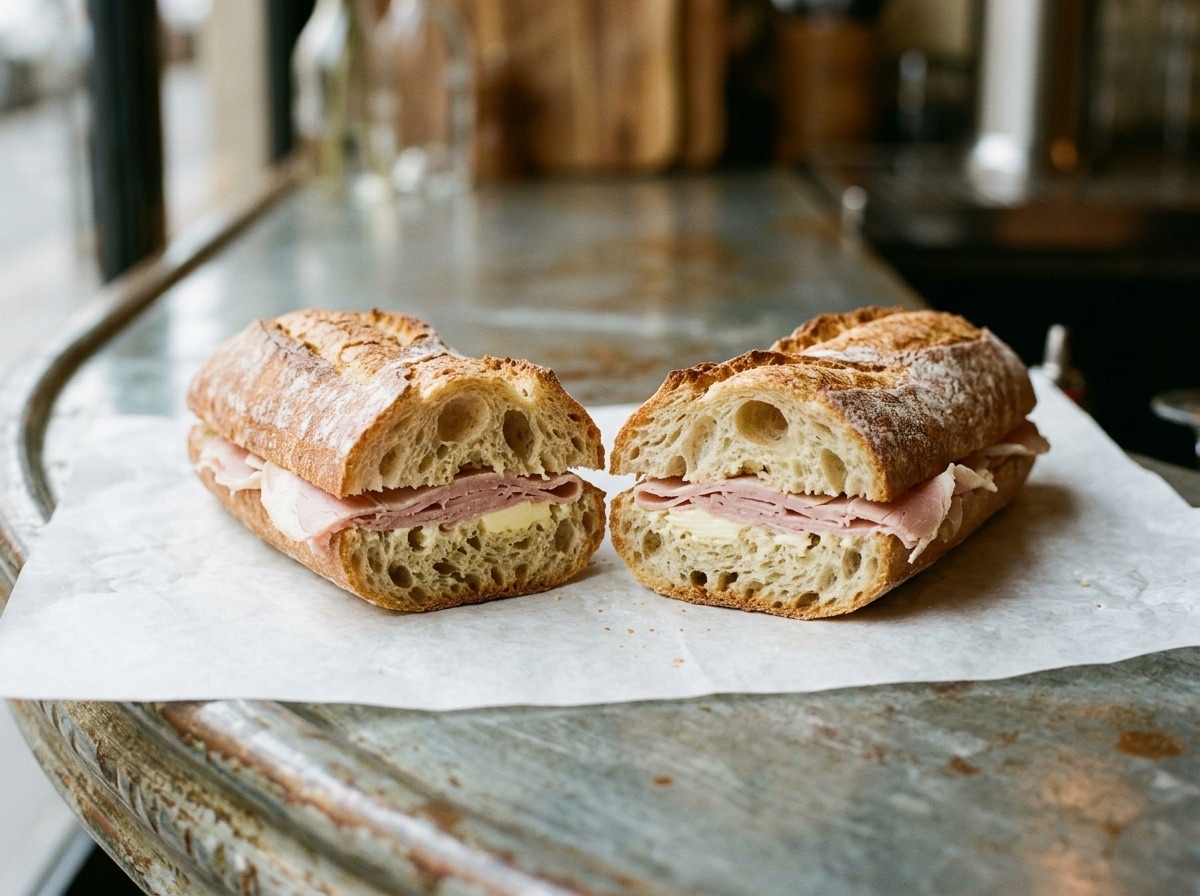
France sells roughly 1.2 billion jambon-beurre sandwiches a year, and the overwhelming majority of them are eaten in Paris, usually standing up. The construction is almost embarrassingly simple: a fresh demi-baguette split lengthways, spread generously with salted Breton butter, layered with two or three folds of jambon de Paris. That’s it. No mustard, no lettuce, no sauce. The genius is in the ratios and the quality of each element: the baguette should have a crackling crust and a slightly chewy crumb, the butter should be cold enough to hold its shape against the bread, and the ham should be pale pink and faintly sweet. Every zinc bar in the city makes one; the pleasure is not in finding the right address but in the ritual of ordering at a counter, paying a few euros, and eating it in two minutes on the pavement. It is the definitive working lunch of a city that invented the concept, and it has not needed updating since the nineteenth century.
Where to try it
- Le Petit Vendôme (1er arrondissement, near Place Vendôme) — A classic Parisian zinc-bar café that has been assembling jambon-beurre the same way for decades: fresh baguette, salted butter spread cold to the crust, folded jambon de Paris. Standing at the counter here among regulars on their lunch break is the experience the sandwich was built for.
- Aux Bons Crus (1er arrondissement, Les Halles, since 1907) — A cave à manger open since 1907, Aux Bons Crus pairs simple wine with equally simple food, and the jambon-beurre on a fresh baguette is one of the few things on the menu that has changed nothing since the Third Republic.
3 · Croque Monsieur
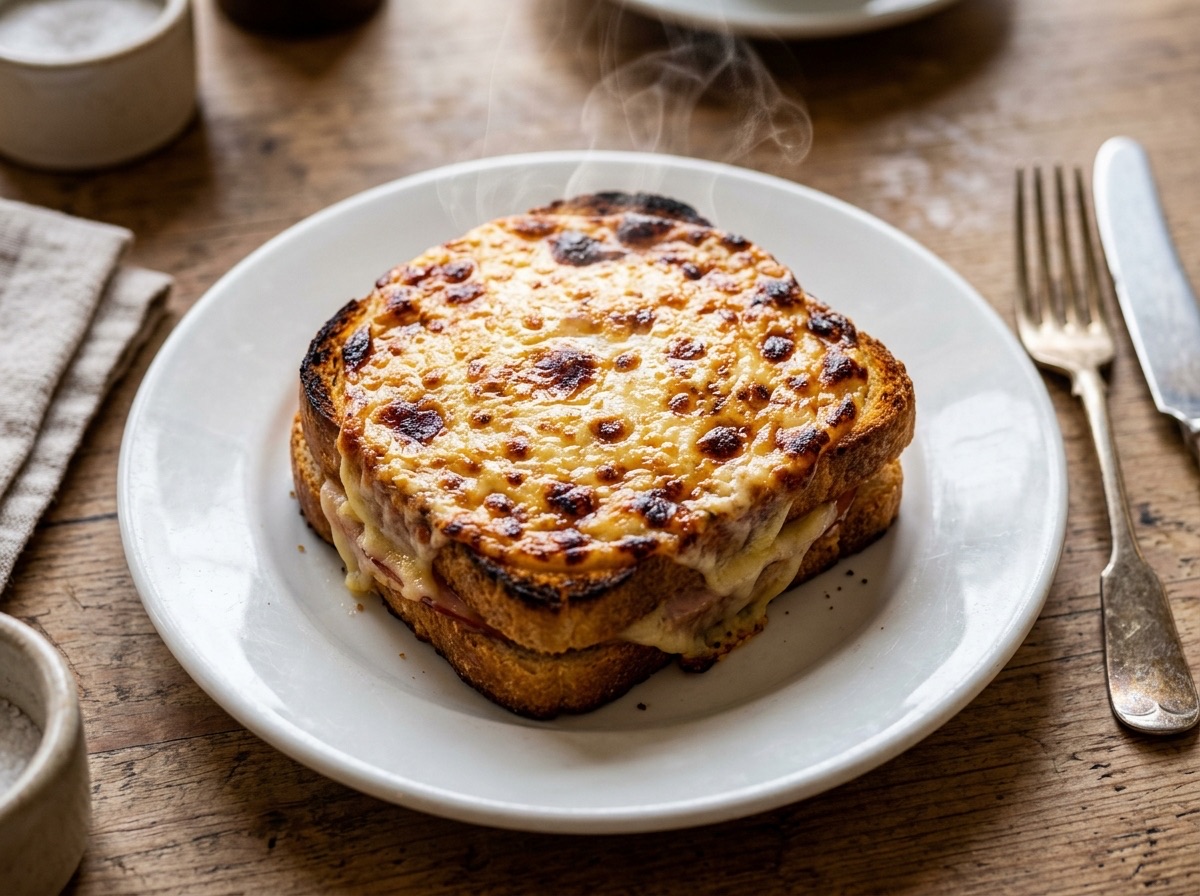
The croque monsieur appeared on a Paris café menu around 1910, and the name has been explained as a joke: you croque (crunch) the monsieur (the gentleman). Whether or not the story is true, the sandwich earned its place by being one of the most satisfying things a café kitchen can produce in under ten minutes. The correct version is grilled or baked, not fried: sliced pain de mie with good ham and Gruyère between the layers, a layer of béchamel on top, more Gruyère over that, then browned until the cheese bubbles and darkens at the edges. The croque madame adds a fried egg on top, which tips the whole construction into full lunch territory. Every Parisian café makes one, and the quality range is wide; the version to seek out has béchamel that is thick enough to hold its shape on the bread but not so stiff it turns chalky when it cools. Eaten at a wicker-chaired terrace table with a small carafe of house white, it covers all the requirements of a Parisian midday.
Where to try it
- Brasserie Lipp (Saint-Germain-des-Prés (6ème), since 1880) — Founded in 1880 by Léonard Lipp from Alsace, this boulevard Saint-Germain institution has fed Sartre, Hemingway, and six decades of French presidents, and its croque monsieur remains a properly béchameled, Gruyère-heavy version that sets the standard for every literary café in the city.
- Les Deux Magots (Saint-Germain-des-Prés (6ème), since 1885) — Open since 1885 on the Place Saint-Germain-des-Prés, Les Deux Magots has awarded its own literary prize since 1933 and still fills every wicker terrace chair by noon. The croque monsieur here is a reliable version of the canon: grilled, béchamel-topped, eaten watching the boulevard with a glass of Côtes du Rhône.
- Café de Flore (Saint-Germain-des-Prés (6ème), since 1887) — Café de Flore has occupied the corner of boulevard Saint-Germain and rue Saint-Benoît since 1887, and Simone de Beauvoir and Jean-Paul Sartre used it as a virtual office for years. The croque monsieur here is classic café execution, best ordered mid-morning before the terrace fills.
4 · Steak Frites
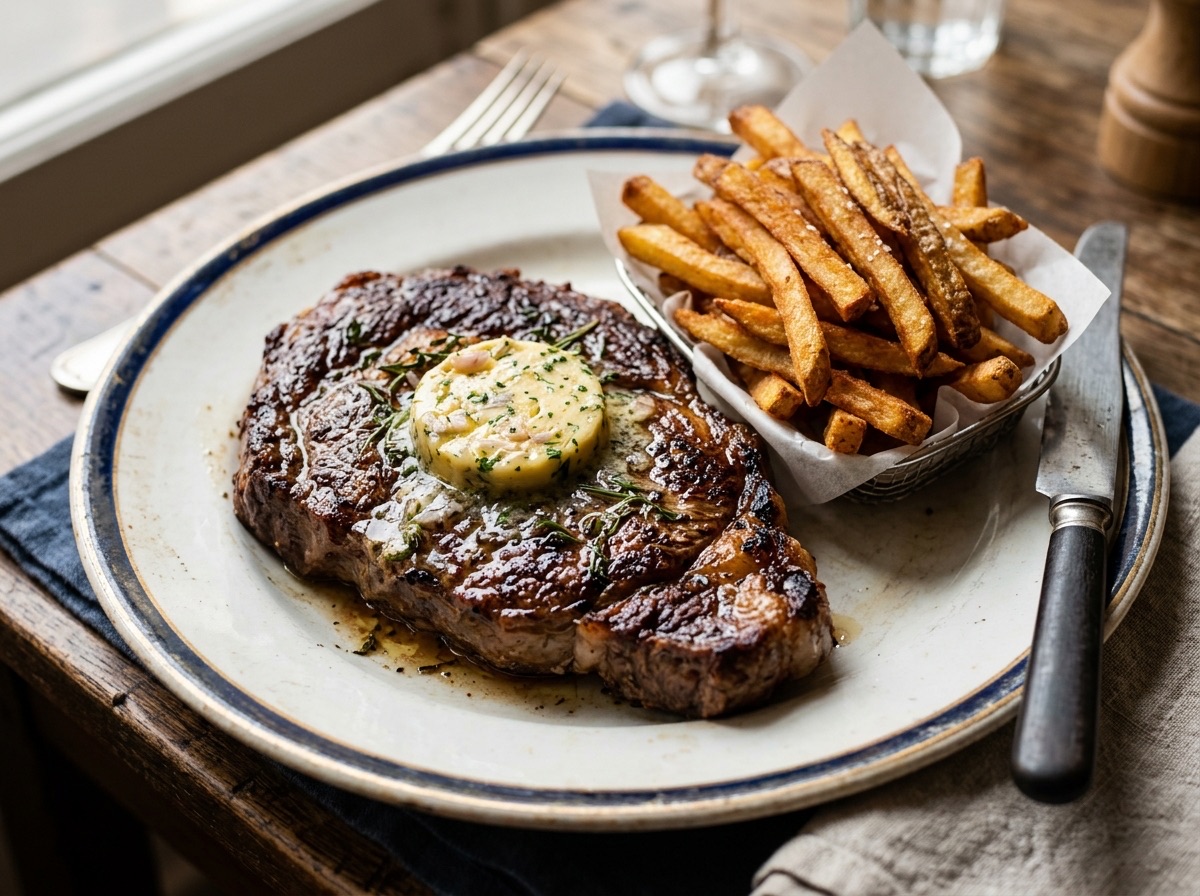
Steak frites is the dish the Parisian bistro was invented to serve. The cut is almost always entrecôte, a bone-in rib section with enough fat to stay juicy over high heat, and the sauce arrives in one of three classic forms: shallot butter melting over the hot surface, sauce béarnaise (tarragon and egg yolk, served in a small pot on the side), or au poivre (crushed black pepper, cream, and cognac). The frites are cooked twice: once at lower heat to cook through, once at high heat to crisp the outside, and served in a ceramic cup or piled directly on the plate with no apology. Le Relais de l’Entrecôte has made the one-item menu into a minor religion, and Le Severo is the address serious carnivores cite for dry-aged beef from small French farms. Every honest bistro in the city has its own version, though, and the pleasure of steak frites is partly that you don’t need a reservation for the good ones. Order the steak saignant (rare) unless you have a compelling reason to do otherwise.
Where to try it
- Le Relais de l’Entrecôte (Saint-Germain-des-Prés (6ème) — also Beaubourg and Madeleine, since 1959) — Le Relais de l’Entrecôte has served exactly one dish since Paul Gineste de Saurs opened it in 1959: entrecôte with a secret herb-and-walnut butter sauce and unlimited frites, in two courses. No menu, no reservations, queue at the door. It is the most single-minded restaurant in Paris and the canonical address for steak frites.
- Bistrot Paul Bert (11ème arrondissement, Faubourg Saint-Antoine) — Bistrot Paul Bert on rue Paul Bert is the 11th’s most trusted traditional table, where the steak frites arrives on a bare zinc plate with béarnaise in a small copper pot and the frites are twice-cooked and unseasoned so you can apply the salt yourself. The blackboard menu changes but the entrecôte never leaves it.
5 · Soupe à l’Oignon Gratinée
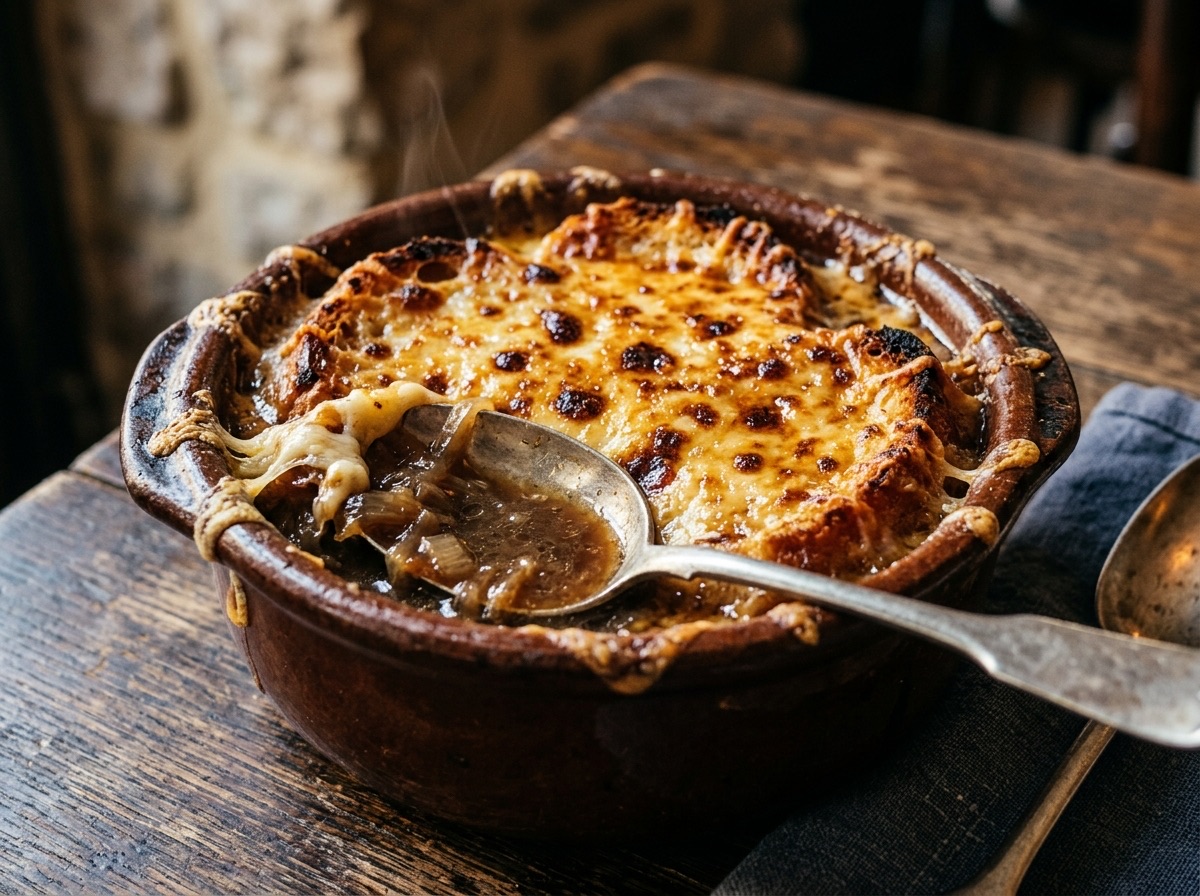
French onion soup has a specific address in Paris history: Les Halles, the central wholesale market that occupied the right bank from the twelfth century until it was demolished in 1971. The market workers, including the porters and butchers who kept brutal predawn hours, needed something warming at four in the morning, and a soup of caramelized onions in beef broth, ladled over stale baguette and covered with molten Gruyère, was the answer. The preparation takes patience: the onions must be cooked slowly over low heat until they collapse entirely and turn a deep amber, not a quick sauté, and the broth must be rich enough to carry the sweetness. The bowl goes under the grill until the cheese forms a burnished crust that you have to break through with a spoon. It’s a dish built for cold, late nights, which is why the bistros around the old market site still serve it until two in the morning. Any traditional bistro in Paris will have it; the ones with the courage to leave it on a summer menu deserve credit.
Where to try it
- Au Pied de Cochon (1er arrondissement, Les Halles, since 1947) — Au Pied de Cochon has served soupe à l’oignon gratinée 24 hours a day since 1947, originally to the night-shift porters and butchers of the Les Halles central market before it relocated to Rungis in 1969. The soup here is the historical anchor of the dish in Paris, a deep amber broth under a burnished Gruyère crust, available at 4am on a Tuesday.
- Chez Denise / La Tour de Montlhéry (1er arrondissement, Les Halles, since 1972) — A few streets from the old Baltard pavilions, Chez Denise has been a late-night refuge for market workers, chefs, and night-owls since 1972. The onion soup here is old-school and unfussy: deep bowl, stale baguette, enough molten Gruyère to require both hands to eat it.
6 · Falafel (Marais)
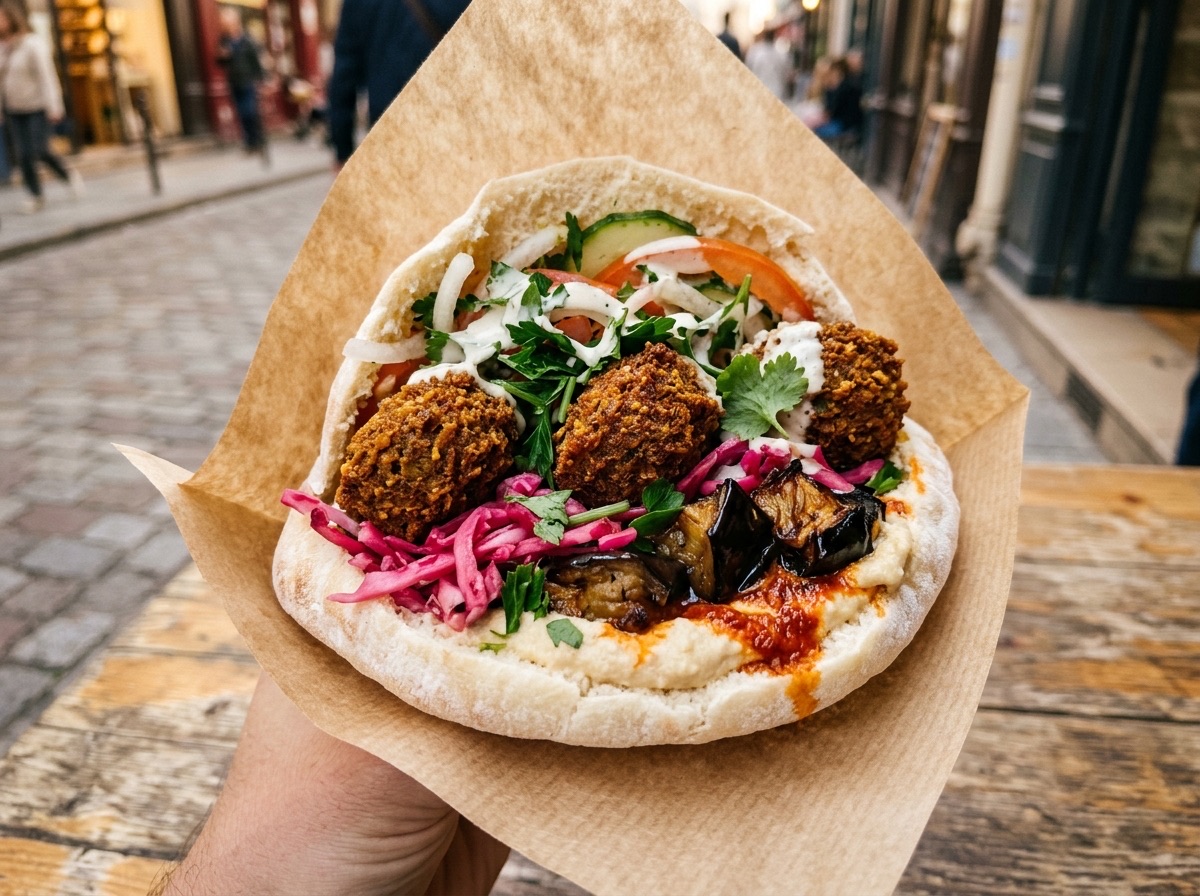
The rue des Rosiers in the Marais has been the heart of Paris’s Jewish quarter since the fourteenth century, and the falafel sold from its storefronts represents one of the oldest street-food traditions in the city. The community here is largely Sephardi and Mizrahi, with roots in North Africa and the Middle East, and the falafel reflects that: the pita is overstuffed with crisp-fried chickpea fritters, hummus, harissa, pickled cabbage, and roasted eggplant, wrapped in paper and handed across a counter to someone who eats it walking because there is nowhere to sit and that is part of the experience. L’As du Fallafel, the stall that Anthony Bourdain once called the best falafel in the world, brought international attention to the street, and a queue there stretches down the block on weekends. The whole rue des Rosiers rewards slow walking; the falafel is the anchor, but the bakeries, the pickle shops, and the pastry windows filled with baklava and boureka are all part of the same long story. Come on a Sunday, when the Marais is at its most animated and the queue, while real, moves faster than it looks.
Where to try it
- L’As du Fallafel (Marais (4ème), rue des Rosiers, since 1979) — L’As du Fallafel was opened by Sacha Slonimcheff in 1979 and is, for better or worse, where every Paris falafel conversation ends. The pita is overstuffed with crisp falafel, hummus, harissa, pickled cabbage, and roasted eggplant; Anthony Bourdain called it the best falafel in the world, and the queue on weekends suggests the title has not been surrendered.
- Chez Hanna (Marais (4ème), rue des Rosiers) — Directly on rue des Rosiers and open since the 1980s, Chez Hanna is L’As du Fallafel’s quieter neighbor and the preferred address for regulars who want the same Sephardi street-food tradition without the tourist queue. The falafel pita here is assembled with the same combination of fritters, hummus, harissa, and pickled vegetables.
7 · Macaron
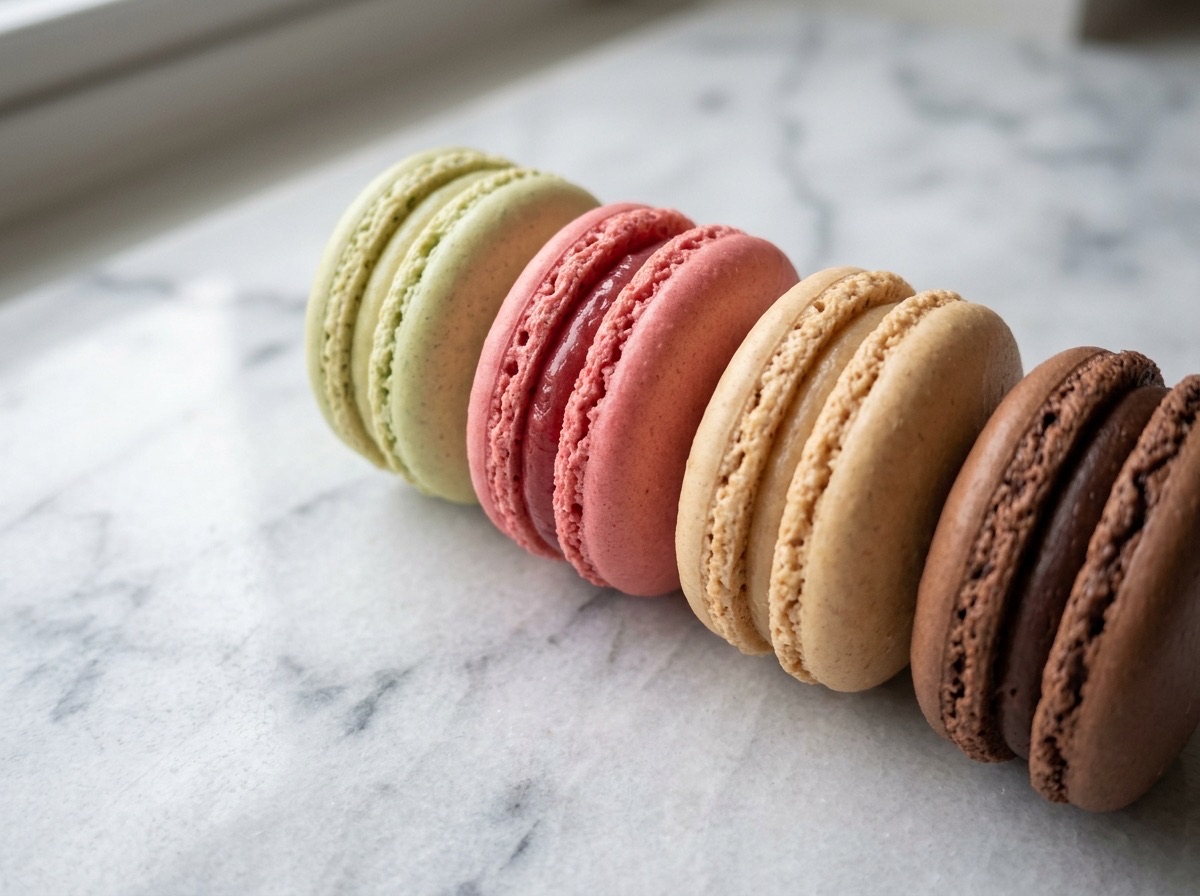
There is an older, plainer confection called a maccarone that arrived in France from Italy in the sixteenth century, but the macaron as Paris perfected it is something different and considerably more recent. In 1862, Pierre Desfontaines at Ladurée joined two almond-meringue shells with a ganache filling and created the double-decker format that became the template for every high-pâtisserie version that followed. The shells should have a thin, barely-there crust that gives way to a dense, slightly chewy interior; the filling, whether ganache, buttercream, or jam, should be applied in a layer thick enough to taste but not so thick it overwhelms the almond. Ladurée on the Champs-Élysées is the tourist pilgrimage and worth doing once, if only for the mint-green shopfront and the occasion of it. Any serious high-pâtisserie in Paris takes the macaron as seriously as the croissant and will have a rotation of seasonal flavors alongside the classics (raspberry, pistachio, salted caramel, chocolate). Buy a box of six, find a bench in a nearby garden, and eat them slowly.
Where to try it
- Ladurée (8ème arrondissement, Champs-Élysées (also Saint-Germain), since 1862) — Ladurée was founded in 1862, and it was here that Pierre Desfontaines joined two almond-meringue shells with a ganache filling and invented the double-decker Parisian macaron in its modern form. The mint-green shopfront on the Champs-Élysées is a pilgrimage; the classics (raspberry, pistachio, salted caramel, rose) remain the benchmark against which every other high-pâtisserie macaron is compared.
- Stohrer (2ème arrondissement, Montorgueil, since 1730) — Paris’s oldest pâtisserie has made macarons for centuries, and its version stays closer to the traditional almond-forward shell than the parfum-heavy modern interpretations. A box from Stohrer is the understated alternative to Ladurée’s theatre, for those who want history over shopfront.
8 · Steak Tartare
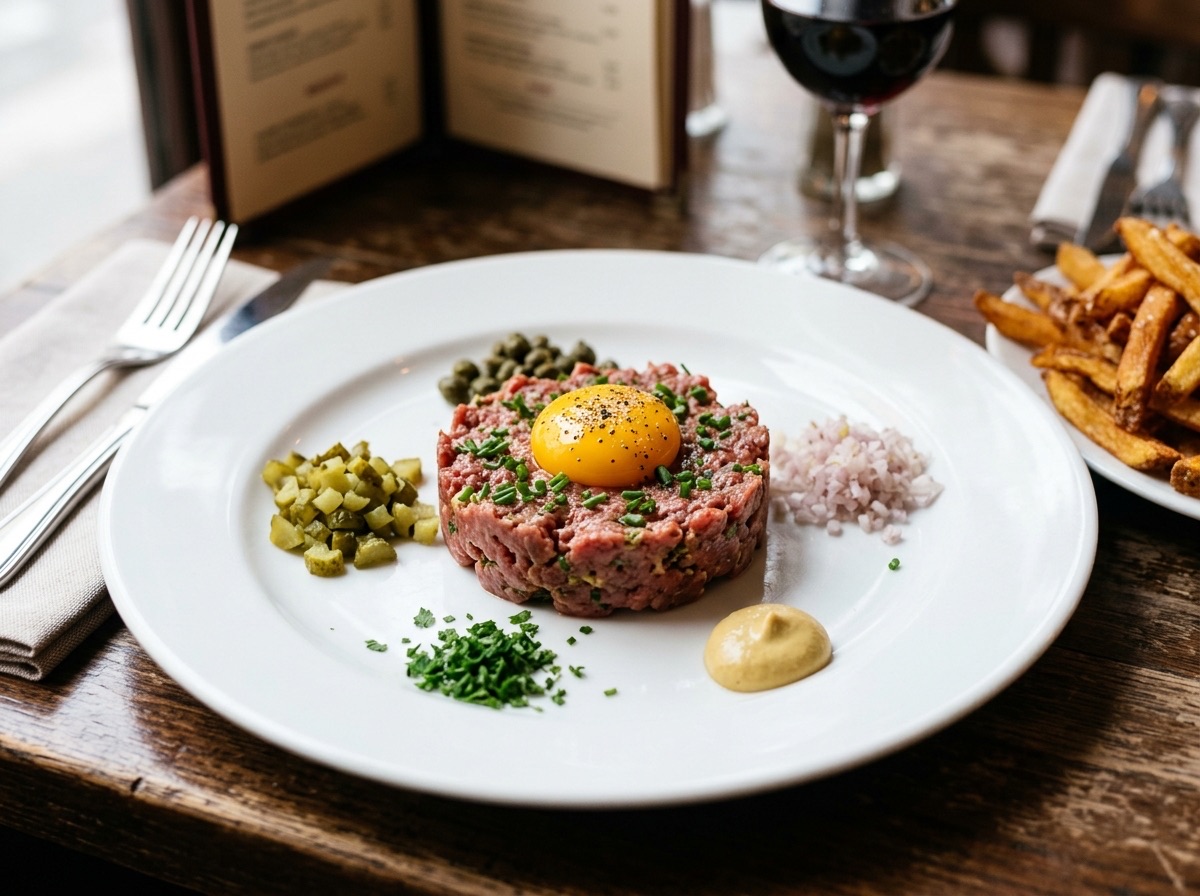
Steak tartare’s raw beef sounds like a dare to first-time visitors, but the dish is one of the most controlled and deliberate preparations in the Parisian bistro kitchen. The beef, always from a lean, flavorful cut, is hand-chopped (never ground) into small pieces and mixed with capers, finely diced cornichons, shallots, flat-leaf parsley, a drop of Worcestershire, and Dijon mustard, with a raw egg yolk placed on top for the diner to fold in at the table. The mixing is done tableside at some establishments; at others it arrives already assembled. Both approaches are correct. The key quality markers are the texture of the beef (fine enough to meld but still recognizably meat, not a paste) and the balance between the salt elements (capers, Worcestershire) and the bright ones (cornichons, shallot). A decent pile of golden frites usually arrives alongside. Any serious zinc-bar bistro in the 11th or 6th arrondissement will have it on the menu, and ordering it is a small declaration of faith in the kitchen.
Where to try it
- Brasserie Lipp (Saint-Germain-des-Prés (6ème), since 1880) — Brasserie Lipp’s steak tartare has been on the menu since before World War I, hand-chopped and assembled tableside in the old manner, with the condiments (capers, cornichons, shallots, mustard) presented separately so the diner controls the mix. It is served with correct frites and costs what a brasserie tartare should cost.
- Le Voltaire (Saint-Germain-des-Prés (7ème), quai Voltaire, since 1840) — Le Voltaire on the quai Voltaire has been a Left Bank institution since 1840, frequented by Baudelaire, Delacroix, and generations of antique dealers from the nearby galleries. The tartare here is hand-chopped from good beef, mixed with classical condiments, and served without fanfare as the main event of a serious bistro lunch.
9 · Pain au Chocolat
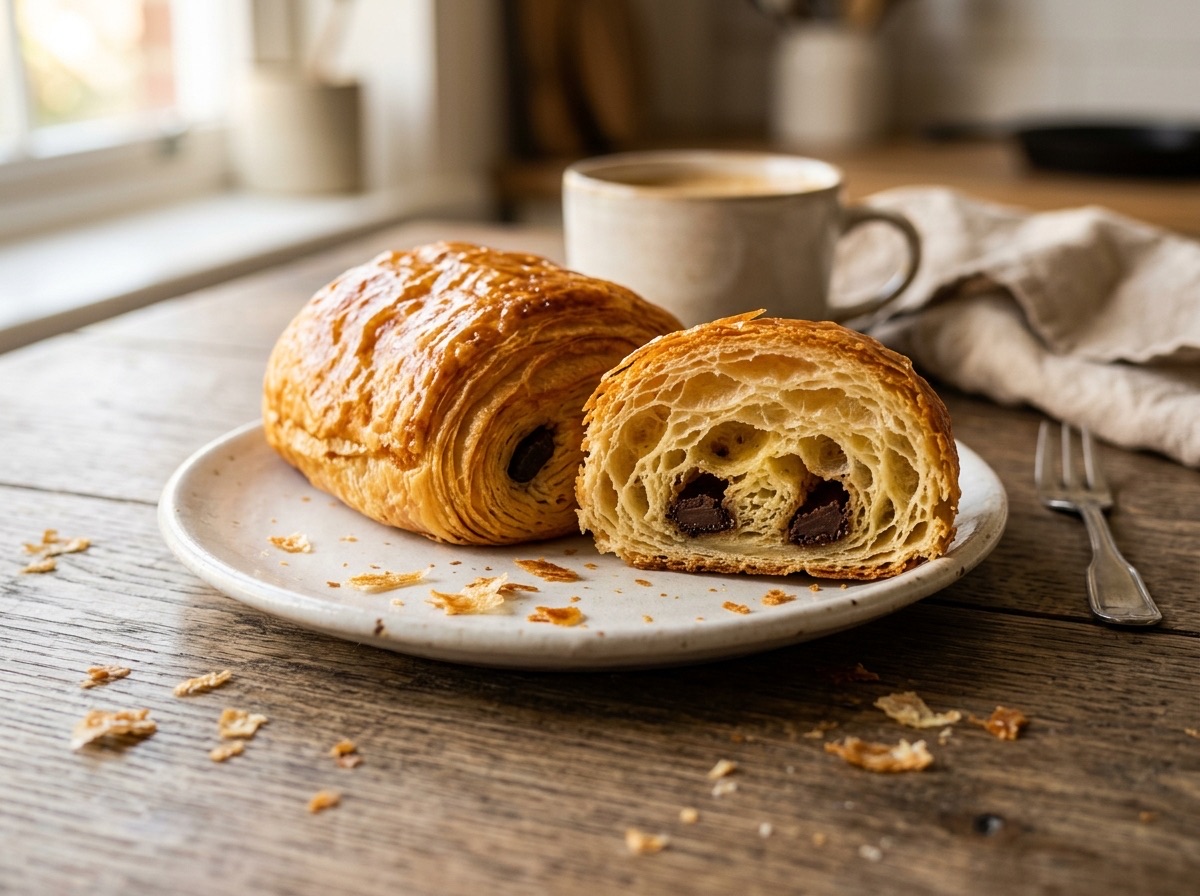
Pain au chocolat is not a Paris invention; it belongs to the whole country, and in the southwest they call it a chocolatine and will correct you firmly if you use the other name. But Paris treats the pain au chocolat with the same seriousness as the croissant, because they share the same laminated viennoiserie dough and the same unforgiving technical demands. The difference is two batons of dark chocolate laid across the dough before rolling, so that each bite contains both the butter-layered pastry and a core of melted chocolate when eaten warm. The chocolate matters: a pain au chocolat made with waxy compound chocolate is a disappointment; one made with proper dark chocolate (60 to 70 percent cacao) is something else entirely. Buy one from any serious boulangerie within twenty minutes of it coming out of the oven, and you will understand immediately why the French have no equivalent word for ‘guilty pleasure.’ It is simply pleasure, treated with the respect it deserves.
Where to try it
- Du Pain et des Idées (10ème arrondissement, Canal Saint-Martin, since 2002) — Christophe Vasseur’s pain au chocolat at Du Pain et des Idées uses two batons of dark Valrhona chocolate in the same cold-laminated dough that makes his croissant exceptional. Eaten within twenty minutes of coming out of the oven, the chocolate is still liquid inside the shattering pastry layers; it is one of the most imitated items on the Paris viennoiserie circuit.
- Poilâne (Saint-Germain-des-Prés (6ème) — also 15ème, since 1932) — Pierre Poilâne founded his boulangerie on rue du Cherche-Midi in 1932, and the house has been most famous for its miche sourdough, but the pain au chocolat here is made with the same disciplined slow-fermented dough and quality chocolate that defines every item in the case. The 6ème address is where Lionel Poilâne developed the philosophy that made the name legendary.
10 · Bœuf Bourguignon
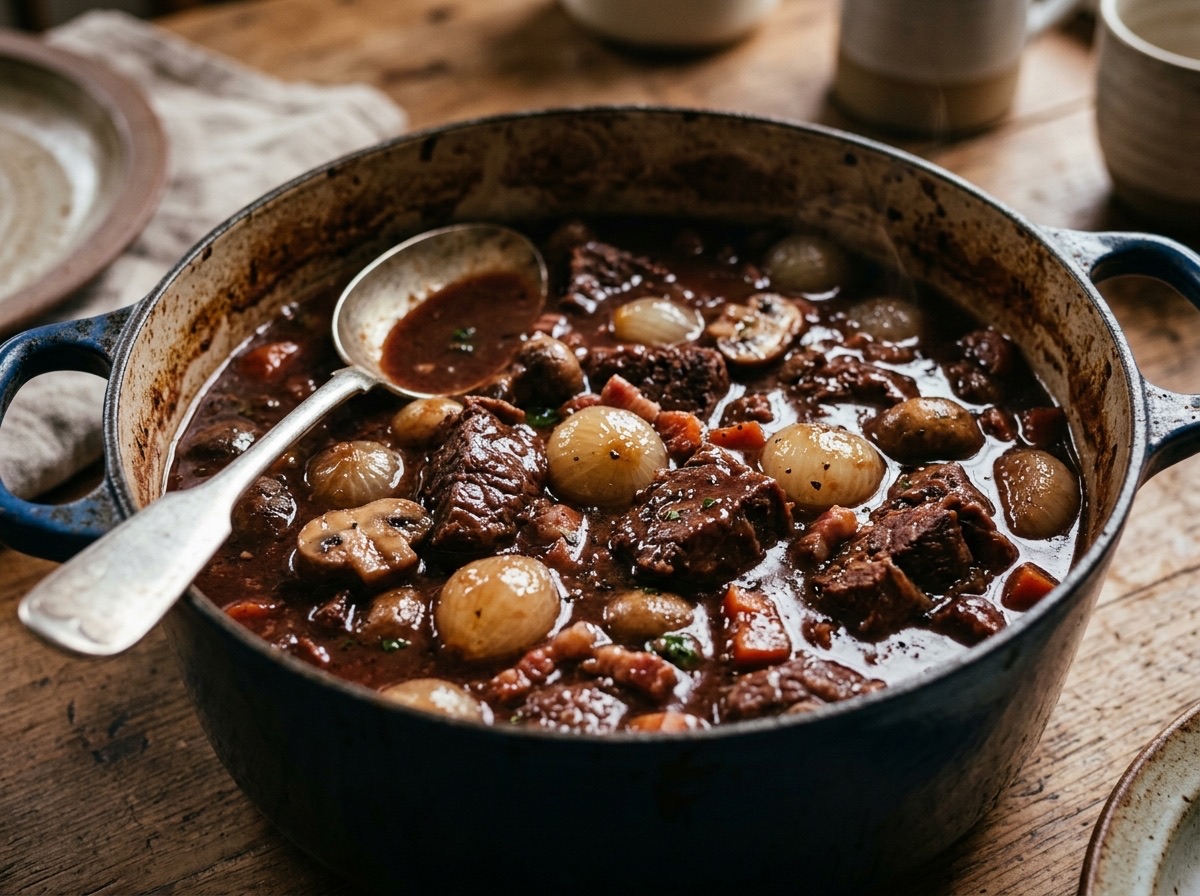
Bœuf Bourguignon is not a Paris dish by origin; it comes from Burgundy, two hours south, where the Charolais cattle and the Pinot Noir were always plentiful enough to make this braise a natural. But Paris adopted it, elevated it, and turned it into the unofficial test of a French kitchen: if a bistro does bœuf bourguignon well, you can trust everything else on the menu. The preparation is a long one, beef cubed and braised with lardons, pearl onions, mushrooms, and enough red wine to cover everything, cooked slowly until the meat yields to a spoon and the wine reduces to a sauce that is glossy and deeply flavored without being heavy. Julia Child encountered it at a Paris restaurant in the early 1950s and gave it her full attention in Mastering the Art of French Cooking (1961), introducing a generation of American home cooks to French technique through this one recipe. That debt runs both ways: the dish is now associated as much with Child’s kitchen-window pedagogy as with its Burgundian origins. Order it at any traditional bistro on a cold evening, with a carafe of the house Burgundy, and the case for Paris in winter makes itself.
Where to try it
- Allard (Saint-Germain-des-Prés (6ème), since 1932) — Marcelline Allard opened her bistro on rue de l’Éperon in 1932 and built its reputation on a short menu of Burgundian and Lyonnaise classics, including a bœuf bourguignon that has been on the menu ever since. Alain Ducasse took over in 2013 but preserved the room and the dish; the pearl onions, lardons, and mushrooms in a Pinot Noir braise are still assembled the way Madame Allard taught the kitchen.
- Chez Georges (2ème arrondissement, Montorgueil, since 1964) — Chez Georges on rue du Mail has been the canonical neighborhood bistro of the 2nd arrondissement since 1964, with a zinc bar, banquette seating, and a handwritten menu that changes daily but always includes bœuf bourguignon when the weather justifies it. The version here is unhurried and deeply flavored, the kind of thing you order when you have nowhere else to be.
- Aux Lyonnais (2ème arrondissement, Opéra, since 1890) — Aux Lyonnais has occupied a tiled corner brasserie near the Opéra since 1890 and is now stewarded by Alain Ducasse, who has kept the Lyonnais soul of the menu intact. The bœuf bourguignon here follows the Lyon-to-Paris tradition of long braising in good wine with a sauce reduced to lacquer; it is served with buttered noodles and arrives in the pot.
Paris rewards the patient and curious eater: the one who lingers over a jambon-beurre at the zinc counter, waits for the boulangerie to pull its second batch, and orders the bœuf bourguignon on a Tuesday when the kitchen has had time to braise it properly. The city’s food culture is dense with history and genuinely delicious in ways that don’t require a reservation or a guidebook. Go hungry, carry coins, and follow the smell of butter. Bon appétit.
Make these at home: recipes from this guide
Frequently Asked Questions
What is the most iconic food to eat in Paris?
The croissant is the single most iconic Parisian food, eaten fresh from the boulangerie each morning. Its laminated-butter dough traces back to August Zang’s Boulangerie Viennoise on rue de Richelieu in 1838, and a properly made croissant, shattering at the bite with hundreds of butter-layered flakes, remains the baseline test of any Paris boulangerie.
Where do locals eat falafel in Paris?
The classic address is the rue des Rosiers in the Marais, Paris’s historic Jewish quarter. L’As du Fallafel is the most famous stall on the street, but the whole block is worth exploring. The falafel pitas are overstuffed with hummus, harissa, pickled cabbage, and roasted eggplant, handed across a counter and eaten walking. Sunday is the most atmospheric day to visit.
What is a jambon-beurre and where can I try one in Paris?
A jambon-beurre is a fresh demi-baguette split and spread with cold salted butter, layered with jambon de Paris. It is the canonical Parisian working lunch, sold at essentially every zinc bar and café terrace in the city for a few euros. No specific address is required; any café with a zinc counter will have one, and the ritual of eating it standing at the bar is part of the experience.
Is steak tartare safe to eat in Paris?
Yes. Parisian bistros use fresh, lean beef that is hand-chopped (not ground) specifically for tartare, and the dish is a kitchen staple with well-established sourcing standards. The beef is mixed with capers, cornichons, shallots, mustard, and a raw egg yolk. If you are immunocompromised or have concerns about raw meat, it is worth consulting a doctor, but for the vast majority of diners it is a safe and outstanding choice at any serious bistro.
What is the difference between a croissant and a pain au chocolat?
Both are made from the same laminated viennoiserie dough, but a pain au chocolat is rolled around two batons of dark chocolate before baking. The croissant is shaped into a crescent and left plain. In Paris both are called by their standard names; only in the southwest of France is pain au chocolat referred to as a chocolatine.
Is bœuf bourguignon a Parisian dish?
By origin, no: bœuf bourguignon comes from Burgundy in central-eastern France. But the Parisian bistro adopted it as a kitchen standard, and it functions today as an informal test of a traditional French kitchen. Julia Child first encountered it at a Paris restaurant in the early 1950s and featured it prominently in Mastering the Art of French Cooking (1961). Order it in Paris on a cold evening with a carafe of house Burgundy.

Jambon-beurre from a corner traiteur on a park bench in the Marais, fantastic call. Easy to talk yourself into a tasting menu and miss the actually-good food.
Spending five days in Paris in June with my mom for her 60th, this list is the spine of our daily plans. Adding Du Pain et des Idées on a Wednesday morning and a bistro pot night sounds exactly right. Thanks for cutting through the noise.
I lived in the 11th for four years between 2014 and 2018 and a morning croissant from a corner boulangerie still sits in my head as the bit of Paris life I miss most. Du Pain et des Idées on a weekday queue is exactly worth the wait. Boeuf bourguignon at a bistro on a Tuesday in November when the rain is sideways is incredible, you nailed it.
Would love a follow-up post on the natural wine bars you’d send a first-timer to. Fascinated by the new generation of caves a manger but don’t know where to start. Any picks?
Hey Olga, here are some favorites:
Aux Deux Amis
Yard Cave
Le Barav
Try those, and then ask the staff there where to go next, they will point you in the right direction!
Ironically the two restaurants owned by the Ducasse group that you advertise here are not serving Boeuf Bourguignon anymore. I would say it’s not exactly a spring/summer dish so perhaps it’ll be back on the menu but considering the minimal dishes that are on their menu, I doubt they even attempt something that needs proper cooking.
Hey there, thanks for pointing that out, I appreciate it! Do you have another suggestion for a place we should feature??
Bookmarked!! Thanks for this!
This was a perfect roundup, my partner and I will be eating our way through this in June, already booking another visit!
My grandmother lived above a boulangerie in Montparnasse and the smell of croissants at six in the morning is one of my earliest memories. The shattering quality you describe is exactly the tell. Absolutely heavenly when fresh, Stohrer in the second arrondissement still does it that way.
I lived in the 11th for nine years and this list is exactly what I’d write if someone asked me. Croissant from Du Pain et des Idées on a weekday morning, jambon-beurre from a corner traiteur for lunch, steak frites at a tiny zinc-counter bar in the evening, and a glass of natural wine somewhere in between. The pot-au-feu reference is the surprise here, almost no list mentions it. Thank you for keeping the canon honest.