
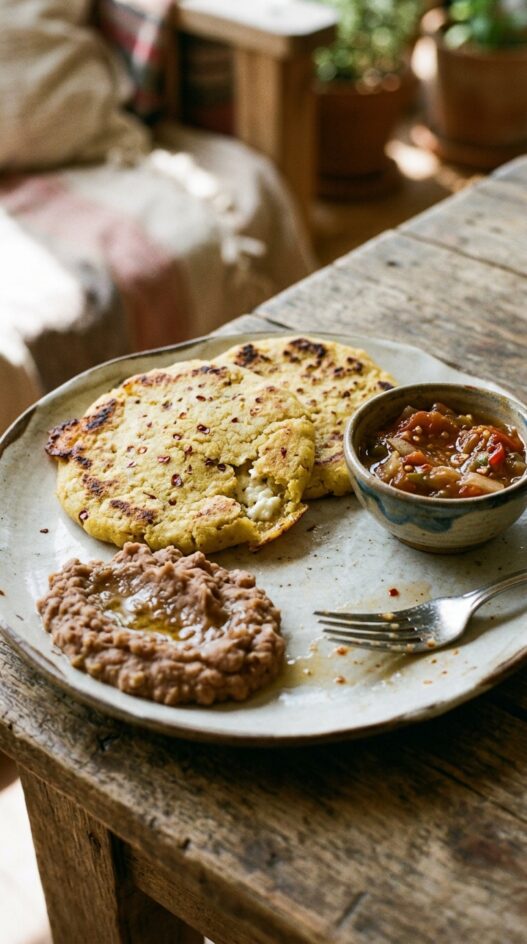
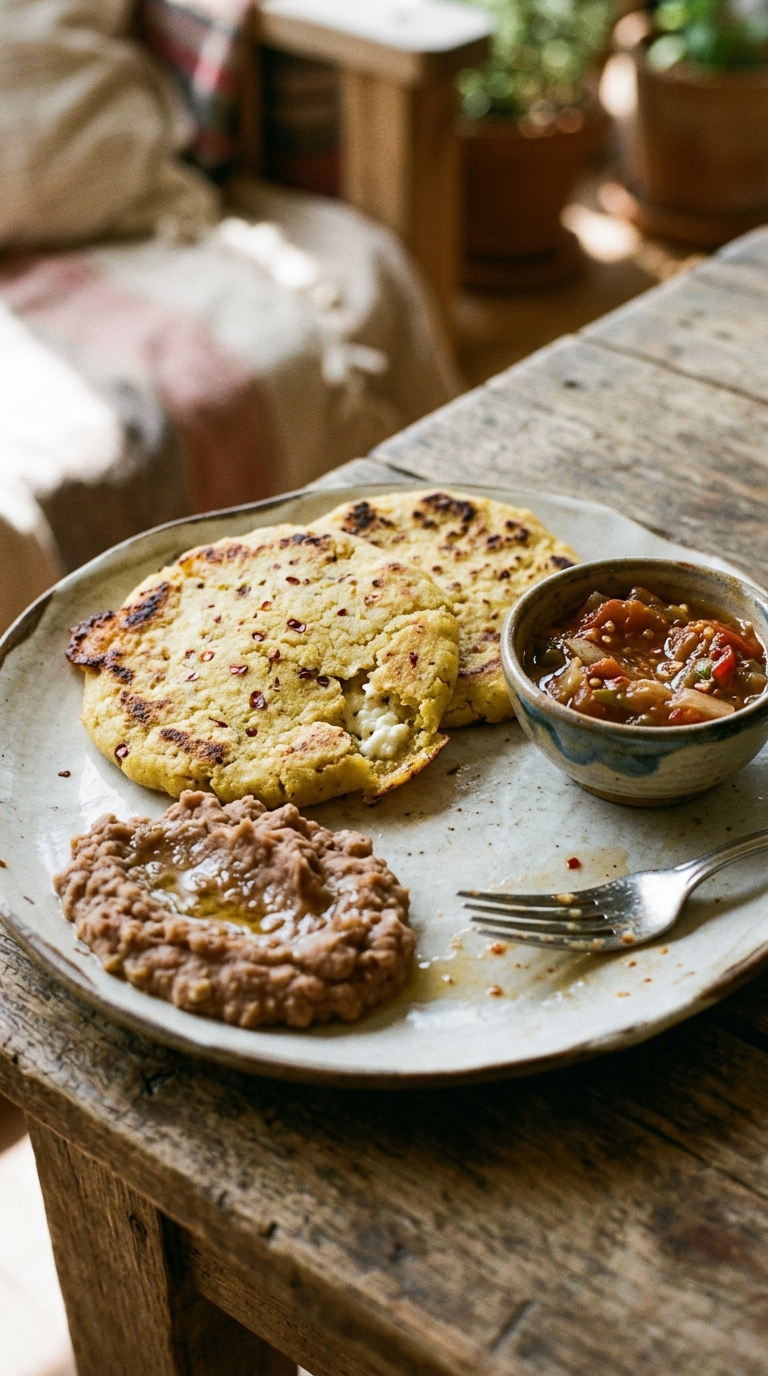
Pupusas can be stuffed with cheese, meat, beans or vegetables. If you’re familiar with Hispanic food think of Pupusas as a relative to Mexican gorditas or South American arepas. Additionally pupusas are served alongside a traditional fermented cabbage salad called curtido.
As you can see from the photos my pupusas aren’t quite authentic El Salvadoran pupusas. These are more of a gordita-pupusa Spicie Foodie fusion… Or something like that. For starters the dough I used was fine yellow corn flour not the white masa harina called for. (yellow corn flour makes a great substitute) The cheese, I’ve used Feta, my queso fresco substitute, instead of a melting white cheese. To give the pupusas my special touch I added red pepper flakes to the dough. Lastly instead of serving alongside curtido I choose refried beans and Mexican salsa. Regardless of authenticity these pupusas are also very good. In the past I’ve made my pupusas in the traditional way but every once in a while it’s good to change up recipes.
Print
Pupusas, El Salvadoran Corn Cakes
- Total Time: 26 minutes
- Yield: 9-11 pupusas
Description
These pupusas are a fusion of El Salvadoran and Mexican flavors, featuring a fine yellow corn flour dough stuffed with Feta cheese and spiced with red pepper flakes.
Ingredients
- 1 1/2 cups (360 ml) fine yellow corn flour
- 1 cup (240 ml) white flour OR 2 1/2 cups (600 ml) Maseca Instant Corn Masa (masa harina)
- 1 1/2 tsp red pepper flakes
- 1/2 tsp salt
- 2 tbsp (30 ml) sunflower or corn oil
- 1 cup (240 ml) water
- Feta cheese or queso fresco substitute, for stuffing
- Refried beans, for serving
- Mexican salsa, for serving
Instructions
- Heat a comal or griddle over medium heat.
- In a large bowl, combine the corn flour, white flour or masa harina, red pepper flakes, and salt.
- Make a well in the center of the dry ingredients and pour in the oil and water.
- Stir until a wet dough is formed. The dough will not have elasticity but should hold together when pressed.
- Divide the dough into 9-11 equal portions, depending on desired size.
- Flatten each portion into a disc, about 1/4 inch thick.
- Place a small amount of Feta cheese or queso fresco substitute in the center of each disc.
- Fold the edges over the filling and gently flatten again to seal the cheese inside.
- Place the pupusas on the heated comal or griddle and cook for about 3 minutes on each side, until golden brown and slightly crispy.
- Serve hot with refried beans and Mexican salsa on the side.
Notes
- Yellow corn flour can be used as a substitute for white masa harina.
- Feta cheese is used instead of traditional melting cheese for a unique twist.
- Serve with refried beans and Mexican salsa instead of curtido for a different flavor profile.
- Adjust the red pepper flakes to taste for desired spiciness.
- Prep Time: 20 minutes
- Cook Time: 6 minutes
- Category: Main Course
- Cuisine: Latin American
Nutrition
- Serving Size: 1 pupusa
- Calories: 200
- Sugar: 1
- Sodium: 300
- Fat: 7
- Carbohydrates: 30
- Fiber: 3
- Protein: 5
- Cholesterol: 10
If You Liked This Recipe, You’ll Love These
- Birria Tacos
- Huitlacoche Sopes with Mint Salsa Verde
- Smokey Sweet Potato and Black Bean Tacos
- How to Make Birria Ramen
Frequently Asked Questions
Can I use regular masa harina instead of yellow corn flour?
Yes — I offer this swap in the recipe itself: use 2½ cups of Maseca Instant Corn Masa (masa harina) in place of the 1½ cups yellow corn flour plus 1 cup white flour. I find yellow corn flour is a great substitute for the traditional white masa harina used in El Salvador.
Why doesn't the pupusa dough feel stretchy like regular bread dough?
That’s expected. The dough will not have elasticity but should hold together when pressed. Corn-based doughs contain no gluten the way wheat doughs do, so they feel more crumbly — just press and flatten each portion and it will hold once shaped around the filling.
How do I keep the filling from bursting out during cooking?
Make sure the edges of each pupusa are well sealed before placing them on the comal. Fold the dough disc edges up around the filling and press firmly to close, then gently flatten the stuffed ball again. Cook for about 3 minutes per side until golden brown.


These look SO good… I often make arepas at home, so am sure I will love these.
One of my best friends is Salvadoreña and she made me these once. Fabulous little secret those Salvadorans are keeping, eh? Yours look different, as you explained in the post, but wonderful in their own way. And besides, you know what I say about authenticity: Bah humbug!