
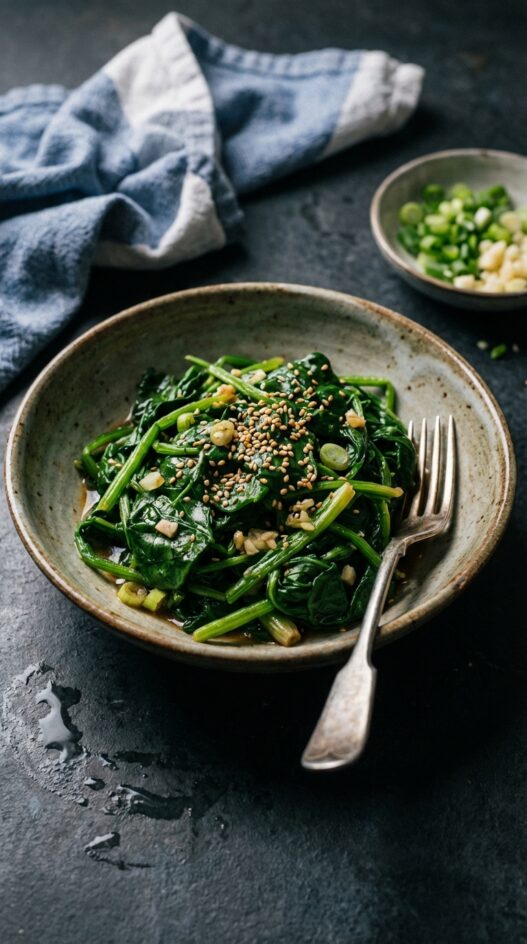
Banchan literally means “side dish,” but this translation doesn’t really capture its significance. A typical Korean meal features anywhere from 3 to 12 different banchan varieties simultaneously, and in many ways they are just as important to the experience as the “main course”.
Unlike Western appetizers, banchan is served alongside the main course, not before it. Each person at the table shares from the same banchan dishes, and some banchan varieties are meant to be refilled throughout the meal (called gongjinban or “unlimited side dishes”), particularly in restaurants, while others are served in limited portions.
Sigeumchi Namul: A Classic Banchan
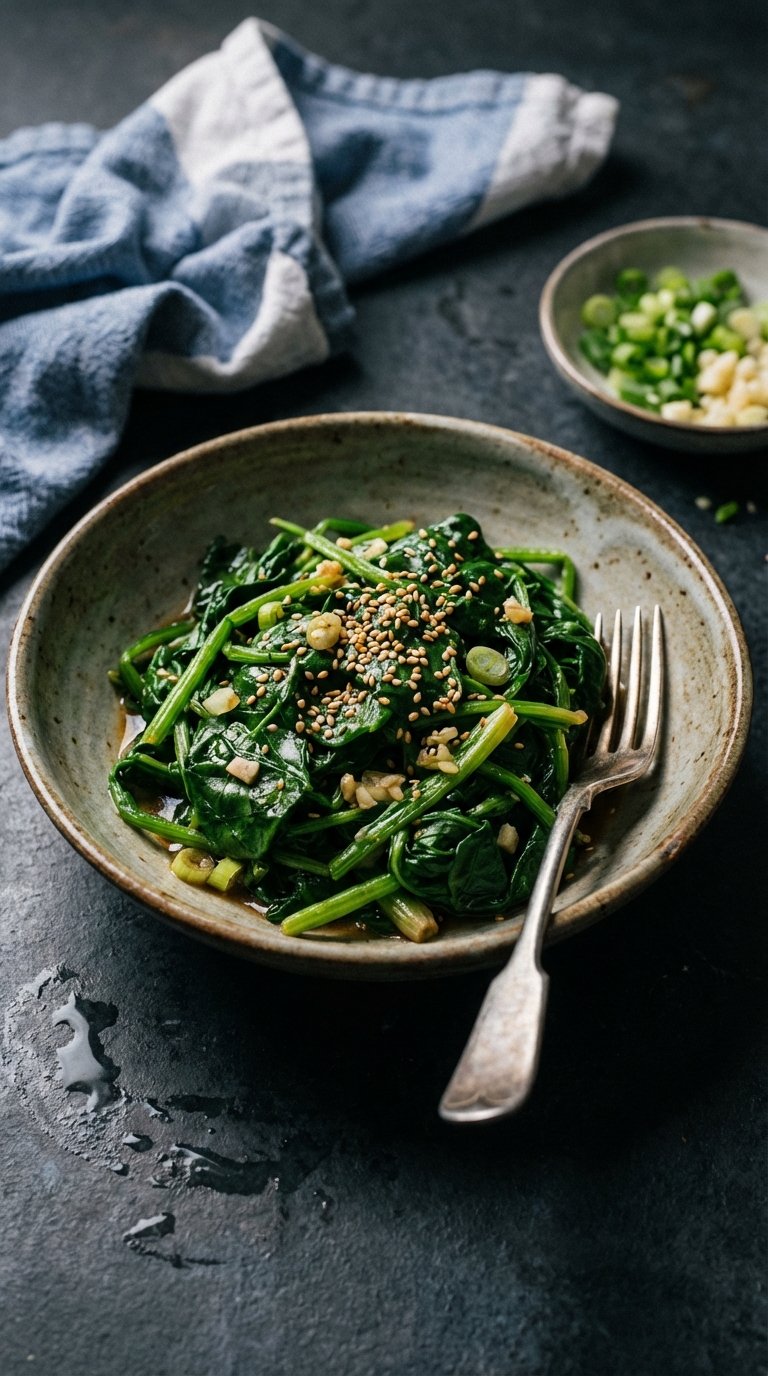
Sigeumchi namul or Korean seasoned spinach holds a place of honor for its simplicity, nutritional value, and versatility. “Namul” refers to seasoned vegetable dishes, a subcategory of banchan with vegetables dressed with minimal seasonings.
Sigeumchi namul is spinach, quickly blanched to preserve color and nutrients, then lightly seasoned with staple Korean ingredients—sesame oil, garlic, and soy sauce.
Delicious!
Step By Step Guide to Making Sigeumchi Namul: Korean Spinach Banchan
Step 1: Prepare Spinach
Remove any roots or tough stems from spinach.
Wash spinach thoroughly in cold water 2-3 times, removing all dirt and grit. Set aside.
Step 2: Mix Sauce Ingredients
In a large bowl, combine minced garlic, thinly sliced green onion, soy sauce (or tamari), and sesame oil. Stir well to combine flavors evenly. Set aside.
Step 3: Blanch the Spinach
Bring a medium-sized pot of water to a rolling boil. Add 1 teaspoon sea salt to the water.
Add spinach to boiling water and blanch quickly for exactly 30 seconds. Immediately remove spinach and drain.
Step 4: Shock and Drain Spinach
Rinse blanched spinach under cold running water to halt cooking. Repeat rinsing 3 times.
Gently but firmly squeeze excess water from spinach until it feels dry but remains soft.
Step 5: Season and Mix
Roughly chop spinach into bite-sized pieces, then place into the bowl containing the sauce.
Toss spinach gently by hand or with tongs, evenly coating it with the seasoning mixture.
Step 6: Serve
Transfer spinach to a serving plate or bowl.
Sprinkle evenly with toasted sesame seeds before serving.
Korean Spinach Banchan FAQ
Can I use frozen spinach?
Fresh spinach is best. Frozen spinach is too watery and lacks ideal texture.
Is this dish gluten-free?
Use tamari instead of soy sauce for a gluten-free option.
How do I store leftovers?
Store in a sealed container in the refrigerator for 2-3 days.
Can I skip the blanching step?
Blanching softens the spinach and removes bitterness, making it essential.
Can I add spice?
Yes, adding Korean chili flakes (gochugaru) or chili paste (gochujang) gives it heat.
Sigeumchi-Namul: Korean Spinach Banchan
- Total Time: 11 minutes
- Yield: Serves 2
- Diet: Vegetarian, Gluten-Free
Description
A vibrant Korean side dish, this simple spinach banchan is quick to make and bursts with fresh flavor. Perfect with any Korean meal!
Ingredients
- 7 oz (200 g) fresh spinach (leaves and stems), roots removed
- 2 cloves garlic, minced finely
- 1 green onion, thinly sliced
- 1 1/2 tbsp (22 ml) soy sauce (or tamari for gluten-free option)
- 1/2 tbsp (7 ml) sesame oil
- 1/2 tbsp (7 g) toasted sesame seeds
- 1 tsp sea salt (for blanching water)
Instructions
- Prepare Spinach
- Remove any roots or tough stems from spinach. Wash spinach thoroughly in cold water 2-3 times, removing all dirt and grit. Set aside.
- Mix Sauce Ingredients
- In a large bowl, combine minced garlic, thinly sliced green onion, soy sauce (or tamari), and sesame oil. Stir well to combine flavors evenly. Set aside.
- Blanch the Spinach
- Bring a medium-sized pot of water to a rolling boil. Add 1 teaspoon sea salt to the water. Add spinach to boiling water and blanch quickly for exactly 30 seconds. Immediately remove spinach and drain.
- Shock and Drain Spinach
- Rinse blanched spinach under cold running water to halt cooking. Repeat rinsing 3 times. Gently but firmly squeeze excess water from spinach until it feels dry but remains soft.
- Season and Mix
- Roughly chop spinach into bite-sized pieces, then place into the bowl containing the sauce. Toss spinach gently by hand or with tongs, evenly coating it with the seasoning mixture.
- Serve
- Transfer spinach to a serving plate or bowl. Sprinkle evenly with toasted sesame seeds before serving.
Notes
- For optimal flavor, use young, tender spinach leaves.
- Toasted sesame oil can be substituted for regular sesame oil for a richer flavor.
- Store leftover namul in an airtight container in the refrigerator for up to 3 days.
- Prep Time: 10 minutes
- Cook Time: 1 minutes
- Category: Side Dish
- Method: Blanching
- Cuisine: Korean
Nutrition
- Serving Size: 1/2 cup
- Calories: 50
- Sugar: 2
- Sodium: 200
- Fat: 2
- Saturated Fat: 1
- Unsaturated Fat: 1
- Trans Fat: 0g
- Carbohydrates: 8
- Fiber: 2
- Protein: 2
- Cholesterol: 0g
If you liked this, you are going to love these favorite Korean recipes:
Slow Cooker Korean-Style Beef Stew
Galbi Jjim – Korean Braised Short Ribs
Frequently Asked Questions
How do I properly blanch the spinach for Sigeumchi Namul?
To blanch the spinach, bring a pot of salted water to a rolling boil, add the spinach, and blanch for exactly 30 seconds. Immediately drain and rinse under cold running water several times to stop the cooking, then gently squeeze out the excess water.
Can I use tamari instead of soy sauce in this recipe?
Yes, tamari can be used as a gluten-free alternative to soy sauce in the Sigeumchi Namul recipe.
What should I do if I can’t find sesame oil for seasoning?
If sesame oil is unavailable, you can substitute it with a neutral oil, but the flavor will differ; try to use a small amount of toasted sesame seeds to add some of the characteristic flavor.
If You Liked This Recipe, You’ll Love These
- Cheese Filled Arepas – Colombian Corn Cakes
- Yukhoe: Sesame, Soy and Chili Beef Tartare
- How to Make Perfectly Smooth Hummus






Oh yes, one of the best Korean sides!!
I love Korean BBQ, and the small dishes that are served with the meat are my fave! This is so delicious!
I am loving this recipe so much. Love Korean, and this is my fave side!
This is fantastic!
Sounds as if it would be delicious made with baby bok choy as well. Will definitely be trying this!
wow, this sounds really good, going to make it just to have by itself, thanks for posting