
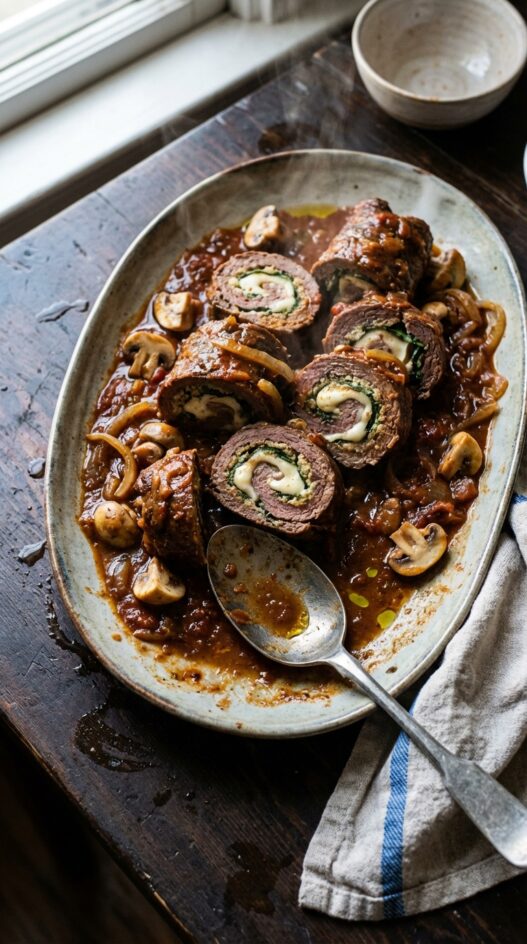
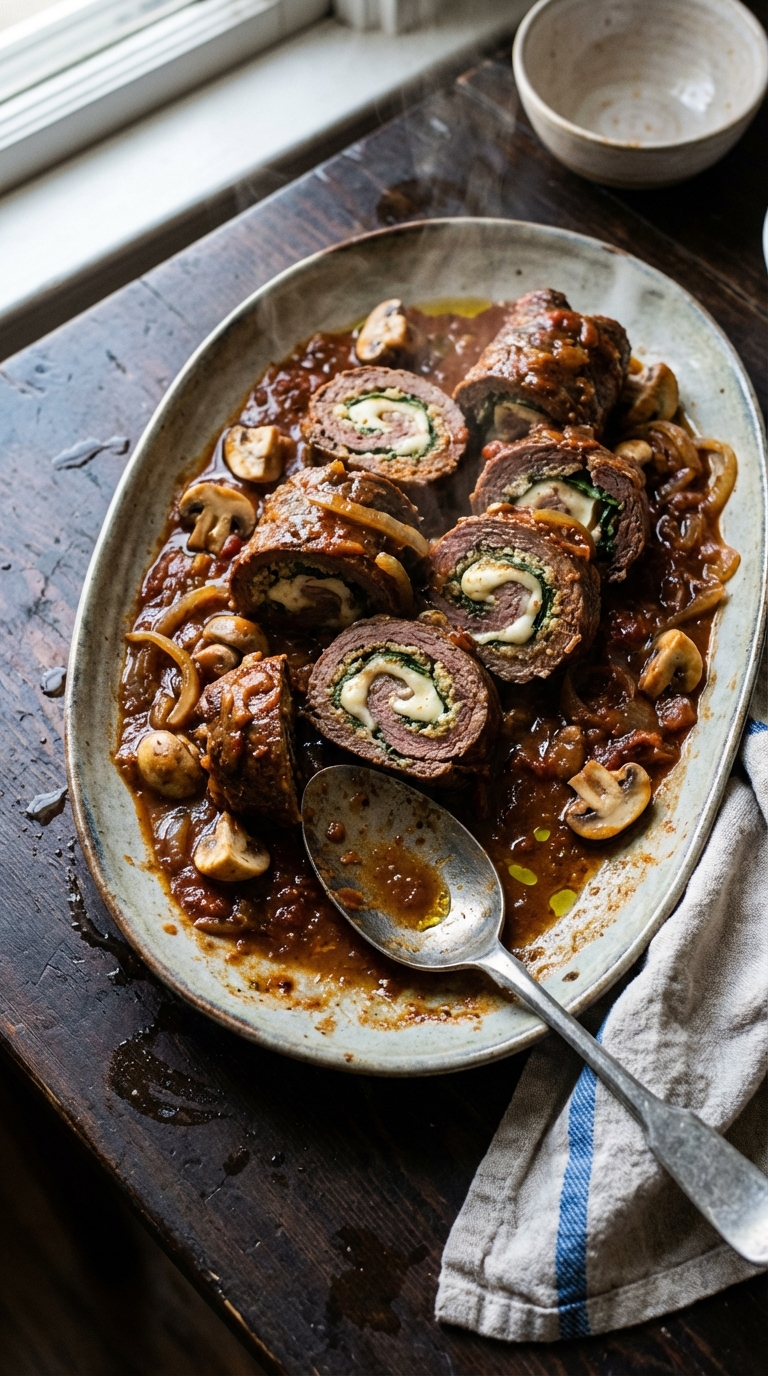
Braciole (pronounced brah-CHO-lay) is one of those awesome Italian dishes that are both rustic and ceremonial at the same time. In southern Italy (particularly in Campania and Puglia) thin slices of beef are rolled around cheese, herbs, and breadcrumbs, then simmered slowly in tomato sauce. The rolls are often cooked alongside the sauce for pasta, turning one pot into a full meal. Italian immigrants brought the dish to the U.S., where it evolved into the red-sauce classic served at Sunday tables and neighborhood trattorias.
This version uses one whole flank steak instead of small roulades — easier to handle, easier to slice, and just as satisfying.
How to Make Italian Braised Braciole:
Step 1 – Prepare the steak
Place the flank steak on a cutting board. With a sharp knife, slice horizontally along the grain to butterfly the meat without cutting all the way through. Open it like a book. Using a meat mallet, pound the steak to an even 1/4-inch thickness. Season both sides with 1 teaspoon salt and 1/2 teaspoon pepper.
Step 2 – Make the filling
In a food processor, pulse the mozzarella, Parmigiano, breadcrumbs, and basil until combined. Spread the mixture evenly over the steak, leaving a small border around the edges.
Step 3 – Roll and tie
Roll the meat lengthwise, jelly-roll style, enclosing the filling. Secure with kitchen twine in five or six places to hold its shape.
Step 4 – Brown the beef
Heat 2 tablespoons of olive oil in a large Dutch oven over medium-high heat. Add the beef and sear until browned on both sides — about 2 minutes per side. Transfer to a plate.
Step 5 – Build the sauce
Add the remaining oil and onions to the pot. Lower heat to medium, season with 1/2 teaspoon salt, and cook until the onions soften and turn golden, about 8 minutes. Add the wine and simmer until nearly reduced, about 2 minutes. Stir in the crushed tomatoes and red pepper flakes. Bring to a boil.
Step 6 – Braise
Return the beef and add the mushrooms to the sauce. Cover, reduce to a gentle simmer, and cook for about 1 1/2 hours, turning the meat occasionally, until it’s tender and slices easily with a knife.
Step 7 – Rest and serve
Remove the beef and let it rest for 10 minutes before slicing thinly. Spoon the sauce and mushrooms over the top to serve.
Recipe Notes
Cut: Flank steak makes this easier to roll and slice, but top round or sirloin can work too.
Wine: Use something dry and medium-bodied — Chianti or Montepulciano fit well.
Serving idea: Serve with pasta, polenta, or crusty bread to soak up the sauce.
Make-ahead: Tastes even better the next day after resting overnight in the sauce.
FAQ – Beef Braciole
What does “braciole” mean?
It refers to thin slices of meat rolled around a filling — traditionally beef, but also pork or veal depending on the region.
Can I make this in the oven instead of stovetop?
Yes. Once the sauce and beef are assembled, cover and bake at 325°F (160°C) for about 1 1/2 hours.
Can I substitute the mushrooms?
You can skip them or swap for roasted red peppers or olives.
How do I slice it cleanly?
Let it rest for at least 10 minutes so the juices redistribute. Use a sharp knife and cut across the grain.
Can I freeze it?
Yes. Slice first, cover with sauce, and freeze for up to 2 months.
Basil and Mozzarella Stuffed Braised Beef Braciole
- Total Time: 125
- Yield: 4 servings
Description
A whole flank steak butterflied, stuffed with fresh mozzarella, Parmigiano, breadcrumbs, and basil, then braised low and slow in a rich tomato-mushroom sauce.
Ingredients
- 1 large flank steak (about 1 1/2 lb / 680 g)
- 1 tsp salt, divided, plus more for pasta water
- 1/2 tsp freshly ground black pepper, divided
- 4 oz (115 g) fresh mozzarella
- 1/2 cup (50 g) Parmigiano Reggiano, grated
- 1/4 cup (25 g) plain breadcrumbs
- 1/4 cup (10 g) fresh basil leaves, packed
- 3 tbsp olive oil, divided
- 1 medium onion, diced
- 1/2 cup (120 ml) dry red wine (Chianti or Montepulciano)
- 1 can (28 oz / 794 g) crushed tomatoes
- 1/4 tsp red pepper flakes
- 8 oz (225 g) cremini or white button mushrooms, sliced
Instructions
- Place the flank steak on a cutting board. Using a sharp knife, slice horizontally along the grain to butterfly the meat without cutting all the way through. Open it like a book. Using a meat mallet, pound the steak to an even 1/4-inch (6 mm) thickness. Season both sides with 1 teaspoon salt and 1/2 teaspoon pepper.
- In a food processor, pulse the fresh mozzarella, Parmigiano, breadcrumbs, and basil until combined into a rough paste. Spread the filling evenly over the steak, leaving a 1/2-inch border around the edges.
- Roll the meat lengthwise, jelly-roll style, enclosing the filling. Secure with kitchen twine tied at 5 or 6 evenly spaced intervals.
- Heat 2 tablespoons of olive oil in a large Dutch oven over medium-high heat. Add the beef roll and sear until browned on all sides, about 2 minutes per side. Transfer to a plate and set aside.
- Add the remaining 1 tablespoon of olive oil and the diced onion to the pot. Reduce heat to medium, season with 1/2 teaspoon salt, and cook, stirring occasionally, until the onion softens and turns golden, about 8 minutes.
- Pour in the wine and simmer, scraping up any browned bits from the bottom, until nearly reduced, about 2 minutes. Stir in the crushed tomatoes and red pepper flakes and bring to a boil.
- Return the seared beef roll to the pot and nestle in the sliced mushrooms. Cover, reduce heat to a gentle simmer, and cook for about 1 1/2 hours, turning the meat occasionally, until the beef is tender and slices easily with a knife.
- Transfer the beef to a cutting board and let it rest for 10 minutes. Remove the kitchen twine, then slice thinly across the grain. Arrange on a platter and spoon the sauce and mushrooms over the top to serve.
Notes
- Flank steak makes this easiest to roll and slice uniformly, but top round or sirloin also work well.
- For the wine, use something dry and medium-bodied — Chianti or Montepulciano are traditional choices. Avoid anything labeled “cooking wine.”
- Serve with pasta, polenta, or crusty bread to soak up the tomato-mushroom sauce.
- Make-ahead friendly: braciole tastes even better the next day after resting overnight in the sauce. Reheat gently over low heat.
- Oven method: instead of stovetop simmering, cover and bake at 325°F (160°C) for about 1 1/2 hours.
- The mushrooms can be swapped for roasted red peppers or olives, or omitted entirely.
- Prep Time: 20
- Cook Time: 105
- Category: Main Course
- Cuisine: Italian
Nutrition
- Serving Size: 1 portion
If you liked this, you are going to love these favorite Italian recipes:
An Italian Classic: How to Make Ciabatta Bread
Maritozzi con la Panna: Cream Filled Italian Buns
Italian Fried Spinach and Cheese Croquettes
Frequently Asked Questions
How do I butterfly the flank steak for the braciole?
Place the flank steak on a cutting board and use a sharp knife to slice horizontally along the grain, being careful not to cut all the way through. Open it like a book and then pound it to an even 1/4-inch thickness.
What type of mozzarella should I use for the filling?
It’s best to use fresh mozzarella for this recipe as it provides a creamy texture that complements the other ingredients well.
Why do I need to tie the rolled braciole with kitchen twine?
Tying the rolled braciole with kitchen twine helps to hold its shape during cooking, ensuring that the filling stays inside while it simmers in the sauce.
If You Liked This Recipe, You’ll Love These
- Prosciutto Stuffed Beef Braciole
- Slow Cooker Balsamic Short Ribs
- The Perfect Condiment: Garlic and Thyme Confit



So tender in the sauce and all gooey with mozzarella and basil inside, these are a real treat. So good over pasta, a delicious Sunday dinner!
I first ran into this dish in Puglia like ten years ago, and had a most lovely meal with this as the main course. So happy to have found a recipe that seems so similar to what I had then. Made it yesterday and it was absolutely perfect!
I always used pine nuts in mine, but this was actually just as good.
Served it with polenta. Comfort food at its best.
My Nonna made small rolls — this version is easier and just as good.
Fantastic dish, I have had this so many times since I found the recipe a few years back. Love this.