
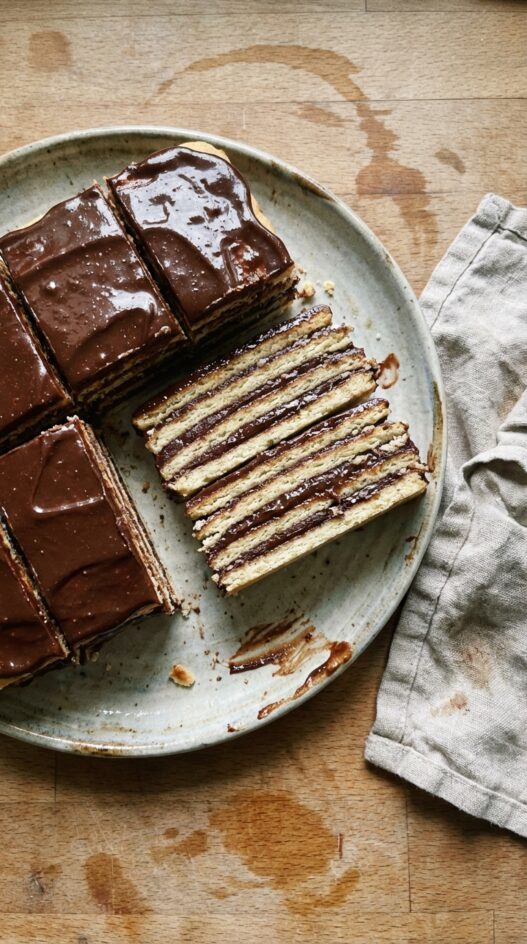
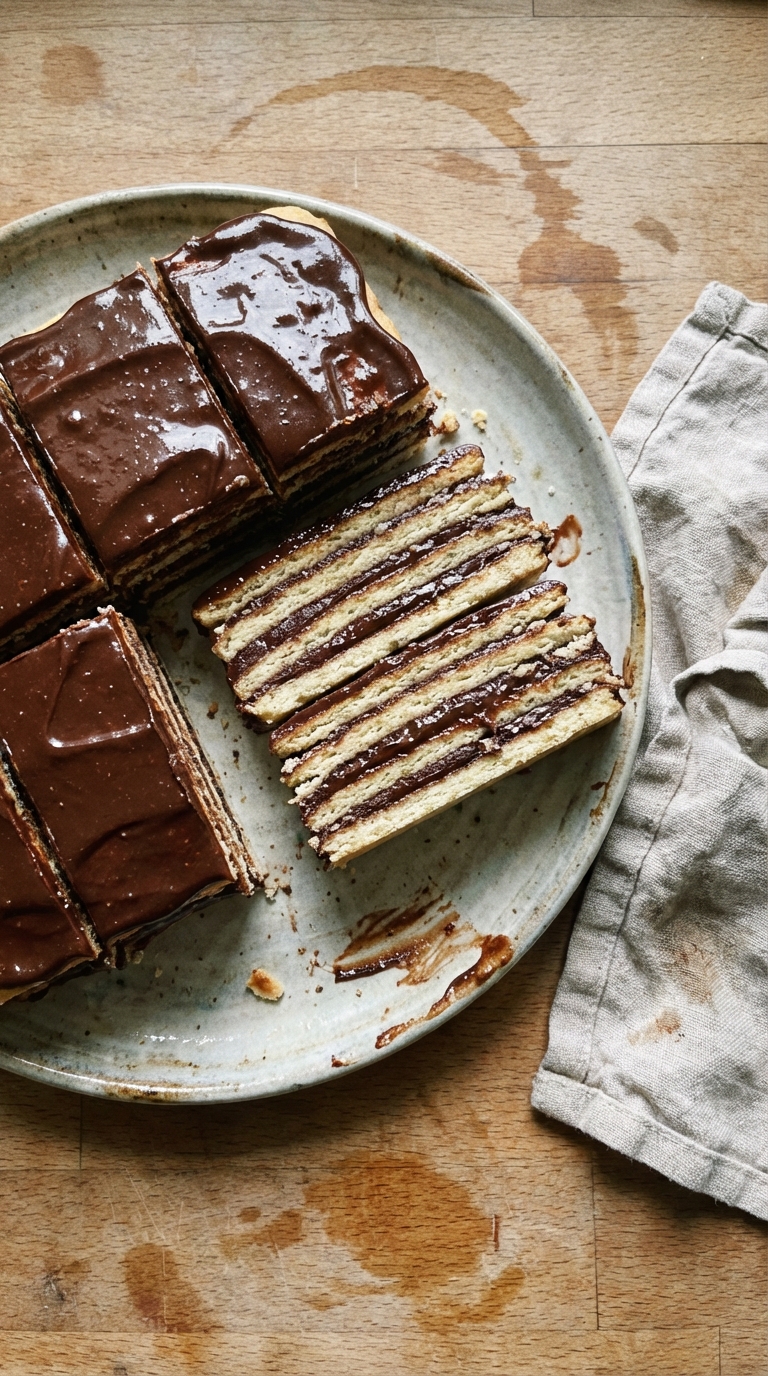
Madjarica shows up at almost every celebration in Croatia, from weddings to name days. The first time I made it, I was working from a handwritten note from a woman in Slavonia who measured everything in coffee cups and handfuls. It took me three attempts to get the layers thin enough. The cake is a project. Six or more pastry sheets, a cooked chocolate custard, and a glaze that needs to set overnight. But when you cut through all those layers and see the clean lines of pastry and filling, you understand why people keep making it.
The filling is rich without being sweet. The filling is slightly bitter from dark chocolate and rum, balanced against the buttery pastry. I make this at least twice a year, and I still find it satisfying every time I peel back the parchment and see the layers stayed even.
How to Make Madjarica
Roll the Dough Thin
Each layer should be about 2-3mm thick. If you can almost see through it, you are close. Thicker layers mean a doughy, heavy cake instead of the delicate structure madjarica is known for.
Roll directly on parchment paper, trim to the size of your pan, and bake each sheet separately at 180C (350F) for 8-10 minutes. They should be pale gold, not brown.
Cook the Custard Until It Pulls Away
Stir the custard constantly over medium heat. When it thickens enough to pull away from the sides of the pan and hold a trail from the spoon, it is done. Undercooking means a runny filling that seeps through the layers.
Add the butter and rum while the custard is still hot. The butter needs the heat to melt and incorporate smoothly.
Let It Set Overnight
Assemble the cake and press it gently with a weight in the fridge overnight. The custard needs time to firm up and the pastry layers need to absorb some moisture. Cutting it too early gives you a mess. A full night changes the texture completely.
Madjarica – Croatian Layer Cake
- Total Time: 110 minutes
- Yield: Serves 12
- Diet: Omnivore
Description
A stunning Croatian dessert, perfect for celebrations. Layers of delicate cake, rich chocolate filling, and a glossy glaze.
Ingredients
- 600 g all-purpose flour
- 2 egg whites
- 180 g sour cream
- 1 tsp baking powder
- 180 g sugar
- 180 g butter
- 4 cups (1 L) milk
- 5 tbsp all-purpose flour
- 5 tbsp cocoa powder
- 1 tsp vanilla extract
- 7 oz (200 g) sugar
- 50 g dark chocolate
- 180 g butter
- 1 tbsp rum
- 100 g dark chocolate
- 3 tbsp oil
- 50 g butter
Instructions
- Prepare the Filling
- In a large saucepan, bring the milk, sugar, and vanilla extract to a boil.
- In a separate bowl, whisk together a portion of the milk with the cocoa powder and flour until smooth.
- Gradually add the cocoa-flour mixture to the boiling milk, stirring constantly. Add the dark chocolate and continue cooking until the mixture thickens.
- Remove from heat and immediately stir in the butter and rum. Mix until the butter is fully melted and the mixture is smooth. Cover with plastic wrap and let cool completely.
- Make the Cake Layers
- In a large mixing bowl, beat the butter, sugar, egg whites, and sour cream until fluffy. Gradually add the sifted flour and baking powder, kneading until a smooth dough forms.
- Divide the dough into six equal parts. Roll each part between two sheets of parchment paper into thin rectangles, sized to fit your baking tray.
- Preheat the oven to 356°F (180°C). Bake each layer, one at a time, on a parchment-lined baking tray for about 8 minutes, or until set but still pale. Cool completely on a wire rack.
- Prepare the Glaze
- In a heatproof bowl, melt the dark chocolate, butter, and oil together, stirring until smooth.
- Assemble the Cake
- Place the first baked layer into a baking tray. Spread an even layer of the filling over it. Repeat the layering process, finishing with a dough layer on top.
- Pour the hot chocolate glaze over the top of the cake, spreading evenly.
- Refrigerate the assembled cake overnight to set.
- Serve
- The next day, cut the cake into small rectangles and serve.
Notes
- To prevent the cake layers from drying out, wrap tightly in plastic wrap after baking and before assembling.
- For a richer flavor, use high-quality dark chocolate in both the filling and the glaze.
- If you don’t have rum, substitute with an equal amount of strong coffee or vanilla extract.
- Prep Time: 60 minutes
- Chilling Time: Overnight
- Cook Time: 50 minutes
- Category: Dessert
- Method: Baking
- Cuisine: Croatian
Nutrition
- Serving Size: 1 slice
- Calories: 400
- Sugar: 50
- Sodium: 100
- Fat: 25
- Saturated Fat: 15
- Unsaturated Fat: 10
- Trans Fat: 0g
- Carbohydrates: 50
- Fiber: 3
- Protein: 4
- Cholesterol: 50
Frequently Asked Questions
Can I use instant yeast dough instead of pastry dough?
No. Madjarica uses a pastry dough rolled very thin. Yeast dough would be too puffy and soft. The thin, crisp pastry layers are what define the cake.
How long does madjarica keep?
Covered in the fridge, it keeps for 5-6 days and actually improves over the first two days as the layers soften and meld with the filling. It does not freeze well because the custard changes texture.
What can I substitute for rum?
Strong brewed espresso works well. It keeps the slight bitterness that balances the chocolate. You could also use vanilla extract, but you lose some of the depth that rum or coffee provides.

My grandmother was from Slavonia and this was the cake she made for every single name day, measured out in coffee cups exactly like you describe. I still have her handwritten card and have been too intimidated to attempt it. Six pastry layers is no small thing. Seeing it broken down step by step finally gives me the push I needed. Wish me luck!
So many “Croatian” recepies we see around internet nowdays but – is it really so!?
I would bet everything this cake originally comes from Hungary, or more specifically, from Austrian-Hungarian empire’s period – 18-th or 19-th century, or even earlier, but I do not have that knowledge.
Croats are proud of their country, that is fine, but sometimes it is good idea to do some research before stamping everything “Croatian”.
Sascha, thanks for your input and comment, much appreciated. Tamara (the author) is Croatian, and she rightly points to the Hungarian inspiration and influence on this and many other recipes. She also points out that it has a very important role to play in Croatian traditional cooking. I believe in this case, two things are true at the same time.
Happy New Year!
This looks so cool, not sure I dare try it, but I am sure it is delicious!
I made this yesterday, and it was a massive success!
The post wont accept the Croatian letter for dj. I’m fine with Madjarica.
You state (above): ‘I still don’t have an explanation for this name.’
The explanation (from my profesorica hrvatskog) is that the cake is a typical Ma?arska (Hungarian) cake that came to Croatia from Hungary. Hence it is called ma?arica cake.
That’s incorrect. I recommend doing some research before stating such things. How disappointing.
These turned out great, very rich and tasty! I had to make a second round of chocolate, I just couldn’t get lumps out. Second batch, I sifted flour into cold milk. It worked a treat. Next time I’d bake the biscuit a bit longer, I prefer mums firm cake, mine was a bit soft.
To Diana, to stop lumps in the filling, first only put a few tablespoons of the milk into the flour to slowly form a thick paste. Then slowly add a few more tablespoons of milk to work this paste into a slurry before slowly adding more milk so mixture becomes becoming runny. Then slowly pour this into the milk mixture, stirring continuously. Hope that helps.
Hi and thanks for this recipe. Love the flavour! I have problems however with the chocolate glaze – When I pour it on it’s beautiful and shiny, but after cooling overnight in the fridge it always becomes cracked. Do you have a remedy for this or any advice?
What size pan do you use for the cake layers?
There is a lot of cross-pollination between Croatians & Hungarians, especially in some regions. Hungarians have TWO desserts this reminds me of… Dobos torte & Gerbeau szellet. Could the Croatians just really have liked the desserts that the ma?ar made? Coffeehouse culture may also have something to do with this & they were very popular in Budapest, Vienna & Paris. Hungarians & Croatians also share a fondness for palacsinta/palacinke.