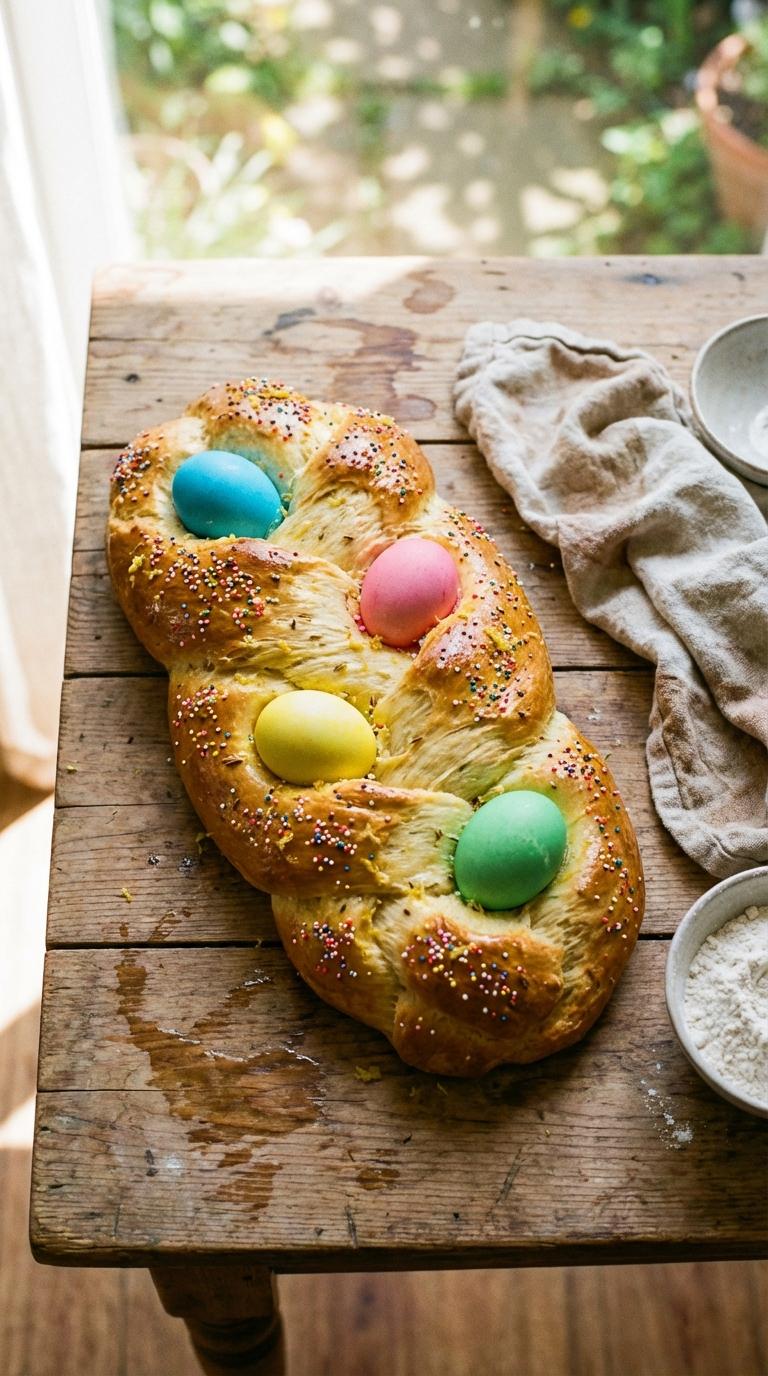
Five cups of flour, a fistful of anise seeds, and a strip of lemon zest. That is the backbone of Italian Easter bread, and it has been on tables across Italian-American households for longer than anyone can pin down. The dough is soft. Slightly sweet, with a citrus warmth from the zest that fills your kitchen before you even open the oven. Have you ever noticed how anise and lemon belong together? In this bread, you get both in every bite.
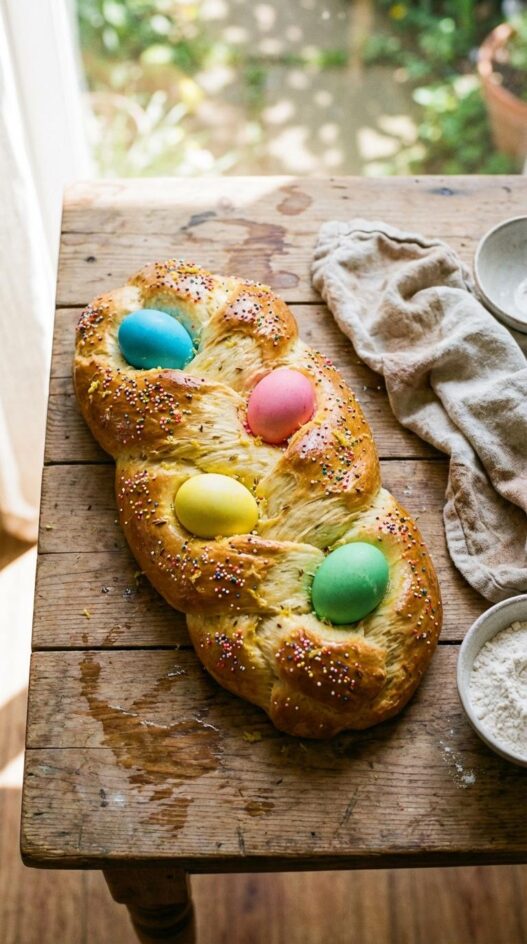
The colored eggs bake right into the dough, tucked into a braided ring, and when you pull a piece off at the table, it feels like a holiday. I make this every spring. The nonpareils on top give it that old-school bakery finish that no other decoration quite matches.
How to Make Easter Bread with Colored Eggs
Use Warm Milk, Not Hot
Heat the milk to about 43C (110F). Too hot and it kills the yeast. Too cool and the dough takes forever to rise.
If you can hold your finger in it comfortably, the temperature is right.
Nestle the Eggs Before the Final Rise
Press the colored eggs gently into the shaped dough so they sit snug but not buried. They need to stay visible through baking.
Brush egg wash over the entire surface, including over the eggs, then scatter the nonpareils while the wash is still wet so they stick.

Pane di Pasqua: Italian Easter Bread with Colored Eggs
- Total Time: 3 hours 15 mins
- Yield: 0 Makes 1 Large Loaf, About 10 Servings
Description
*Can be found in Patsy’s Italian Family Cookbook
Ingredients
SWEET DOUGH
- 1 cup whole milk
- 1/2 cup sugar
- 2 large eggs
- 1 tablespoon instant (also called bread-machine yeast)
- Finely grated zest of 1 lemon
- 2 teaspoons anise seeds
- 1 1/2 teaspoons salt
- 5 cups unbleached all-purpose flour (as needed)
- 6 tablespoons 3/4 stick unsalted butter, cut into tablespoons, at room temperature, plus softened butter for the bowl
MISC
- 6 colored eggs (see Note)
- 1 large egg yolk beaten with 1 teaspoon whole milk (for glaze)
- 2 teaspoons nonpareils (colored sugar decorations for garnish)
Instructions
- To make the sweet dough: combine the milk, sugar, eggs, yeast, lemon zest, anise seeds, and salt together in the bowl of a heavy-duty stand mixer. Mix with the paddle attachment on low speed until combined. Gradually add 3 1/2 cups of the floor to make a thick batter. One tablespoon at a time, beat in the butter, waiting for the first addition to be absorbed before adding more. Gradually add enough of the remaining flour to make a soft dough that cleans the bowl. Switch to the dough hook and mix on medium-low speed, occasionally pulling down the dough as it climbs up the hook, until the dough is smooth, shiny, and slightly sticky (do not add too much flour), about 8 minutes.
- To make the dough by hand: whisk the milk, sugar, eggs, yeast, lemon zest, anise seeds, and salt together in a large bowl. Gradually stir in 3 1/2 cups of the flour to make a thick batter. One tablespoon at a time, stir in the butter, waiting for the first addition to be absorbed before adding more. Gradually stir in enough of the remaining flour to make a dough that cannot be stirred. Turn the dough out onto a lightly floured work surface and knead, adding more flour as necessary, until the dough is smooth, supple, and slightly sticky (do not add too much flour), about 10 minutes.
- Butter a large bowl. Gather the dough into a ball. Turn the dough in the bowl to coat it, leaving the dough smooth side up. Cover tightly with plastic wrap and let stand in a warm place until doubled in volume, about 1 1/4 hours. (Or refrigerate the dough for at least 8 and up to 24 hours.)
- Line a large rimmed baking sheet with parchment paper. Divide the dough into thirds. Roll each piece of dough underneath your palms on the work surface into an 20-inch rope, tapering the ends. Line up the ropes next to each other. Starting from the center, braid the ropes to each end, pinching the rope ends together to shape into a tapered loaf. Transfer the braid to the parchment paper-lined baking sheet. Cover loosely with plastic wrap. Let stand in a warm draft-free place until almost doubled in volume, about 1 hour (or about 1 1/2 hours for chilled dough). During the last 15 minutes of rising, distribute the eggs evenly over the top of the braid, nesting them in the seams.
- Preheat the oven to 350°F
- Brush the braid lightly with the egg glaze and sprinkle with the nonpareils. Bake until the loaf is golden brown and sounds hollow when tapped on the bottom, about 30 minutes. Let cool completely before slicing.
Notes
To color the eggs, you can use a commercial coloring set, or make your own coloring dip. For each color, combine 1 ½ cups boiling water and 1 teaspoon white distilled vinegar in a large glass. Tint the liquid as desired with food coloring gel (which has deeper colors than liquid coloring, although you can use liquid). Dip each egg in the coloring mixture, and let stand for at least 2 minutes, or until the desired color is reached. Remove the egg from the coloring mixture and let dry on a wire cooling rack set over a baking sheet.
- Prep Time: 30 mins
- Cook Time: 30 mins
- Category: Bread
- Cuisine: American
Frequently Asked Questions
Can I use active dry yeast instead of instant yeast?
Yes, but dissolve it in the warm milk first and let it sit for about 10 minutes until it foams. Use the same amount. Instant yeast gets mixed straight into the flour, so if you swap, just adjust that one step.
Will the colored eggs crack or leak dye during baking?
Use store-bought dyed eggs or eggs dyed with food-safe coloring and fully dried before placing. They hold up well at 180C (350F). Some color may transfer slightly to the dough, which honestly looks charming.
How do I store Easter bread, and how long does it last?
Wrap it tightly in plastic wrap or keep it in an airtight container at room temperature. It stays soft for about 3 days. After that, slice it thick and toast it with a bit of butter.
If You Liked This Recipe, You Are Going To Love These:
Crescia: Umbria’s Spectacular Easter Cheese Bread