
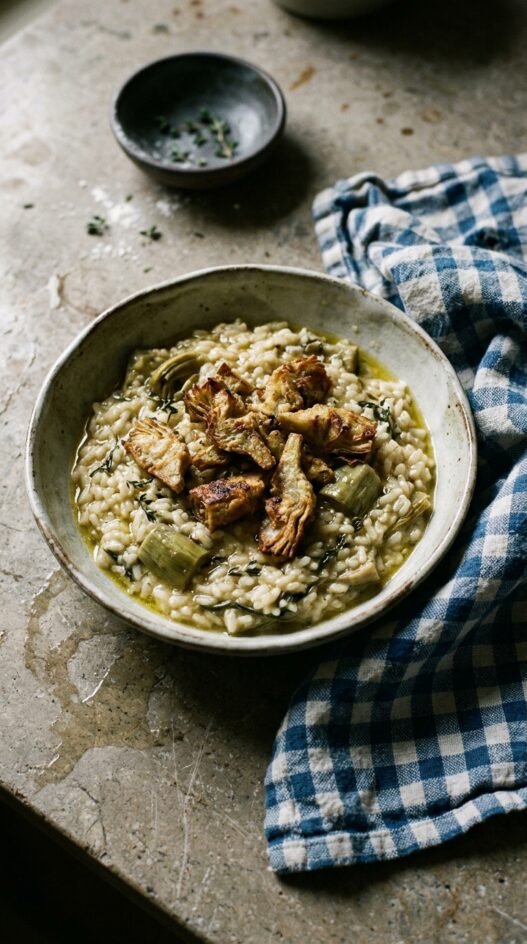
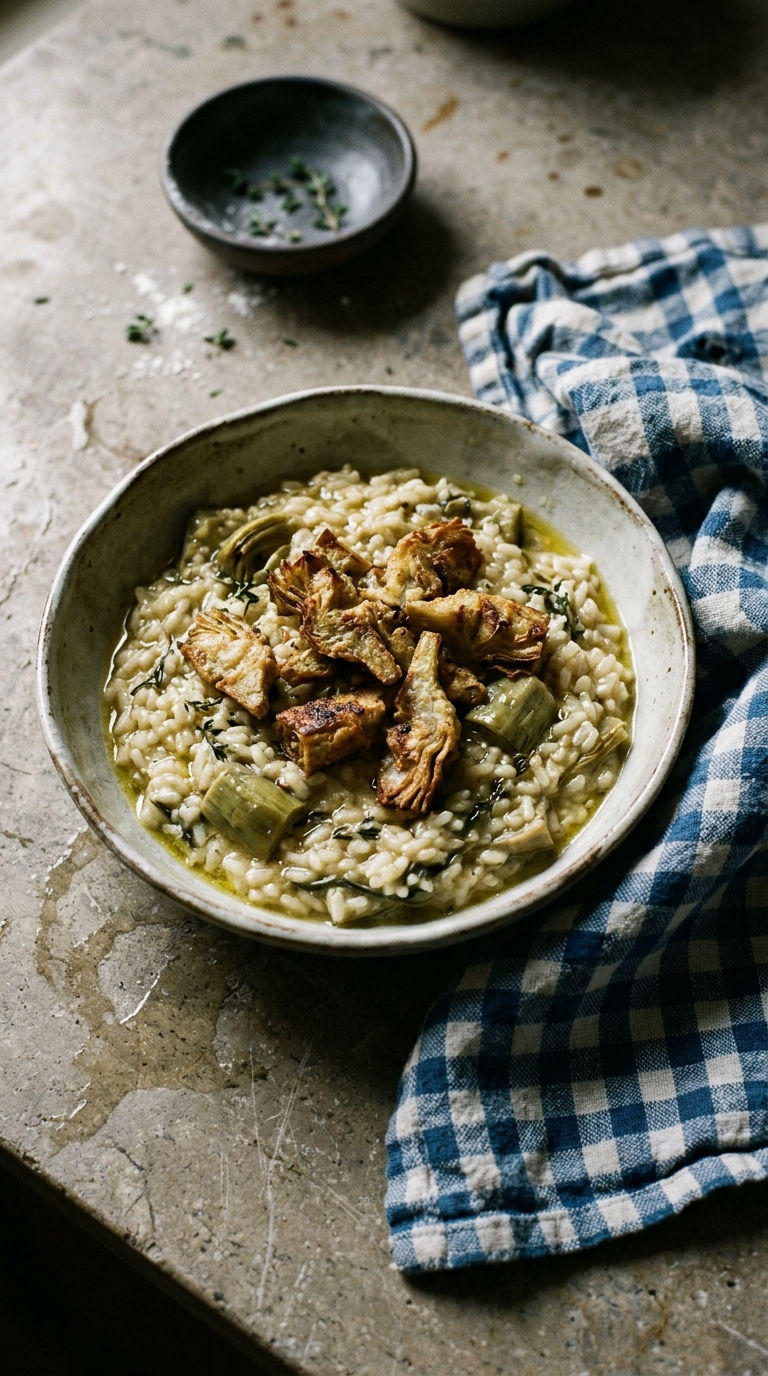
When, wandering about markets, you bump into boxes of artichokes on sale, well, you know it’s officially Spring. No vegetables – except maybe peas – are more related to Spring than these sharp-scaled, thistle-like, prickly dark green buds. Artichokes can be cooked in many ways – boiled, roasted, stuffed, sliced for a frittata, even pickled – but “their death”, as we say in Tuscany, is either fried or in a risotto, meaning that there are no other ways better than these to make the finest use of artichokes.
No doubt artichokes and risotto are like two peas in a pod (we’re in Spring: can we help talking about peas?). On the other hand, even slippers taste good if fried (“fritta è buona anche una ciabatta”), as we say here in Tuscany, and fried artichokes are no exception; hence the idea of combining the two of them in the same dish.
The making of risotto – and those who are a little familiar with its preparation will agree with me – is quite a standard matter. One can easily assert that once you know how to prepare a mushroom or an artichoke risotto, you can make risotto with any vegetable your creativity suggests.
However frying artichokes is slightly different. There are many ways, involving regional and personal variations, to fry artichokes, but according to Italian writer Pellegrino Artusi, one of the most authoritative voices of the boot-shaped peninsula in the cooking field, the Tuscan method seems to be unsurpassed.
“This is a basic fry”, Pellegrino Artusi wrote in 1891, “but strange as it may seem, not everyone knows how to make it. In some places, they boil the artichokes before frying them, which is not a good idea. In others, they first cover them in batter. Not only is that not necessary, but it takes away their natural flavor. Here is the method used in Tuscany, which is the best. Tuscany is the region, where by dint of using and abusing fruits and vegetables as much as they do, they end up cooking them best.”
Artusi wasn’t of Tuscan origin. He was born in 1820 in Forlimpopoli (a small town in Emilia Romagna, another Italian region renowned for its famous culinary traditions), but he spent most of his life in Florence, where he eventually died in 1911. A fine gourmand and a literature enthusiast, Pellegrino Artusi gathered many recipes (790 to be precise) during his frequent journeys. He had these recipes meticulously tested by his personal Tuscan cook and ultimately managed to publish them in 1891 in his masterpiece cookbook “La scienza in cucina e l’arte di mangiar bene” (“Science in the Kitchen and the Art of Eating Well”, here in the English translation by Murtha Baca and Stephen Sartarelli). Though I cannot claim his statement on fried artichokes to be completely true, surely Artusi’s method – that he had learnt during his long sojourn in Tuscany – is undoubtedly a very good one.
Here’s the method explained in his own words:
“As an example, take two artichokes, remove the tough outer leaves, trim off the sharp ends, cut off the stems, and slice in half. Then cut the artichoke halves into wedges, or to be more precise in slices, about 8 to 10 of them for each artichoke, even if they are not particularly large. As you cut them up, toss them into cold water. When they are quite cold, take them out of the water and blot them or just squeeze dry, then dredge them immediately in flour which will stick well to them.
Neat the white of one egg until half-stiff, one egg being enough for two artichokes; then combine the yolk and the white, and salt. Put the artichokes in a colander to shake off the excess flour. Then drop them in the egg, stir and allow to sit a while until they absorb the egg. Place the pieces one at a time in a skillet sizzling with oil. When they have turned a nice golden color, take them out and send to the table […].” Sounds scrumptious, doesn’t it?
Print
Artichoke Risotto with Thyme and Artusi’s Fried Artichokes
- Total Time: 50 minutes
- Yield: 2 servings
Description
This artichoke risotto combines creamy Arborio rice with tender artichoke wedges, topped with crispy fried artichokes using a classic Tuscan method.
Ingredients
- 160 g Arborio rice
- 6 artichokes
- 600 ml vegetable stock
- Extra Virgin olive oil
- 1 garlic clove, peeled
- 1 shallot, peeled and sliced
- Chili pepper flakes to taste
- Salt and pepper to taste
- Sprig of fresh thyme
- 1 egg
- Flour for dredging
Instructions
- Clean the artichokes by removing stems, sharp ends, and all hard leaves. Cut 4 artichokes into wedges for the risotto.
- Slice the remaining 2 artichokes into wedges for frying, following Artusi’s method. Soak all the artichoke pieces in cold water.
- For the risotto, heat a drizzle of olive oil in a pan over medium heat. Add the shallot and garlic, cooking until the shallot is soft and translucent, about 3-4 minutes.
- Add the Arborio rice to the pan, stirring to coat the grains in oil. Cook for 2 minutes until the rice is slightly translucent.
- Begin adding the vegetable stock, one ladle at a time, stirring frequently. Allow each addition to be absorbed before adding the next. Continue until the rice is creamy and tender, about 18-20 minutes.
- In the last 5 minutes of cooking, add the artichoke wedges to the risotto and season with salt, pepper, and chili flakes to taste. Stir in fresh thyme leaves.
- For the fried artichokes, drain and dry the artichoke slices. Dredge them in flour, shaking off the excess.
- Beat the egg white until half-stiff, then combine with the yolk and a pinch of salt. Dip the floured artichokes into the egg mixture and let them sit for a few minutes.
- Heat olive oil in a skillet over medium-high heat. Fry the artichoke slices until golden brown, about 3-4 minutes per side. Drain on paper towels.
- Serve the risotto hot, topped with the crispy fried artichokes.
Notes
- For best results, use fresh artichokes and ensure they are well-dried before frying.
- The risotto should be stirred constantly to achieve the creamy texture.
- Serve immediately for the best flavor and texture.
- Leftover risotto can be stored in the refrigerator for up to 2 days.
- Prep Time: 20 minutes
- Cook Time: 30 minutes
- Category: Side Dish
- Cuisine: Italian
Nutrition
- Serving Size: 1 serving
- Calories: 450
- Sugar: 2
- Sodium: 600
- Fat: 18
- Carbohydrates: 65
- Fiber: 8
- Protein: 12
- Cholesterol: 70
If You Liked This Recipe, You’ll Love These
- Sicilian Caponata al Forno
- Cauliflower with Chimichurri and Tahini
- Crispy Baked Rosemary Polenta Fries
- Grilled Tofu Tacos with Pickled Radishes
Frequently Asked Questions
Why does Artusi’s method specifically avoid battering or pre-boiling the artichokes before frying?
Artusi wrote in 1891 that pre-boiling is “not a good idea” and batter “takes away their natural flavor.” His Tuscan method — soaking in cold water, drying thoroughly, dredging in flour only, then dipping in a half-stiff beaten egg — preserves the artichoke’s own taste while giving a light, crispy coating.
What is the purpose of beating the egg white until only “half-stiff” before combining with the yolk?
A half-stiff white — not fully foamy, not liquid — gives the egg mixture enough body to cling well to the floured artichoke slices. Stir and let the pieces sit in the egg mixture for a few minutes so they fully absorb it before frying in sizzling oil.
How are the 6 artichokes divided between the risotto and the frying?
Four artichokes are cleaned and cut into wedges to cook into the risotto during the last 5 minutes of the 18–20 minute rice cook. The remaining 2 artichokes are sliced following Artusi’s method and fried separately, then served on top of the finished risotto.






Thank you all! Risottos always make a great meal and they’re so easy to make, as I see you know.
Great recipe, Rita. I also recently made an artichoke risotto…
http://tastytravails.blogspot.com/2011/01/where-you-been-making-risotto.html
I enjoy making risottos but have never tried artichoke. It sounds and looks delicious.
What a great recipe