
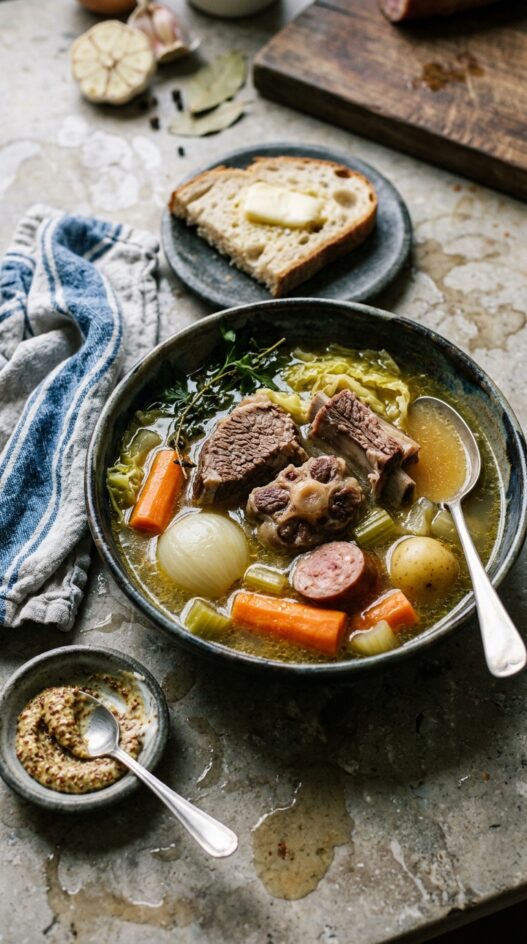
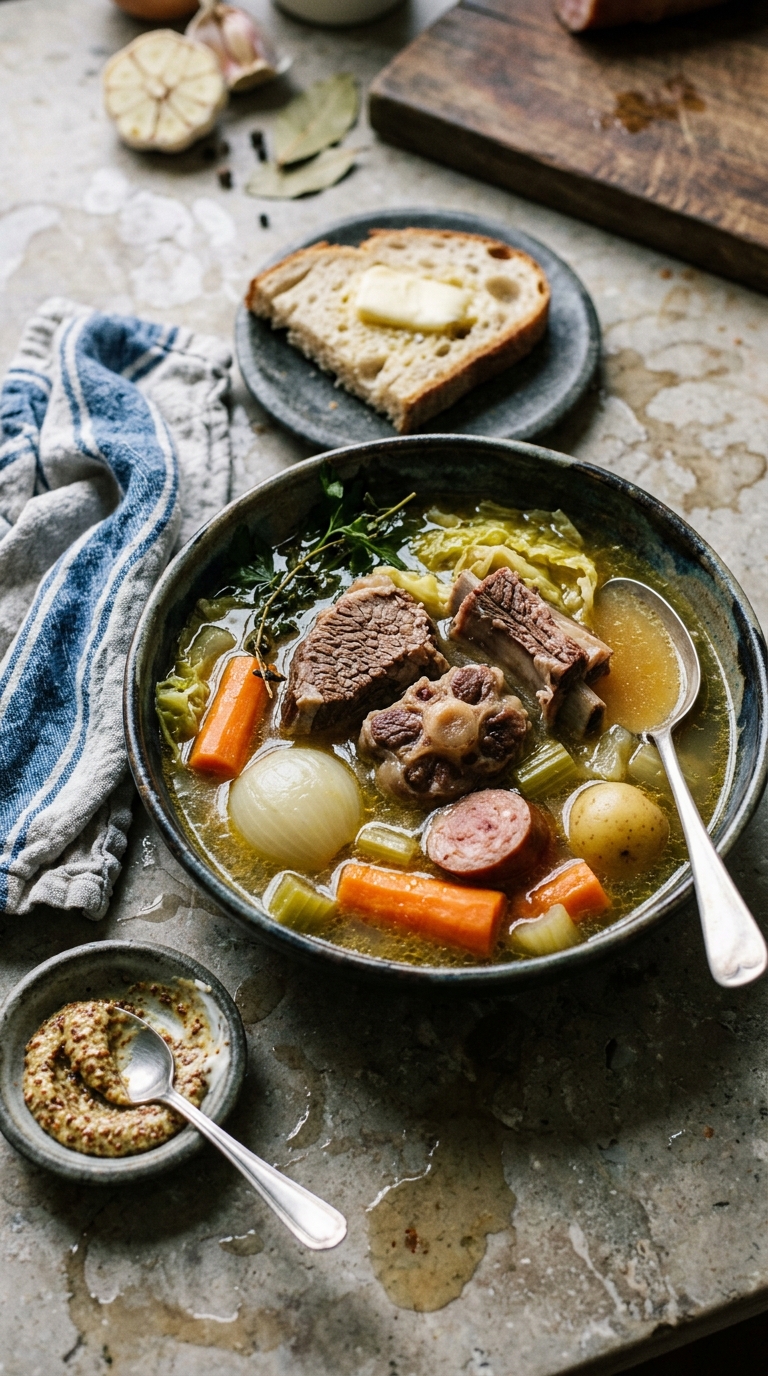
Pot-au-feu, pronounced in French as /paw-toe-fuh/ and literally translating to “pot over fire”, is a peasant’s feast of root vegetables and cheap cuts of meats served with country bread and mustard.
Somewhere along the lines, the culinary world eschewed boiled meats and vegetables as “bland” and “boring”–favoring, instead, techniques like searing, blanching, and sautéing. This could not be further from the truth. The basic method of boiling can transform carrots, cabbages and turnips into exquisite vegetables that melt in your mouth–and tough cuts of meat, like brisket or shanks, into tender and succulent wonders.
Pot-au-feu, pronounced in French as /paw-toe-fuh/ and literally translating to “pot over fire”, is a peasant’s feast of root vegetables and cheap cuts of meats served with country bread and mustard. The only real luxury needed here is time, as it would take at least two hours for the meat to truly soften (four hours would be best). You’ll want to add the vegetables in at the last hour so that they don’t completely disintegrate.
You can use any type of meat that does well with long cooking times, like brisket, short ribs, rump roast, shoulder cuts, etc. I find that on the vegetable side, root vegetables are hardy enough to stand up to the heat. If you don’t eat meat, I think it’s still worth trying with your favorite veggies. Make sure that you have a very large pot or Dutch oven that can easily house all of these ingredients. It’s nice to vary the meats, vegetables and herbs each time, but here’s a basic recipe for you to use as a guideline–feel free to adjust based on what’s available. For serving, I like to sometimes remove the meat and vegetables and arrange them on a large wooden cutting board, carving them into decent-sized portions, and then serving the prized broth in small bowls for sipping on the side.
Recipe Notes:
- Bouquet Garni: The bouquet garni is an essential element in many French dishes. It’s a bundle of herbs and spices that infuses the dish with depth and aroma. While the given herbs are traditional for Pot au Feu, feel free to experiment with your favorite herbs.
- Meat Choices: The combination of different meats gives this soup its distinct hearty flavor. However, if some cuts are unavailable, you can substitute with others. Just ensure you include a bone-in cut for a rich broth.
- Cooking Time: The simmering time mentioned in the recipe provides tender meat. However, the exact time might vary based on the cut and quality of your meat. It’s crucial to check for tenderness and adjust accordingly.
- Leftovers: Pot au Feu tastes even better the next day. If you have leftovers, store the meat, vegetables, and broth separately. This will prevent the vegetables from becoming overly soft when reheating.
- Serving Suggestions: Traditionally, Pot au Feu is enjoyed with strong condiments like mustard or horseradish to cut through the richness. However, feel free to serve it with your choice of condiments. Consider adding gherkins or pickled onions for an added flavor dimension.
- Bone Marrow: If you’ve included marrow bones, once cooked, the marrow can be spread on toasted country bread as a decadent treat.
Step by Step Guide to Making Pot au Feu – French Peasant Soup
-
Prepare the Bouquet Garni:
- Wrap the garlic, bay leaves, parsley sprigs, thyme sprigs, cloves, and black peppercorns in cheesecloth.
- Securely tie the cheesecloth using kitchen twine to create your bouquet garni.
-
Begin the Soup:
- In a large stockpot, place the bouquet garni, brisket, oxtail, short ribs, shank, marrow bones, onions, carrots, and celery.
- Cover the ingredients with water.
- Bring the mixture to a boil. As it boils, skim and discard any scum that rises to the surface.
- Reduce heat to a simmer. Cover the pot and let it simmer for 2.5 to 3 hours. Check occasionally to ensure the meat becomes tender. Adjust the cooking time based on your tenderness preference.
-
Add Remaining Ingredients:
- Incorporate the kielbasa sausages, cabbage, and baby potatoes into the pot.
- Continue simmering for an additional 30 minutes to 1 hour until the vegetables are tender but still hold their shape.
-
Serving:
- Carefully transfer the meats and vegetables onto a separate tray or platter. You can cut them into smaller portions or serve them whole.
- Taste the broth and adjust seasoning with salt and pepper as needed.
- Ladle the broth into serving bowls.
- Serve alongside warmed country bread, room temperature salted butter, and either strong mustard or a creamy horseradish mixture.

Pot au Feu – French Peasant Soup
- Total Time: 230 minutes
- Yield: Serves 6-8
- Diet: Omnivore
Description
Hearty beef and root vegetable stew, simmered to perfection. Serve with crusty bread and mustard for a classic French meal.
Ingredients
- 1 head of garlic, halved crosswise
- 2 bay leaves
- 10 sprigs of parsley
- 10 sprigs of thyme
- 3 whole cloves
- 1 tsp whole black peppercorns
- 1 lbs (454 g) beef brisket
- 6 pieces of oxtail
- 6 pieces of beef short ribs
- 1 beef shank
- 3 pieces of marrow bones
- 4 links of Polish kielbasa sausages
- 2 white onions, peeled and halved
- 5 large carrots, peeled and cut into 2-inch pieces
- 2 celery stalks, chopped
- 1 small head of savoy cabbage, halved
- 1 lbs (454 g) baby potatoes
- Country bread, warmed or toasted
- Salted butter, at room temperature
- Strong mustard or horseradish mixed with sour cream
Instructions
Prepare the Bouquet Garni
- Wrap the garlic, bay leaves, parsley sprigs, thyme sprigs, cloves, and black peppercorns in cheesecloth and securely tie the cheesecloth using kitchen twine.
Begin the Soup
- In a large stockpot, combine the bouquet garni, brisket, oxtail, short ribs, shank, marrow bones, onions, carrots, and celery; cover with water; bring to a boil; skim off any scum; reduce heat to a simmer; cover and simmer for 2.5 to 3 hours, checking occasionally for tenderness.
Add Remaining Ingredients
- Add the kielbasa sausages, cabbage, and baby potatoes; simmer for an additional 30 minutes to 1 hour, until vegetables are tender.
Serving
- Transfer the meats and vegetables to a separate tray or platter; cut into smaller portions or serve whole; taste and adjust broth seasoning with salt and pepper; ladle broth into bowls; serve with warmed country bread, room temperature salted butter, and either strong mustard or a creamy horseradish mixture.
Notes
- For deeper flavor, sear the beef before adding it to the pot.
- Leftover Pot au Feu broth can be stored in the refrigerator for up to 5 days and used as a base for other soups or stews.
- Feel free to substitute other hearty root vegetables like parsnips or turnips for some of the carrots or potatoes.
- Prep Time: 20 minutes
- Cook Time: 210 minutes
- Category: Soup
- Method: Braising
- Cuisine: French
Nutrition
- Serving Size: 1.5 cups
- Calories: 600
- Sugar: 5
- Sodium: 800
- Fat: 35
- Saturated Fat: 15
- Unsaturated Fat: 15
- Trans Fat: 0.5g
- Carbohydrates: 40
- Fiber: 10
- Protein: 40
- Cholesterol: 150
Frequently Asked Questions
How long should I cook the brisket for it to become tender?
You should cook the brisket for at least two hours, but four hours is ideal for achieving optimal tenderness.
When should I add the root vegetables to the pot?
Add the root vegetables during the last hour of cooking to prevent them from completely disintegrating.
Can I use other types of vegetables in the Pot Au Feu?
Yes, you can experiment with other hardy vegetables, but root vegetables like carrots, turnips, and cabbages are recommended for their ability to withstand long cooking times.







My grandmother cooked pot-au-feu every Sunday in January when I was a kid. The broth served first, then the meat and vegetables on the board. I’ve tried fancier French recipes since and somehow none of them settle into me like this one does.