
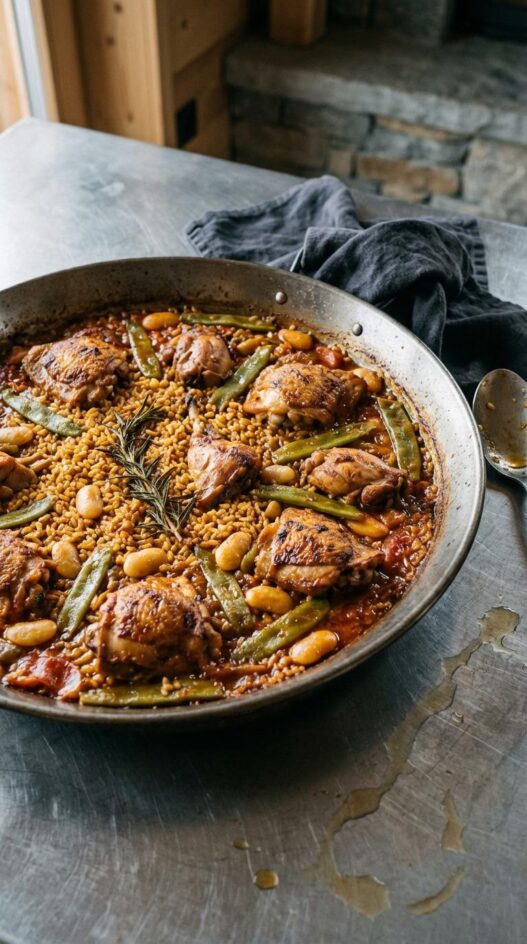
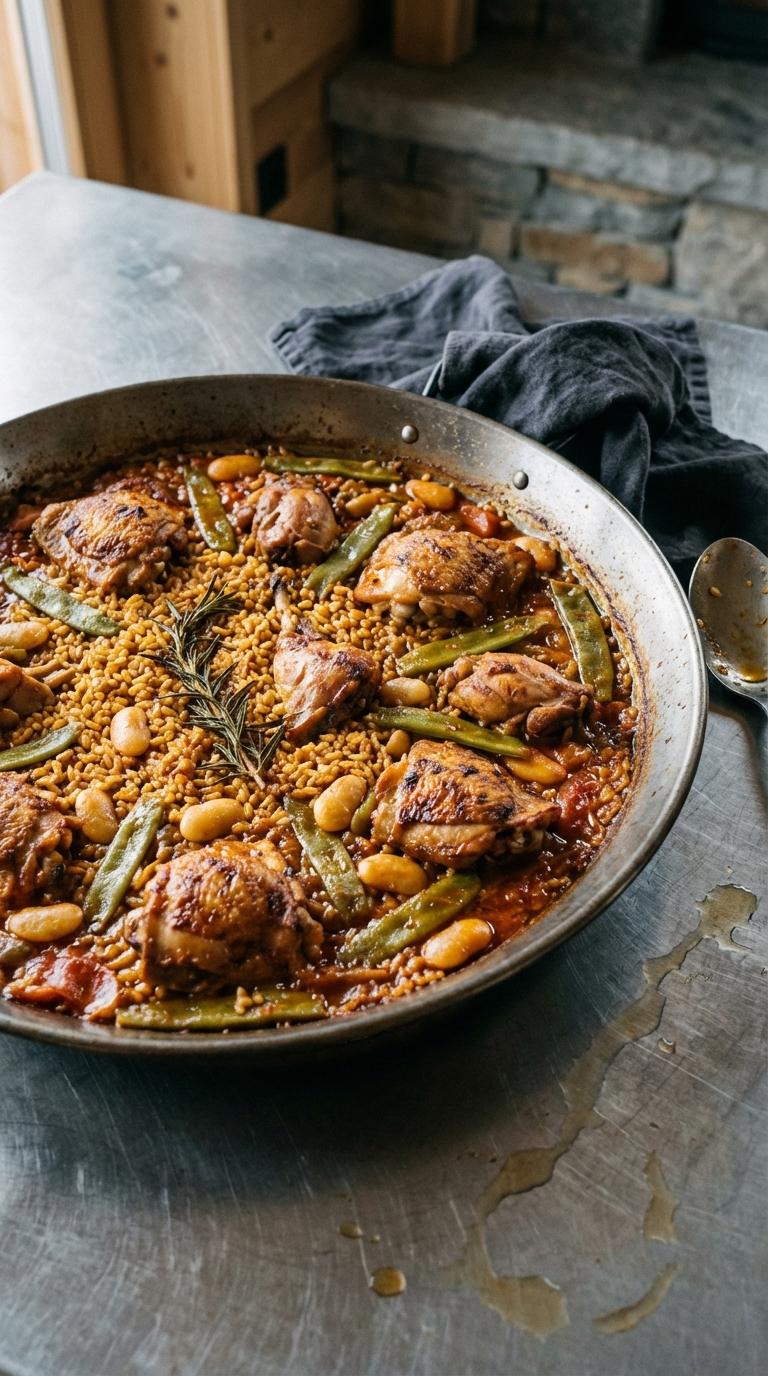
Paella Valenciana is not the seafood-laden dish that fills tourist menus along the Spanish coast. It is a land dish from the rice-growing region around Valencia: chicken, rabbit, flat green beans, butter beans, and short-grain rice cooked in saffron-tinted stock. What separates good paella from great paella is the socarrat, the toasted, caramelized crust that forms on the bottom of the pan in the final minutes. That crust is what you work toward the entire time. It is why paella should be cooked in a wide, shallow pan rather than a deep pot. Bomba or calasparra rice absorbs stock without turning mushy, so it is worth hunting down.
Arborio is an acceptable backup; long-grain is not an option. The single rule that most people break: do not stir the rice after you spread it across the pan. Stirring releases starch and the dish drifts toward risotto. Let it cook undisturbed, listen for the faint crackle from the bottom in the last few minutes. Serve directly from the pan with a clean kitchen towel laid over it during the five-minute rest. This is the one dish we make when we want the table to slow down and actually pay attention.
Sear the Meat, Then Build the Sofrito
It starts with the oil hot and the chicken and rabbit salted. Give them eight to ten minutes and actually let them brown — deep brown, not pale gold. The fond left on the bottom of the pan is the first layer of flavor in the dish, and there is no second chance at it. Pull the meat onto a plate and leave the oil exactly where it is.
The beans go into that same oil until the flat green beans blister in spots, then get pushed out to the edge of the pan. Grated tomato goes into the middle. This is the step people rush: cook it three or four minutes until it darkens and the water has gone out of it, then the smoked paprika for thirty seconds and no longer. Paprika scorches fast and turns bitter, and there is no coming back from that.
Add the Rice and Leave It Alone
Meat back in, warm stock in, saffron with its soaking liquid, one sprig of rosemary. Let it cook hard for fifteen minutes to build the broth, and taste it now — this is the last moment you can fix the salt. Once the rice goes in you are committed.
Then sprinkle the rice across the pan in an even layer and stop touching it. This is the cardinal rule and it is the one everybody breaks. Stirring pulls the starch out and you end up with risotto, which is a fine thing to eat but it is not this. Spread the beans and meat around, put the spoon down, walk away.
Chasing the Socarrat
Medium-high for eight to ten minutes, then down to medium-low for another eight to ten while the rice drinks the stock. For the last two or three minutes, turn the heat up and listen. You want a faint crackling from the bottom of the pan and the smell of something toasting — that is the socarrat forming, the caramelized crust everyone at the table will quietly compete for. If you smell actual burning, pull it off the heat immediately. The gap between the two is about thirty seconds, and your nose is a better instrument than the clock here.
Off the heat, covered loosely with a kitchen towel, five minutes. Serve it straight out of the pan and scrape the bottom.
Print
Paella Valenciana
- Total Time: 90 minutes
- Yield: 6 servings
Description
True paella Valenciana comes from the rice fields around Valencia and is nothing like the seafood-loaded tourist version served elsewhere. The original is a land dish: chicken, rabbit, green beans, and butter beans cooked with short-grain rice tinted golden with saffron. The measure of a great paella is the socarrat, the caramelized crust of rice that forms on the bottom of the pan. It is not burned — it is the prize.
Ingredients
- 1/3 cup extra-virgin olive oil
- 1 pound bone-in chicken thighs, cut into pieces
- 8 ounces rabbit pieces (or additional chicken thighs)
- 1 teaspoon kosher salt
- 6 ounces flat green beans (judias verdes), trimmed and snapped in half
- 4 ounces butter beans (garrofon) or large lima beans
- 1 medium ripe tomato, grated on a box grater (skin discarded)
- 1 teaspoon sweet smoked paprika (pimenton)
- Generous pinch of saffron threads (about 1/2 gram), steeped in 2 tablespoons warm water
- 4 1/2 cups chicken stock, warmed
- 2 cups bomba or calasparra rice (do not substitute long-grain)
- 1 sprig fresh rosemary
- Salt to taste
Instructions
- Heat the olive oil in a 15-inch paella pan or wide, shallow skillet over medium-high heat. Season the chicken and rabbit pieces with salt. Sear in the hot oil for 8-10 minutes, turning occasionally, until deeply browned on all sides. Remove to a plate.
- In the same oil, add the green beans and butter beans. Saute for 3-4 minutes until the green beans blister in spots. Push them to the edges of the pan.
- Add the grated tomato to the center of the pan. Cook for 3-4 minutes, stirring, until the tomato darkens and the moisture cooks out. Add the paprika and stir for 30 seconds.
- Return the meat to the pan. Pour in the warm stock and the saffron with its soaking liquid. Add the rosemary sprig. Bring to a boil and let it cook on medium-high for 15 minutes to develop the broth. Taste and adjust salt.
- Sprinkle the rice evenly across the pan in a uniform layer. Do not stir the rice after this point — this is the cardinal rule of paella. Distribute the beans and meat evenly.
- Cook on medium-high heat for 8-10 minutes, then reduce to medium-low for another 8-10 minutes. The rice should absorb the liquid. In the last 2-3 minutes, increase the heat to high to develop the socarrat — listen for a faint crackling sound from the bottom.
- Remove from heat, cover loosely with a clean kitchen towel or foil, and rest for 5 minutes. Serve directly from the pan.
Notes
- Bomba or calasparra rice is essential — these short-grain varieties absorb liquid without turning mushy. Arborio is an acceptable substitute but not ideal; never use long-grain rice.
- Do not stir the rice once it is added to the pan. Stirring releases starch and turns paella into risotto. The rice should cook undisturbed in a thin, even layer.
- The socarrat is developed by increasing the heat at the very end. You should smell a faint toasting aroma and hear crackling — but if you smell burning, pull it off immediately.
Nutrition
- Serving Size: 1 serving
- Calories: 550
- Sugar: 3g
- Sodium: 700mg
- Fat: 22g
- Carbohydrates: 57g
- Protein: 29g
Frequently Asked Questions
Why should I not stir the rice after adding it?
Stirring releases starch and turns the rice gummy. Once the stock and rice are in the pan, shake it once to distribute evenly, then leave it alone. The socarrat, the crusty bottom layer, only forms if the rice stays undisturbed.
What rice should I use for paella?
Bomba or calasparra, Spanish short-grain varieties that absorb liquid without turning mushy. Arborio works in a pinch but is not ideal. Never use long-grain rice like basmati or jasmine.
Do I need a paella pan?
A wide, shallow pan is important because the rice should cook in a thin layer, no more than an inch deep. A 15-inch paella pan is traditional. A large cast-iron skillet works if you do not have one, but avoid deep pots.
been meaning to make a proper one with the rabbit instead of seafood, doing it saturday.