
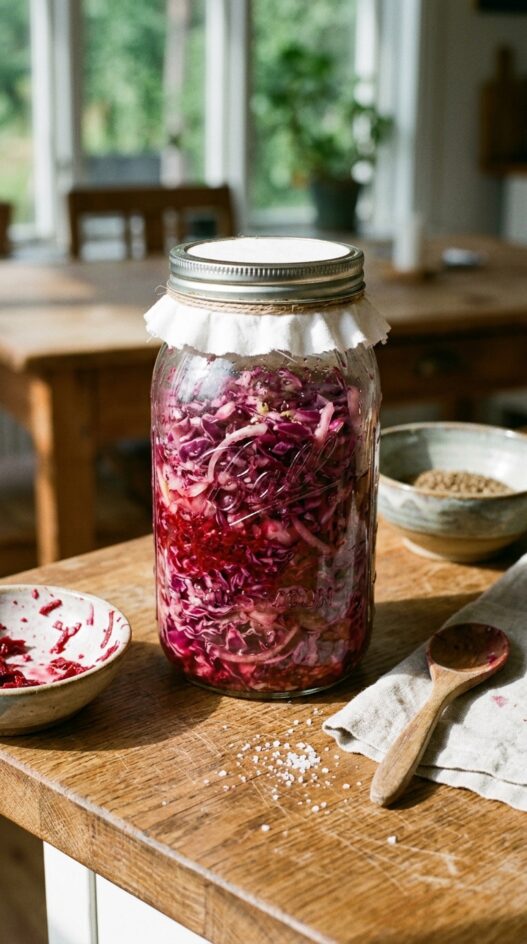
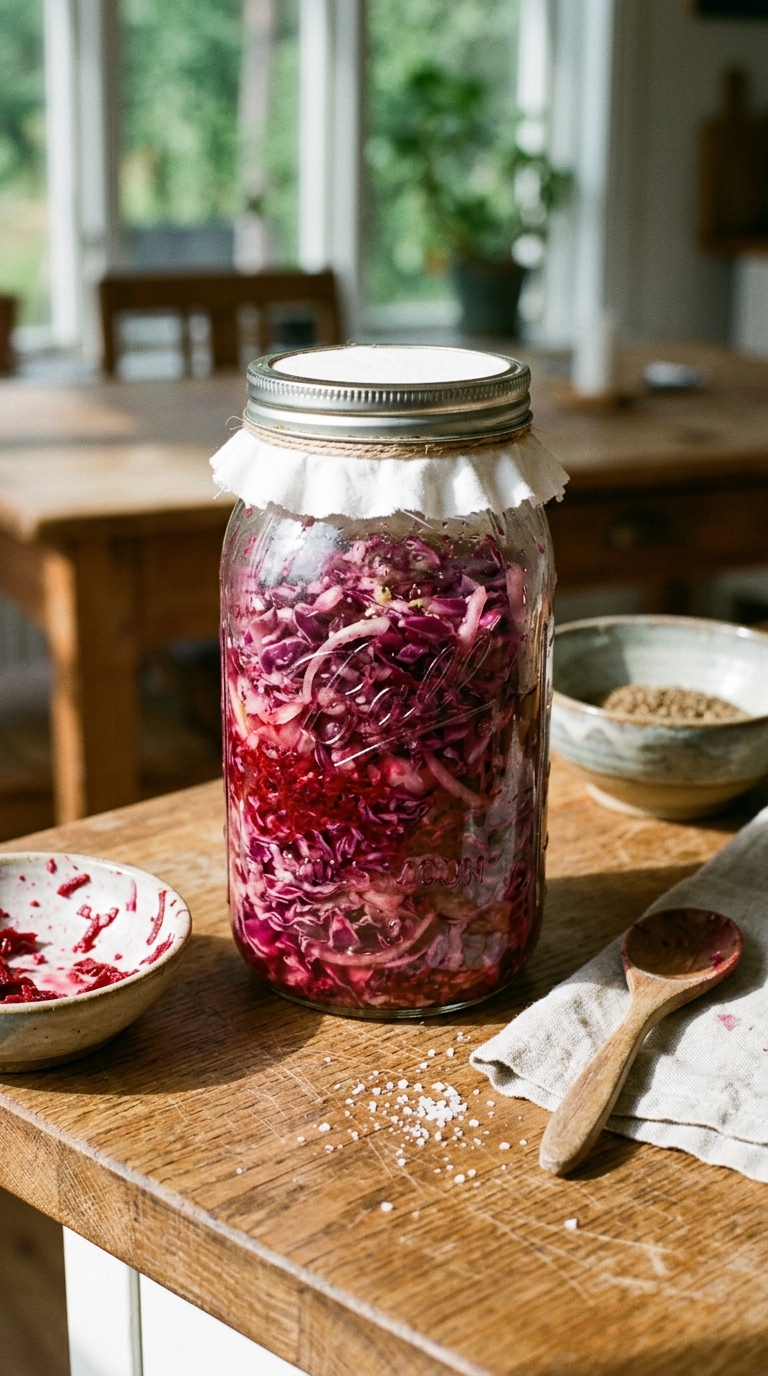
Making sauerkraut at home doesn’t have to be a big ordeal. It’s actually very easy to make small batches, requiring only a few minutes of prep time. Then stand by and watch as nature takes its course. This recipe is just lightly fermented, resulting in a kraut that is fresh, crunchy and not overly salty –making it a perfect side “salad” to any meal.
In this recipe I use purple cabbage and grated beets, which gives it this beautiful vibrant color. But feel free to use just cabbage if you prefer. The refreshing bite is such a welcome accompaniment to dinner, especially with heavier meals, providing good contrast in texture and flavor. It’s also delicious on sandwiches, in tacos, wraps or have a bowl of it on its own. And you really don’t need any special equipment to make this…. a mason jar works just as well as a crock.
As cabbage ferments, it produces live bacteria. These bacteria, or “probiotics” replenish the good bacteria in our bodies and help stop the growth of bad bacteria, boosting our whole immune system. But if you eat sauerkraut that has been pasteurized (usually the store bought kind) the heat in the pasteurization process actually kills these good live bacteria, and so we won’t benefit from the probiotics…and that’s why I like to make it at home. Plus it’s SO easy, and you can flavor it however you like.
I add a ? to ¼ cup of sliced onion, and sometimes minced garlic. This is optional. It will make the smell slightly off putting as it ferments, but once it’s refrigerated, its adds a really delicious flavor.
Once it chills, it’s ready to eat. As it rests in the fridge, it will continue to ferment but at a much slower rate. It will taste better and better.
Print
How to Make Beet Sauerkraut
- Total Time: 10 minutes plus 3-7 days fermentation
- Yield: 4 cups
Description
This homemade beet sauerkraut combines vibrant purple cabbage and grated beets for a fresh, crunchy, and lightly fermented kraut that’s perfect as a side salad or topping for tacos and sandwiches.
Ingredients
- 3 cups (720 ml) cabbage, finely sliced
- 1 cup (240 ml) grated beet (or substitute with an extra cup of cabbage or grated carrot)
- 1/8-1/4 cup (30-60 ml) sliced onion (optional)
- 1 tsp kosher salt
- 1 tsp caraway seeds (optional)
- 1 clove minced garlic (optional)
Instructions
- Finely slice the cabbage and grate the beets. You need about 4 cups total of vegetables.
- If using, add the sliced onion, minced garlic, and caraway seeds to the bowl.
- Place the vegetables in a large bowl and sprinkle with 1 tsp of kosher salt.
- Massage the salt into the vegetables for about 5-10 minutes until they start to release their juices.
- Pack the mixture tightly into a clean mason jar or fermentation crock, pressing down firmly to ensure the vegetables are submerged in their own juices.
- Cover the jar with a lid or cloth and let it sit at room temperature for 3-7 days, depending on your taste preference. Taste it every few days until it reaches your desired level of tanginess.
- Once fermented to your liking, store the sauerkraut in the refrigerator where it will continue to ferment slowly and develop more flavor.
Notes
- Feel free to adjust the fermentation time to suit your taste; longer fermentation results in a tangier kraut.
- You can use a mason jar instead of a fermentation crock.
- Optional ingredients like onion and garlic add depth of flavor but may produce a strong smell during fermentation.
- Store in the refrigerator to slow down fermentation and enhance flavor over time.
- Prep Time: 10 minutes
- Cook Time: 0 minutes
- Category: Side Dish
- Cuisine: Scandinavian
Nutrition
- Serving Size: 1/2 cup
- Calories: 20
- Sugar: 2
- Sodium: 290
- Fat: 0
- Carbohydrates: 5
- Fiber: 2
- Protein: 1
- Cholesterol: 0
Frequently Asked Questions
Can I use a different type of cabbage instead of purple cabbage?
Yes, you can use any type of cabbage if you prefer; the recipe will still work well.
What is the purpose of adding sliced onion and minced garlic to the beet sauerkraut?
Adding sliced onion and minced garlic enhances the flavor, though it’s optional and may create a stronger smell during fermentation.
How long does it take for the beet sauerkraut to ferment?
The sauerkraut will ferment for several days, and you can taste it periodically to determine when it reaches your desired level of tanginess.
If You Liked This Recipe, You’ll Love These
- Sweet and Sour Pickled Beets
- Homemade Sauerkraut
- How to Make Homemade Kimchi
- Crispy Baked Beet Chips









I don’t want to make this any other way now that I’ve added the onion the note mentions. Electric magenta color and it tastes better than any store kraut I’ve picked up.
How long is it good for in the fridge?
Thanks!
Good question! Once it’s fermented to your liking and moved to the fridge, the beet sauerkraut will keep well for at least 2–3 months, often longer. As long as it smells clean and pleasantly sour (not moldy or off), it’s still good, the flavor will just continue to deepen over time.