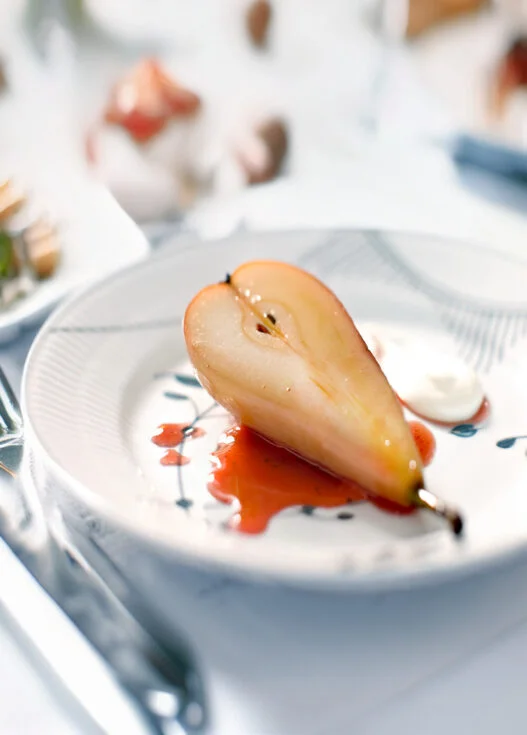
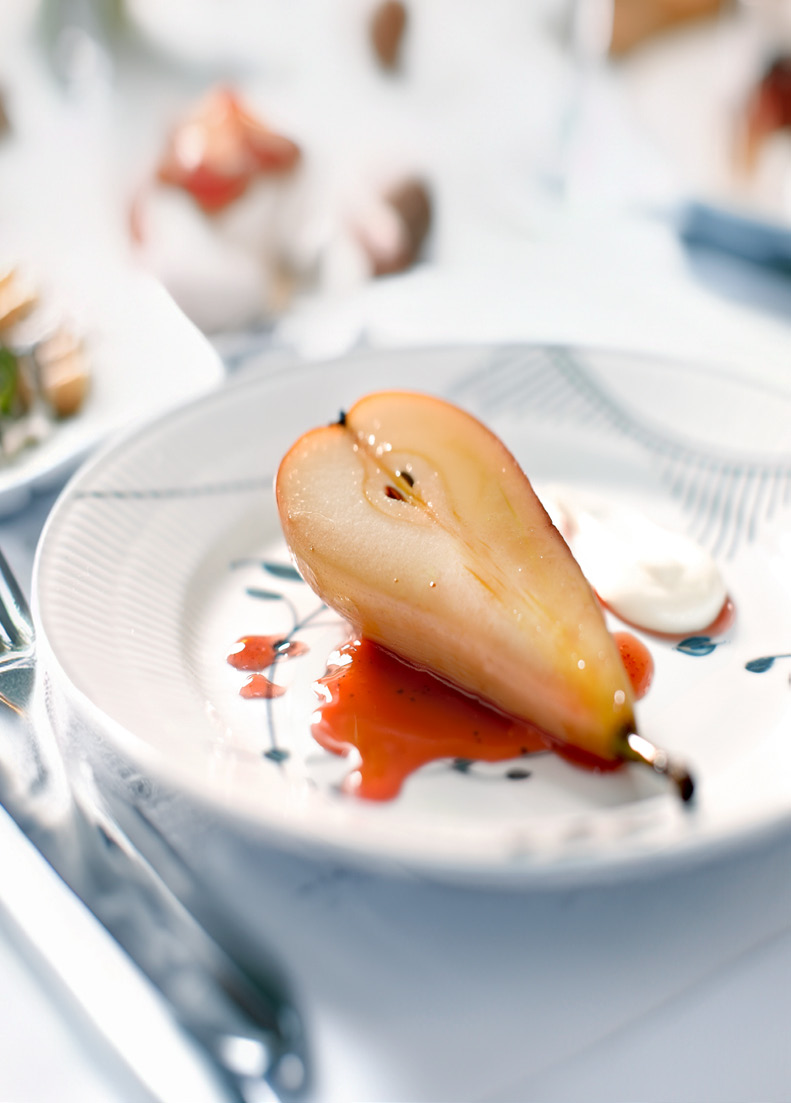
Lingonberries are small, tart red berries, a Scandinavian cousin of the cranberry, and here whole pears are poached in them until the fruit takes on the color and the liquid becomes the sauce. Poached pears sound like something that might have been served at a dinner party hosted by Marie Antoinette in the late 1700s. And, come to think of it, they probably were. Despite being deceptively simple to make, there’s something undeniably regal about them, isn’t there?
From my cookbook NORTH – Scandinavianish Cooking.
Print
Lingonberry-Poached Pears with Whipped Cream
- Total Time: 35 minutes
- Yield: Serves 4
Description
Poached pears sound like something that might have been served at a dinner party hosted by Marie Antoinette in the late 1700s. And, come to think of it, they probably were. Despite being deceptively simple to make, there’s something undeniably regal about them, isn’t there?
Ingredients
- 2 large pears, peeled and halved
- 2 cups (4.7 dl) fresh lingonberries (or cranberries if lingonberries are unavailable)
- 1 cup (200 g) sugar
- 1 cup (2.4 dl) water
- Whipped cream, for serving
Instructions
- In a saucepan, combine the lingonberries (or cranberries), sugar, and water. Bring the mixture to a boil over medium heat, stirring until the sugar is fully dissolved. Lower the heat and let it simmer for 5 minutes
- Once the poaching liquid is prepared, carefully add the pears to the simmering liquid.
- Cover and poach the pears gently over low heat for 15-20 minutes, or until they are tender but still firm enough to hold their shape. Test the tenderness with a fork or skewer.
- When the pears are ready, remove them from the liquid and set them aside. Using an immersion blender, blend the poaching liquid until smooth. For a smoother sauce, strain the liquid through a fine-mesh sieve to remove seeds and pulp.
- To serve, place one pear half on each plate and drizzle the warm berry sauce over the top. Add a dollop of whipped cream on the side.
Notes
Use firm pears. They poach 15 to 20 minutes and need to come out tender but still holding shape, so test with a skewer rather than going by the clock.
Cranberries are the substitute the book names, and the quantity stays at 2 cups.
Blending the poaching liquid is what turns it into a sauce. Pass it through a fine sieve afterwards if you want it smoother.
- Prep Time: 10 minutes
- Cook Time: 25 minutes
- Category: Recipes
- Cuisine: Swedish
Nutrition
- Serving Size: 1 serving
- Calories: 269
- Fat: 0 g
- Carbohydrates: 69 g
- Protein: 1 g
Frequently Asked Questions
What kind of pears work best?
Firm ones. They poach for 15 to 20 minutes and need to come out tender but still holding their shape, so test with a fork or a skewer rather than going by time alone. Very ripe pears will collapse.
I cannot find lingonberries. What else can I use?
Cranberries. The book names them as the substitute, and the quantity stays the same at 2 cups.
Do I have to blend the poaching liquid?
Blending it with an immersion blender is what turns it into a sauce. If you want it smoother still, pass it through a fine-mesh sieve afterwards to take out the seeds and pulp.
If You Liked This Recipe, You’ll Love These
- Almond and Pear Tart with a Caramel Drizzle
- Aged Havarti and Cardamom Pear Butter
- Aged Havarti, Pear Chutney, and Walnut Puff Triangles
- Baked Honey and Chevrot Goat Cheese Pears