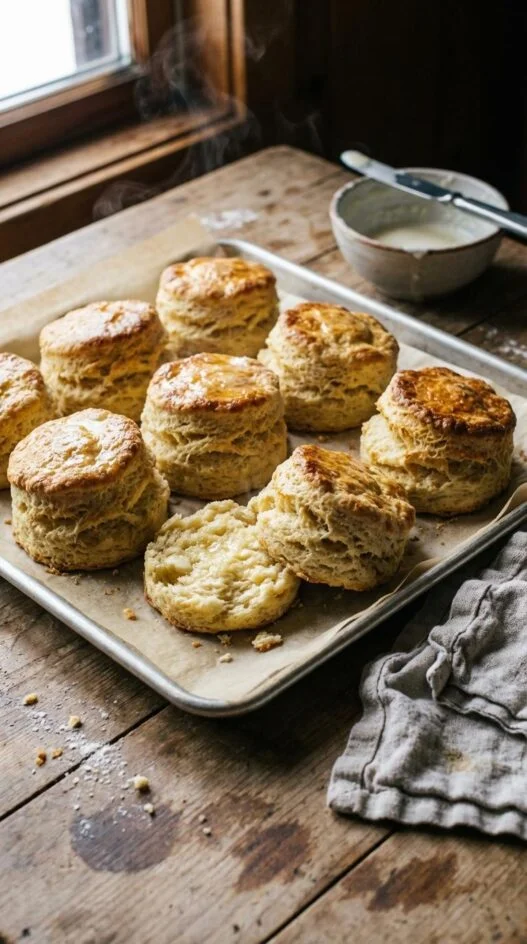
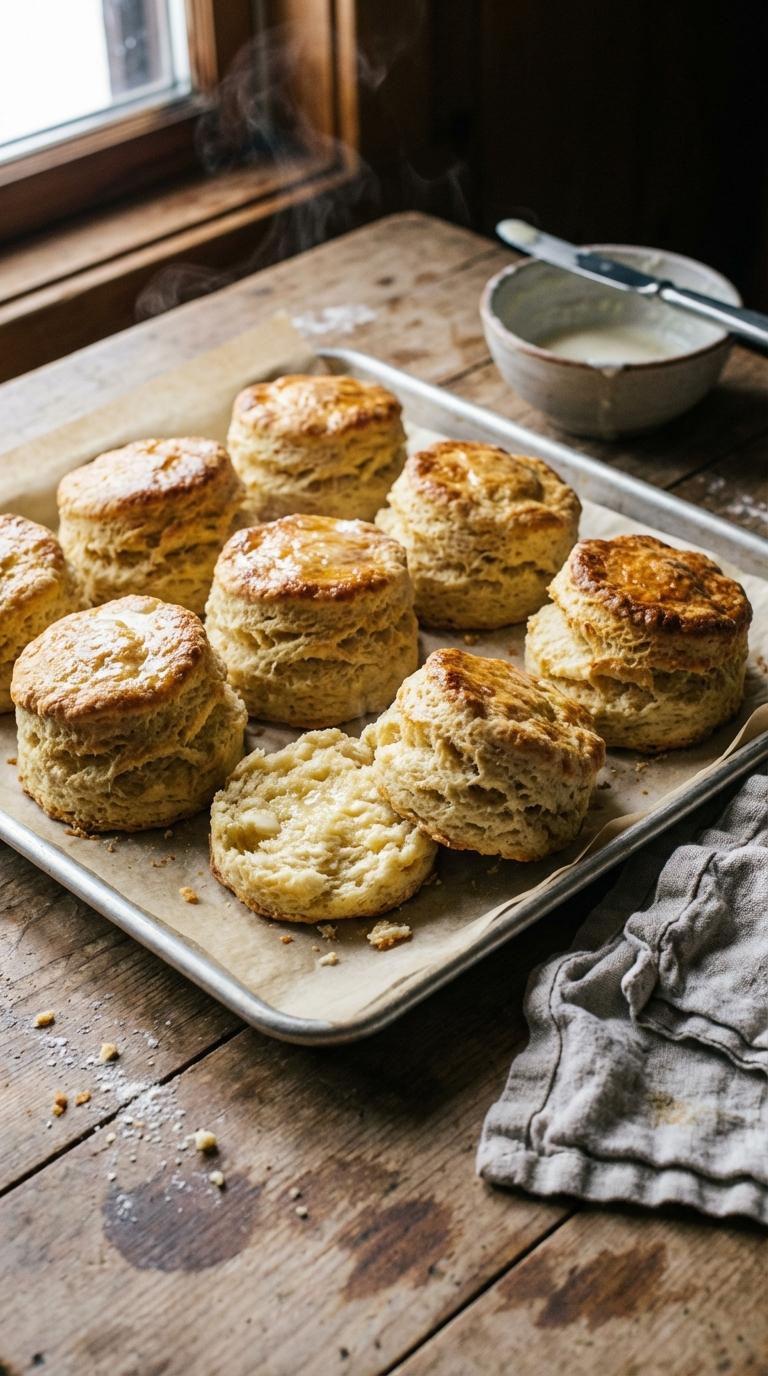
A proper buttermilk biscuit is one of the simplest things you can bake, and also one of the easiest to get wrong. The ingredient list is short and humble: flour, butter, buttermilk, leavening, salt. There is nowhere to hide. Every decision matters, from the temperature of your butter to how many times you fold the dough. Get it right and you get biscuits that shatter when you pull them apart, with visible flaky layers and a tender, slightly tangy interior that makes store-bought versions feel like cardboard.
Cold is the operative word throughout this recipe. Cold butter, cold buttermilk, and work quickly so nothing warms up. The folding technique, three folds in thirds like a letter, is what builds those dramatic layers without overworking the dough. When you cut, press the cutter straight down and do not twist. Twisting seals the edges and prevents the biscuit from rising properly. Bake them close together on the pan so they push each other upward. These are best eaten within an hour of coming out of the oven, split open and spread with salted butter, honey, or good jam. They also make a killer base for a breakfast sandwich with scrambled eggs and sharp cheddar.
Work Cold Butter into Flour
Whisk together flour, baking powder, baking soda, salt, and sugar. Add cold butter cubes and toss to coat. Using a pastry cutter or your fingertips, work quickly to cut the butter into the flour until the mixture has pea-sized and some slightly larger pieces. Do not rub it into fine crumbs. The visible butter pieces are what create flaky layers. Keep everything cold.
Mix Minimally and Fold
Make a well in the center and pour in cold buttermilk. Stir gently with a fork until a shaggy dough just barely is ready. It should look rough and under-mixed with some dry flour still visible. Turn out onto a floured surface and pat into a rectangle about one inch thick. Fold the dough in thirds like a letter, rotate ninety degrees, pat out again, and fold again. Repeat one more time for a total of three folds.
Cut Without Twisting
Pat the dough to a final thickness of about three-quarters of an inch. Cut straight down with a sharp two-and-a-half-inch biscuit cutter without twisting. Press straight down and lift straight up. Twisting seals the edges and prevents the biscuits from rising tall. Place biscuits on a baking sheet with sides touching. Brush tops with melted butter and bake at 425F for twelve to fifteen minutes until deeply golden.
Print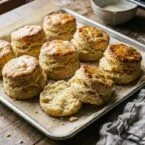
Buttermilk Biscuits
- Total Time: 30 minutes
- Yield: 8 biscuits
Description
Tall, flaky, golden buttermilk biscuits with layer upon layer of tender, buttery dough. These Southern-style biscuits rely on cold butter and a gentle folding technique to create dramatic flaky layers. They are perfect for breakfast with butter and jam, as a base for biscuits and gravy, or alongside soups and stews.
Ingredients
- 2 cups (260g) all-purpose flour
- 1 tablespoon baking powder
- 1/4 teaspoon baking soda
- 1 teaspoon fine sea salt
- 1 tablespoon granulated sugar
- 6 tablespoons cold unsalted butter, cut into small cubes
- 3/4 cup cold buttermilk
- 1 tablespoon melted butter for brushing tops
Instructions
- Preheat the oven to 425F (220C). Line a baking sheet with parchment paper.
- In a large bowl, whisk together the flour, baking powder, baking soda, salt, and sugar. Add the cold butter cubes and toss to coat in flour. Using a pastry cutter or your fingertips, quickly work the butter into the flour until you have a mix of pea-sized and slightly larger flat pieces. Work fast to keep everything cold.
- Make a well in the center and pour in the cold buttermilk. Stir gently with a fork until a shaggy dough just barely comes together — it should look rough and under-mixed. Do not overwork it.
- Turn the dough out onto a floured surface. Pat it into a rectangle about 1 inch thick. Fold the dough in thirds like a letter, then rotate 90 degrees, pat out, and fold again. Repeat this folding process one more time for a total of 3 folds — this creates the flaky layers.
- Pat the dough to a final thickness of about 3/4 inch. Cut straight down with a sharp 2.5-inch biscuit cutter — do not twist the cutter, as this seals the edges and prevents rising. Gather scraps gently and cut remaining biscuits.
- Place biscuits on the prepared baking sheet with sides touching (this helps them rise taller). Brush tops with melted butter.
- Bake for 12-15 minutes until tall and deeply golden on top. Serve immediately.
Notes
- Cold ingredients are critical — put the butter in the freezer for 10 minutes and use buttermilk straight from the fridge.
- Do not twist the biscuit cutter. Press straight down with a sharp edge for the tallest rise.
- The dough should look shaggy and under-mixed. Overworking develops gluten and makes biscuits tough instead of tender.
- No buttermilk? Mix 3/4 cup milk with 1 tablespoon lemon juice or white vinegar and let sit 5 minutes.
Nutrition
- Serving Size: 1 serving
- Calories: 222
- Fat: 11 g
- Carbohydrates: 27 g
- Protein: 4 g
Frequently Asked Questions
Why are my biscuits flat and dense instead of tall and fluffy?
The most common causes are overworking the dough, using warm butter, or twisting the biscuit cutter. Keep the butter cold, handle the dough minimally, and cut straight down without twisting.
Can I make biscuits without buttermilk?
Yes. Make a substitute by mixing three-quarters cup regular milk with one tablespoon lemon juice or white vinegar. Let it sit for five minutes until it curdles slightly, then use it in place of the buttermilk.
Why do the biscuits need to touch each other on the baking sheet?
When biscuits touch, they support each other as they rise, pushing upward instead of spreading outward. This results in taller biscuits. If you want crusty sides all around, place them with space between.