
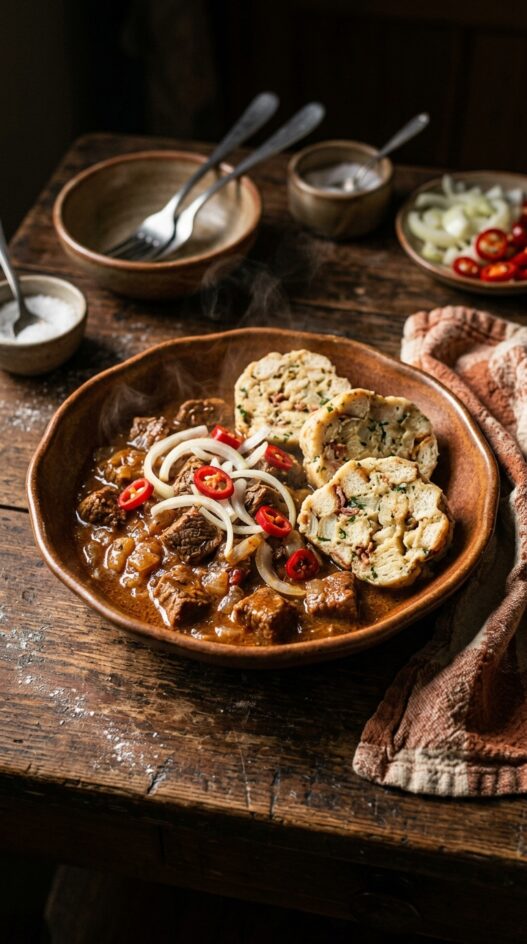
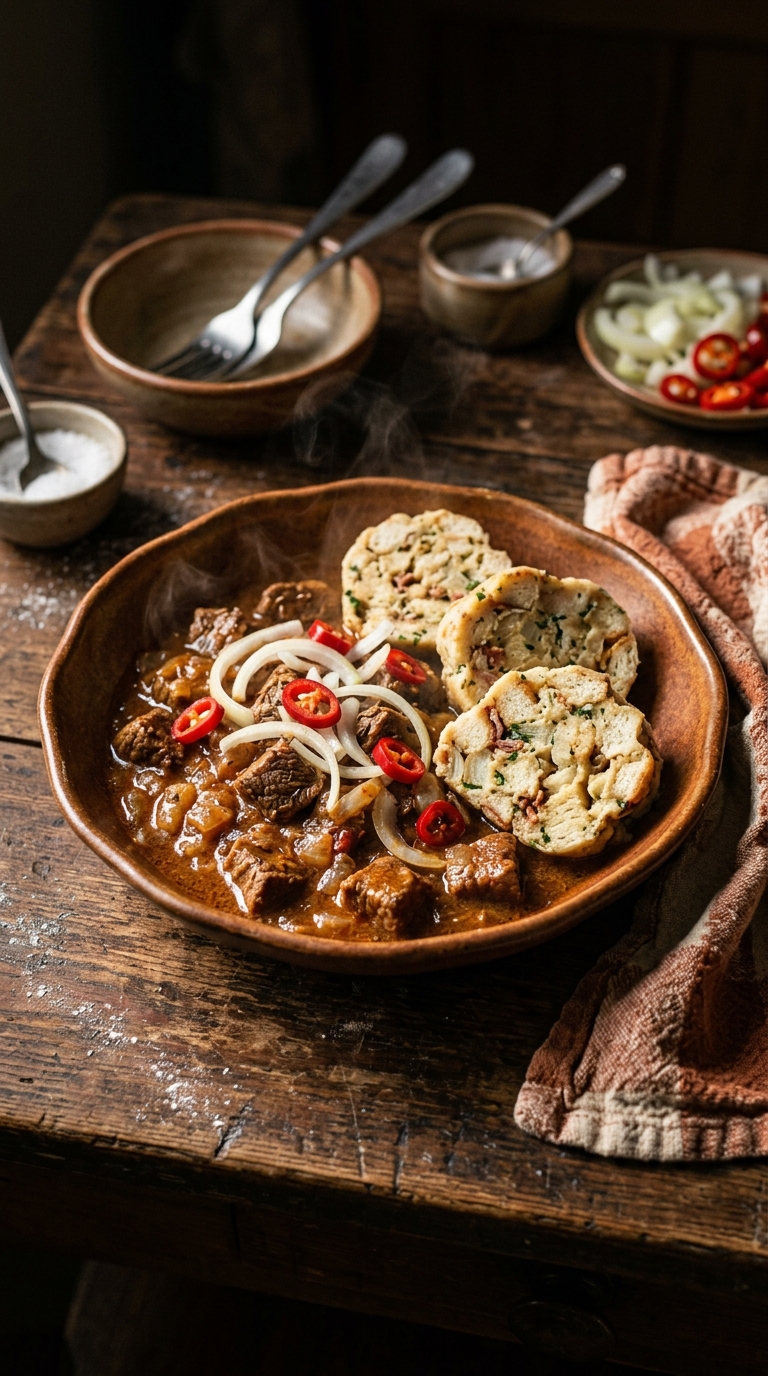
Despite the fact that I ate a ton of goulash in Prague, I decided to make more because–well–I was actually craving it again and I wanted to share with you some of the deliciousness I had while there. Of course I picked one of those most famous beers to make this with–Pilsner Urquell–not only because it’s Czech and it’s awesome, but because the mild and fresh flavor profile of the beer really helps boost the flavors along without overpowering anything. I’d stick to Pilsner Urquell or a similarly grainy, malty, low-bitterness pils like Budvar or even Victory Prima Pils. I hope you like it!
Print
Goulash with Bacon Dumplings
- Total Time: 1 hour 50 minutes
- Yield: 2
Description
This goulash is a little creamier than a typical Czech goulash would be – it’s more along the lines of a Hungarian goulash. But that’s ok – it tastes great!
Ingredients
For the goulash:
- 2 lbs (900g) cubed beef
- flour
- salt and pepper
- olive oil
- 1/2 medium-sized sweet onion, diced
- 1/4 tsp caraway seed
- 2 TB sweet paprika
- 1/8 tsp ground black pepper
- 8 TB tomato paste
- 2 1/2 cups (600ml) pilsner beer
- 1 beef bouillon cube or condensed beef stock
- 4 cloves garlic, minced
- 1/8 tsp marjoram
- raw onion slices
- raw sweet and/or chili peppers
For the dumplings:
- 10-12 slices of regular white bread, crusts removed and cut into cubes. Allow to sit overnight to get stale.
- 1 TB unsalted butter
- 1/2 sweet onion, finely diced
- 4 TB finely chopped parsley
- 3 strips of bacon, cooked and crumbled
- 3/4 cup (70g) all-purpose flour
- salt and pepper
- 1/3 cup (80ml) whole milk
- 1 egg, beaten
Instructions
To make the goulash:
- Start by drying the beef off with a paper towel. Season with the salt and pepper and lightly coat each piece with the flour, being sure to shake off any excess. Set aside.
- Heat about a tbsp of olive oil in a large pot over medium heat. Toss in the diced onion and cook, stirring often, until just shy of golden brown. Just before the onion is done, add the caraway seeds.
- Put the seasoned beef back into the pot. Add the paprika, black pepper, tomato paste, beer, and beef bouillon cube. Stir until combined.
- Cover and simmer over low heat, stirring often, for about 45 minutes.
- Add the garlic and marjoram and cook for another 10 minutes more.
- Adjust seasonings as needed. Serve with raw sliced onion and peppers.
To make the dumplings:
- Slightly brown the onions in the butter, but not too much.
- When finished, add the onions to the flour, salt, pepper, bacon, and parsley. Mix until just combined.
- Add the milk. Knead until you have a soft dough.
- Add the stale/toasted bread cubes and slightly combine.
- Add in the beaten egg. Knead until all is well-incorporated and you have a slightly sticky (but doesn’t stick to your fingers) dough. Add more milk/flour as needed to get the required consistency and then shape them into a log form.
- Let rest for a few minutes while you bring a pot of salted water to a simmer (don’t boil).
- Carefully place the dumplings in the simmering water. Simmer for about 25-30 minutes, gently flipping them over about halfway through.
- When done, remove to some paper towels and let it drain for a minute.
- While still hot, slice the dumplings. Serve alongside the goulash.
- Prep Time: 20 mins
- Cook Time: 1 hour 30 mins
- Category: Main Course
- Cuisine: Eastern European
Nutrition
- Serving Size: 1 serving
- Calories: 780
If You Liked This Recipe, You’ll Love These
- Warm Asparagus Salad with Bacon, Egg, and Hazelnuts
- Strawberry Balsamic Pizza with Chicken and Bacon
- Chicken and Dumplings
- Bacon & Pineapple Chicken Kabobs with Hawaiian Sauce
Frequently Asked Questions
Why does the recipe call for Pilsner Urquell specifically?
Pilsner Urquell’s mild, fresh, grainy and malty flavor profile boosts the goulash without overpowering anything, making it a better choice than a hoppy or bitter beer. I use 2½ cups (600 ml) and recommend sticking to Pilsner Urquell or a similarly low-bitterness pilsner like Budvar or Victory Prima Pils.
Why do the bread cubes for the dumplings need to be stale?
Remove the crusts from 10–12 slices of white bread, cut them into cubes, and allow them to sit overnight to get stale before making the dumplings. Stale bread absorbs the milk and egg more slowly and evenly, keeping the dumplings from becoming gummy or falling apart during the 25–30 minute simmer.
Why do you simmer the dumplings rather than boil them?
Bring the water to a simmer — not a boil — before adding the dumplings. A vigorous boil would batter the outside of the dumplings and cause them to break apart. Cook them for 25–30 minutes at a gentle simmer, flipped halfway through.
When should I add the garlic and marjoram to the goulash?
Add the garlic and marjoram only in the last 10 minutes of the goulash’s 45-minute simmer. Adding them too early would cause them to lose their fresh aromatic quality during the long braise; the shorter exposure at the end keeps their flavor more distinct.


I’m an expat in Prague and love Czech food. Your recipe was my second try at goulash, and it came out delicious! Definitely better than my first attempt.
Two FYIs:
a) The instruction/step for browning the beef is missing.
b) The beaten egg is missing in the ingredient list for the dumplings.