
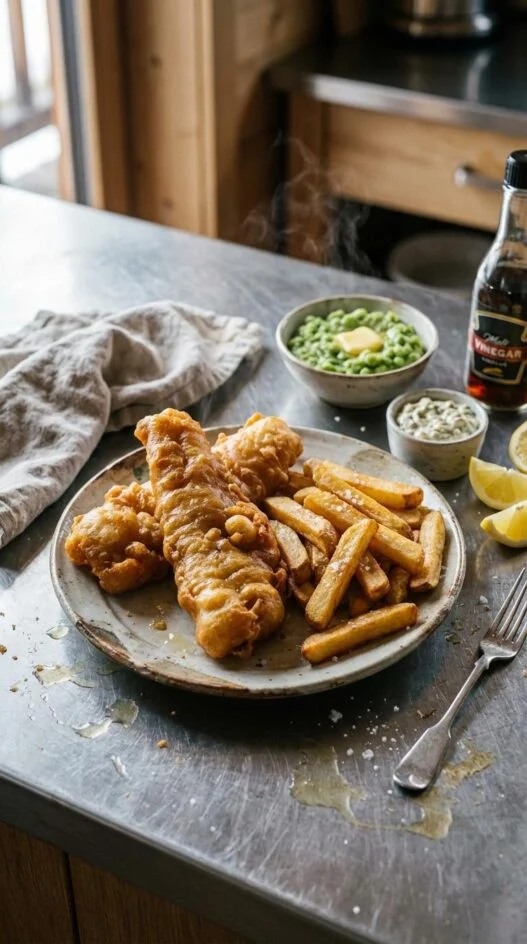
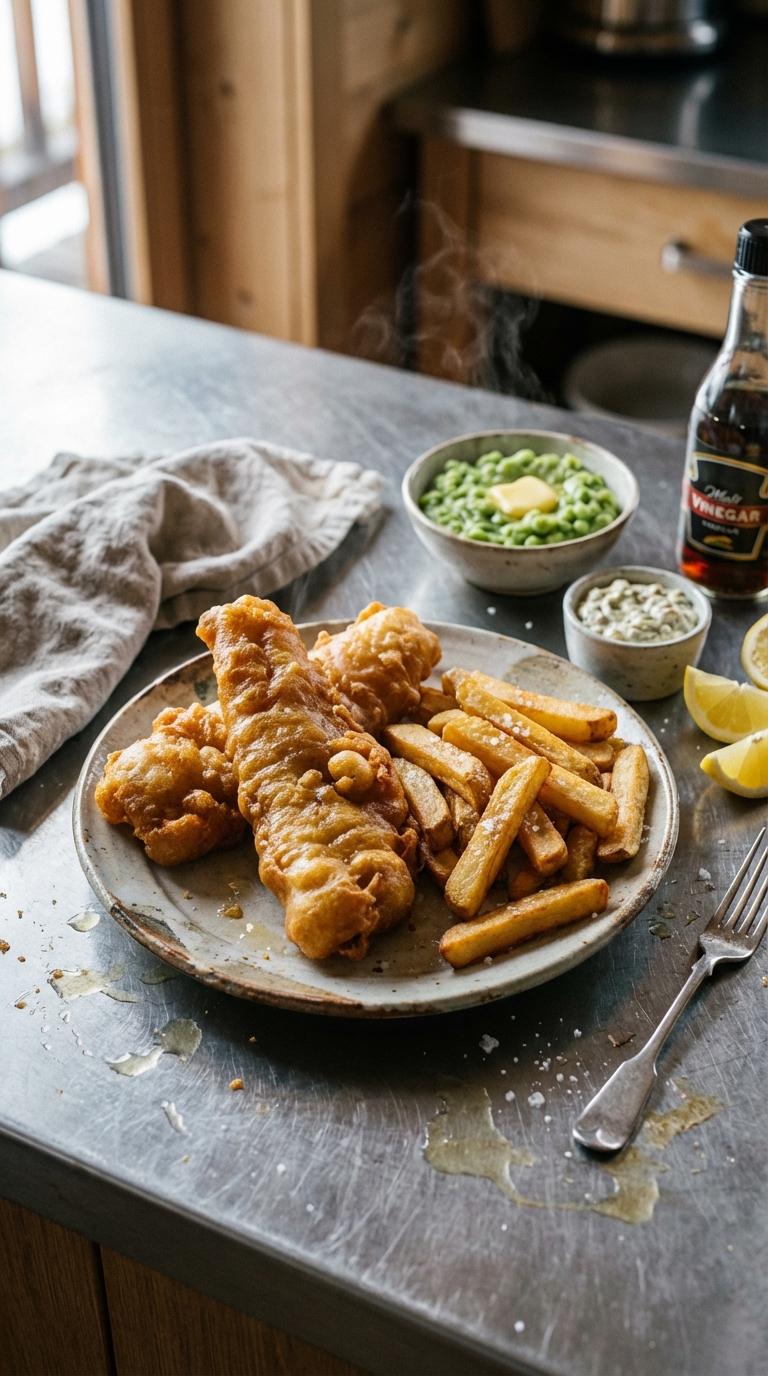
Good fish and chips are harder to find than they should be, even in restaurants. Too often the batter is thick and doughy, the fish is overcooked, and the chips are limp. Done right, this is one of the most satisfying fried foods on the planet: flaky cod inside a light, crisp beer batter, served alongside thick-cut chips with a malt vinegar tang and a cold tartar sauce on the side. It is pub food at its peak, and making it at home gives you control over every element. Two techniques make this version stand out. First, the batter: cold beer and a drizzle of vodka create a lighter, crispier coating than flour and water alone.
The carbonation adds lift, and the vodka evaporates faster than water, which means less sogginess. Second, the chips get the double-fry treatment, starting at 325 degrees F to cook through, then finished at 400 degrees F for a hard, golden shell. Do not crowd the fryer for either the fish or the chips. Overcrowding drops the oil temperature and steams everything instead of frying it. Serve on paper with malt vinegar, lemon wedges, and tartar sauce. Mushy peas are traditional if you want to go full British.
Boil the Chips, Then Dry Them Completely
Rinsed potato batons go into cold water, come up to a boil, and simmer for just 6 to 8 minutes — until a knife meets slight resistance, not none. Drain carefully and spread them out to dry and cool for at least 20 minutes; an uncovered stint in the fridge helps too, if you have the time. Skip the drying step and you’re frying wet potatoes straight into a pot of hot oil, which means spitting fat and a soft exterior that no amount of second-frying can fix later. The first fry itself, once they’re dry, only takes 5 to 6 minutes at 325°F and should leave them pale and just cooked through, not browned — the color comes on the second pass.
Don’t Overmix the Batter
Whisk the dry ingredients together first, then pour in the cold beer and vodka and stop stirring as soon as it’s combined. A few small lumps are genuinely fine here, better than fine — overworking the batter develops the gluten in the flour and turns it heavy and elastic instead of light. What you want is something close to the consistency of heavy cream, thin enough to coat but not so thin it slides off the fish.
Dredge Before You Dip
Pat the fish dry, season it with salt and pepper, and dredge each piece in flour first, shaking off the excess before it ever touches the batter. That thin flour layer is what the batter actually grips onto — skip it and the coating slides right off the second it hits hot oil. Fry at 375°F, 6 to 8 minutes, turning once, until the batter’s gone deeply golden and the fish flakes through.
Print
Fish and Chips
- Total Time: 45 minutes
- Yield: 4 servings
Description
Fish and chips has been Britain’s national takeaway since the 1860s. The batter should be light, crisp, and audibly crunchy, shattering at the first bite to reveal flaky white fish that just barely holds together. The chips — thick-cut, twice-fried, fluffy inside and golden outside — are their own art form. The use of beer and a touch of vodka in the batter creates an ethereally light coating that frying oil alone cannot achieve.
Ingredients
- For the chips:
- 2 pounds russet potatoes, peeled and cut into 1/2-inch thick batons
- Vegetable oil or beef tallow for frying
- Flaky sea salt
- For the batter:
- 1 cup all-purpose flour
- 2 tablespoons cornstarch
- 1 teaspoon baking powder
- 1 teaspoon kosher salt
- 1/2 teaspoon freshly ground black pepper
- 3/4 cup cold lager beer
- 2 tablespoons cold vodka (optional, for extra crispness)
- For the fish:
- 1 1/2 pounds thick cod or haddock fillets, cut into 4 pieces
- Kosher salt and freshly ground black pepper
- 1/4 cup all-purpose flour for dredging
- For serving: malt vinegar, tartar sauce, lemon wedges, mushy peas
Instructions
- Rinse the cut potatoes in cold water to remove excess starch. Place in a large pot, cover with cold water, and bring to a boil. Simmer for 6-8 minutes until just tender — a knife should pass through with slight resistance. Drain carefully and spread on a sheet pan lined with paper towels. Let dry and cool completely, at least 20 minutes. Refrigerate uncovered for 30 minutes if time allows.
For the First Fry
- Heat the oil to 325°F in a deep pot or Dutch oven. Fry the chips in batches for 5-6 minutes until cooked through and blond but not browned. Remove to a wire rack. These can rest while you fry the fish.
Make the Batter
- Whisk together the flour, cornstarch, baking powder, salt, and pepper. Pour in the cold beer and vodka. Whisk until just combined — a few small lumps are fine and preferable to an overworked, gluten-y batter. The batter should be the consistency of heavy cream.
- Pat the fish fillets dry and season with salt and pepper. Dredge each piece in the flour, shaking off the excess. Holding one end, dip into the batter, letting the excess drip off for a moment.
- Heat the oil to 375°F. Carefully lower the battered fish into the oil, 1-2 pieces at a time. Fry for 6-8 minutes, turning once, until the batter is deeply golden and the fish is cooked through. Drain on a wire rack.
- For the second fry of the chips: increase the oil to 400°F. Fry the chips in batches for 2-3 minutes until golden brown and crisp. Drain and season immediately with flaky salt.
- Serve at once with malt vinegar, tartar sauce, lemon wedges, and mushy peas.
Notes
- Cold beer and cold vodka are the keys to a light, crisp batter. The carbonation creates lift, and the alcohol evaporates faster than water, producing a drier, crunchier coating.
- Twice-frying the chips is essential: the first fry cooks the interior, the second creates the crisp golden shell. This is the same technique used for Belgian frites.
- Do not crowd the fryer — adding too much food at once drops the oil temperature and results in greasy, soggy food rather than crisp food.
- Category: Main Course
- Cuisine: British
Nutrition
- Serving Size: 1 serving
- Calories: 760
- Fat: 30 g
- Carbohydrates: 75 g
- Protein: 38 g
Frequently Asked Questions
Why fry the chips twice?
The first fry at 325F cooks the potato through and creates a dry surface. The second fry at 400F crisps the outside to a golden crunch. Single-fried chips are either raw inside or soft outside. The double-fry is how chip shops get that contrast.
Why add vodka to the batter?
Vodka evaporates faster than water during frying, producing a drier, crunchier batter. The alcohol cooks off completely. Combined with cold lager beer for carbonation, it creates an exceptionally light, crisp coating.
What fish should I use?
Cod or haddock are traditional. The fillets should be thick, at least 1 inch, firm, and white-fleshed. Pollock also works. Avoid thin, flaky fish like tilapia or sole, they fall apart in the batter.

Faff but worth it.