
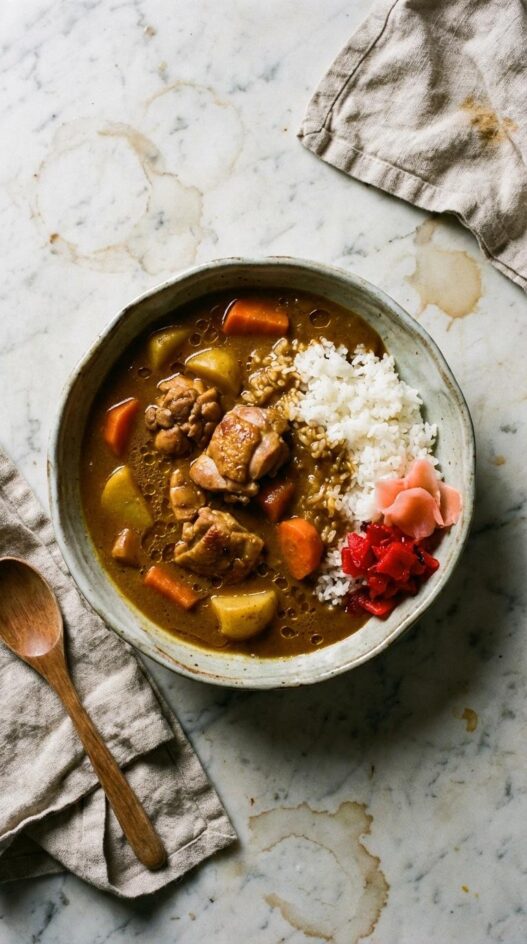
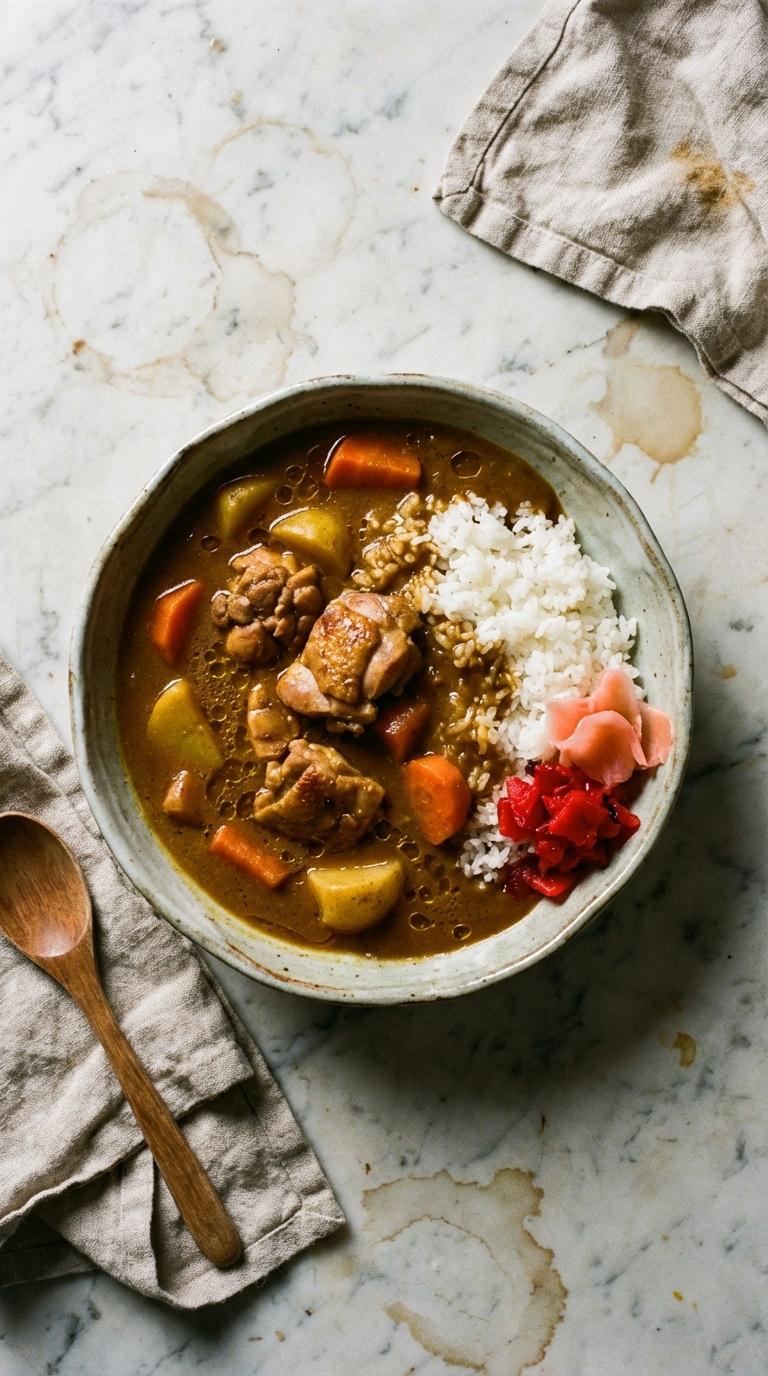
Japanese curry rice gets its distinctive flavor from an unexpected pantry lineup: ketchup, Worcestershire sauce, honey, soy sauce, and curry powder cooked into a roux of butter and flour. These aren’t shortcuts or substitutions, they’re traditional ingredients in Japanese home-style curry, building that sweet-savory depth that separates it from Indian or Thai curries. Browning the chicken thighs first creates fond on the bottom of the pot, and cooking the onion for a full eight to ten minutes until deep golden builds the sweet, caramelized base that everything else layers onto. This is the curry we make when we want something that tastes like it simmered all day but only took 45 minutes.
The flour and curry powder cook together for two minutes before the broth goes in gradually, which prevents lumps and gives the sauce its characteristic thick, velvety texture that coats a spoon. Carrots and potatoes simmer covered for 25 minutes until they’re soft enough to start breaking down at the edges, thickening the curry further. Served over steamed rice with pickled ginger on the side, this is a 45-minute weeknight dinner that genuinely tastes better reheated the next day as the flavors meld overnight.
Browning the Chicken and Onions
Heat the oil in a large pot over medium-high heat. Add the chicken thigh pieces and brown them on all sides for about five minutes. Remove the chicken and set it aside. Add the butter to the same pot. Once it melts, add the diced onion and cook for eight to ten minutes, stirring frequently, until deeply golden and caramelized. This step builds the sweet, savory base that makes Japanese curry taste right. Don’t rush it.
Building the Curry Base
Add the flour and curry powder to the caramelized onions. Stir constantly for two minutes to cook out the raw flour taste and bloom the spices. The mixture will be thick and paste-like. Gradually add the chicken broth, stirring to prevent lumps from forming. Add the carrots, potatoes, garam masala, soy sauce, Worcestershire sauce, honey, and ketchup. Stir everything together until the sauce is smooth and the vegetables are evenly distributed.
Simmering and Finishing
Return the browned chicken to the pot. Bring the curry to a simmer, then reduce the heat to medium-low. Cover and cook for twenty-five minutes, stirring occasionally, until the vegetables are tender and the sauce has thickened to a gravy-like consistency. If the curry is too thick, add a small pour of water. If it’s too thin, simmer uncovered for a few more minutes. Taste and adjust seasoning if needed. Serve over steamed rice with pickled ginger.
Print
Japanese Curry Rice
- Total Time: 45 minutes
- Yield: 4 servings
Description
Japanese curry rice is the ultimate Japanese comfort food — a thick, mildly spiced, slightly sweet curry served over steamed rice. It is nothing like Indian or Thai curry — it is gentler, darker, and has a savory depth from soy sauce and Worcestershire. In Japan, it is eaten several times a week in homes and curry shops alike.
Ingredients
- 1 lb boneless, skinless chicken thighs, cut into pieces
- 2 tablespoons vegetable oil
- 1 large yellow onion, diced
- 3 medium carrots, cut into chunks
- 2 medium Yukon Gold potatoes, cut into chunks
- 3 cups chicken broth
- 3 tablespoons curry powder
- 1 teaspoon garam masala
- 2 tablespoons all-purpose flour
- 2 tablespoons unsalted butter
- 1 tablespoon soy sauce
- 1 tablespoon Worcestershire sauce
- 1 tablespoon honey
- 1 tablespoon ketchup
- Steamed rice for serving
- Pickled ginger and fukujinzuke for serving
Instructions
- Heat oil in a large pot over medium-high heat. Brown the chicken pieces on all sides, about 5 minutes. Remove.
- Add butter to the pot. Cook the onion 8 minutes until deeply golden. Add the flour and curry powder. Stir 2 minutes to cook out the raw taste.
- Gradually add the broth, stirring to prevent lumps. Add the carrots, potatoes, garam masala, soy sauce, Worcestershire, honey, and ketchup.
- Return the chicken. Bring to a simmer, then cover and cook 25 minutes until the vegetables are tender and the sauce is thick.
- Serve over steamed rice with pickled ginger.
Notes
- Cooking the onion until deeply golden — 8 to 10 minutes — builds the sweet, savory base that defines Japanese curry.
- The ketchup and Worcestershire are not shortcuts — they are traditional ingredients in Japanese curry that add tomato sweetness and umami.
- Japanese curry gets better overnight. Make a big batch and reheat the next day for even deeper flavor.
- Prep Time: 10 minutes
- Cook Time: 35 minutes
- Category: Main Course
- Cuisine: Japanese
Nutrition
- Serving Size: 1 serving
- Calories: 520
- Sugar: 12
- Sodium: 820
- Fat: 18
- Carbohydrates: 58
- Fiber: 4
- Protein: 36
- Cholesterol: 100
Frequently Asked Questions
Can I use curry blocks instead of curry powder?
Yes. Japanese curry blocks, like S&B Golden Curry or Vermont Curry, are convenient and produce authentic flavor. Use them according to the package directions instead of the flour and curry powder in this recipe.
Can I make this vegetarian?
Absolutely. Skip the chicken and add more vegetables like mushrooms, sweet potatoes, or green beans. Use vegetable broth instead of chicken broth.
How long does this keep?
Japanese curry keeps in the refrigerator for up to five days and freezes well for three months. The flavors improve after a day as everything melds together.





Is this mild enough for kids or should i cut the curry powder back?
Hi Laura, curry powder brands vary a lot, so for kids I’d start with 2 tablespoons instead of 3 and taste before serving. Japanese curry is meant to be mellow and a little sweet, so it’s usually a hit with kids. Thanks for asking!