
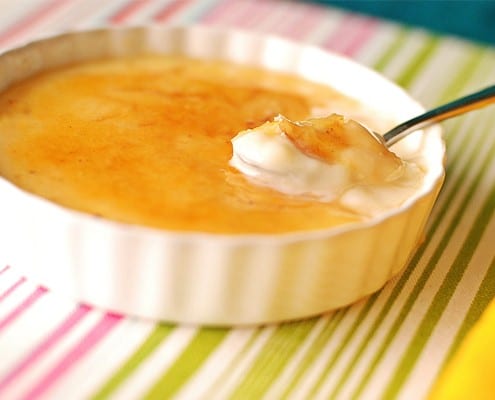
If there’s one thing Egyptians love, it’s dessert – the creamier, the better. From Konafa – vermicilli-like pastry, stuffed with gooey cheese or soft thick cream, baked then doused with enough sugar syrup to keep a child running in circles for days – to Roz Be Laban, a rice pudding, with scents of mastic and the enveloping flavor of sweetened milk.
Egypt is not a place for the lactose-intolerant.
As a kid, I never liked Roz Be Laban. I didn’t like the stickiness of the rice stuck to the jelly/jello-like milk surrounding it. Eating slower then than I do now, I could not stand keeping this strange sweet gluey concoction in my mouth. Instead, I would choose to have Mehalabia – a plain and simple milk pudding, similar to Roz Be Laban minus the rice.
Today, I eat both. Passionately.
The recipe below is not a traditional Mehalabia recipe in the sense that it includes lemon zest and a crackling brûlée crust. I could not resist adding a little bit of naughtiness to this old Egyptian favorite.
Print
Lemon-Mastic Mehalabia Brûlée
- Total Time: 25 minutes
- Yield: 4 servings
Description
This Lemon-Mastic Mehalabia Brûlée adds a zesty twist and a crackling brûlée crust to the traditional Egyptian milk pudding, creating a delightful fusion of flavors and textures.
Ingredients
- 3 cups (710 ml) of cold full cream milk
- 3 tbsp (28 grams) of cornstarch
- 3/4 cup (150 grams) of sugar
- 1/2 tsp of mastic grains
- 1 1/2 tsp (5 grams) of freshly grated lemon zest
- Extra caster sugar for the brûlée topping
Instructions
- In a medium saucepan, dissolve the sugar and cornstarch in the cold milk, stirring until completely combined.
- Place the saucepan over medium to low heat. Add the mastic grains and lemon zest.
- Stir continuously to melt the mastic and combine all ingredients, ensuring the mixture does not burn. Continue stirring until the mixture thickens and coats the back of a spoon, approximately 15-20 minutes.
- Once thickened, pour the mixture into individual serving dishes and let it cool to room temperature.
- Refrigerate for at least 2 hours or until fully set.
- Before serving, sprinkle an even layer of caster sugar over the top of each pudding.
- Using a kitchen torch, caramelize the sugar until it forms a crackling golden crust. Serve immediately.
Notes
- For a smoother texture, ensure the mastic is completely melted before the mixture thickens.
- Use a kitchen torch for the brûlée topping for best results.
- The pudding can be made a day in advance and stored in the refrigerator, but add the brûlée topping just before serving for the best texture.
- Prep Time: 5 minutes
- Cook Time: 20 minutes
- Category: Dessert
- Cuisine: Egyptian
Nutrition
- Serving Size: 1 serving
- Calories: 250
- Sugar: 30
- Sodium: 50
- Fat: 8
- Carbohydrates: 40
- Fiber: 0
- Protein: 5
- Cholesterol: 25
If You Liked This Recipe, You’ll Love These
- Shiso Meyer Lemon Tart
- Lemon Cream Cake: Light, Buttery, and Irresistible
- Plantains Foster: A Caribbean Twist on New Orleans’ Classic Dessert
- How to Make Traditional British Brandy Butter
Frequently Asked Questions
What is mastic and where do I find it?
Mastic is a resin harvested from mastic trees grown mainly on the Greek island of Chios; it has a subtle pine-like, slightly floral flavor that is central to Egyptian Mehalabia. You can find mastic grains at Middle Eastern grocery stores or specialty spice shops.
How do I prevent the mastic from clumping rather than melting into the pudding?
Add the mastic grains to the cold milk mixture before heating and stir continuously over medium-to-low heat for the full 15–20 minutes; constant movement prevents the grains from sticking to the bottom and helps them dissolve evenly as the pudding thickens.
Can I make the pudding ahead and still get a crisp brûlée crust?
Yes — you can make the pudding a day in advance and store it in the refrigerator, but add the caster sugar and torch the brûlée topping just before serving, because a pre-torched crust will soften and weep overnight.
Is a kitchen torch required, or can I use a broiler?
I recommend a kitchen torch for best results because it gives precise control over the caramelization. A broiler can work in a pinch, but keep the dishes as far from the broiler element as possible and watch closely, as it risks warming the set pudding beneath the crust.

My favorite desserts are the creamy ones. This is heaven :)