Description
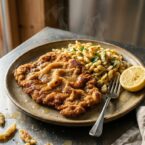
Schnitzel is Austria and Germany’s most beloved export — a pounded, breaded, and fried cutlet with a crust so light and puffy that it visibly separates from the meat in a golden, rippled shell. Served alongside spaetzle — the soft, irregular German egg noodles that soak up sauce and butter like nothing else — it is one of the most satisfying plates of food in the European canon. The technique of the schnitzel demands a very thin cutlet, a proper three-stage breading, and enough oil to let the coating float and puff.
Ingredients
Units
- For the schnitzel:
- 4 boneless pork loin cutlets (about 5 ounces each)
- 1 cup all-purpose flour
- 2 large eggs, beaten
- 1 tablespoon water
- 2 cups fine dry breadcrumbs (not panko)
- 1 teaspoon kosher salt
- 1/2 teaspoon freshly ground black pepper
- Clarified butter, lard, or vegetable oil for frying (about 1 inch deep)
- Lemon wedges for serving
- For the spaetzle:
- 2 cups all-purpose flour
- 3 large eggs
- 1/2 cup whole milk
- 1/2 teaspoon kosher salt
- 1/4 teaspoon freshly grated nutmeg
- 2 tablespoons unsalted butter
- 1 tablespoon fresh flat-leaf parsley, chopped
Instructions
- Make the spaetzle batter: whisk together the flour, eggs, milk, salt, and nutmeg until you have a thick, sticky batter with no lumps. Let it rest for 15 minutes.
- Bring a large pot of salted water to a boil. Working in batches, press the batter through a spaetzle maker, colander with large holes, or the large holes of a box grater directly into the boiling water. The irregular little dumplings will sink and then float to the surface.
- Once the spaetzle float (about 2 minutes), scoop them out with a slotted spoon and transfer to a bowl of ice water to stop cooking. Drain well. Set aside.
- Prepare the schnitzel: place each pork cutlet between sheets of plastic wrap. Pound with a meat mallet to an even 1/4-inch thickness — very thin is the goal. The cutlets should be large and almost translucent at the edges. Season with salt and pepper.
- Set up a three-station breading line: flour, beaten egg mixed with water, and breadcrumbs. Dredge each cutlet in flour (shake off excess), dip in egg (let excess drip), and press into breadcrumbs, coating both sides evenly. Do not compress the breading — let it sit loosely so it can puff during frying.
- Heat 1 inch of clarified butter or oil in a large skillet to 325-340°F. Fry each schnitzel one at a time for 2-3 minutes per side, spooning hot fat over the top and gently shaking the pan to encourage the coating to puff and separate from the meat. The crust should be golden and wavy, not flat.
- Meanwhile, melt the 2 tablespoons butter in a separate skillet over medium-high heat. Saute the drained spaetzle for 3-4 minutes, tossing frequently, until golden and lightly crisped on the edges. Season with salt and garnish with parsley.
- Serve each schnitzel immediately on a warm plate with the buttered spaetzle alongside and a lemon wedge. Squeeze the lemon over the schnitzel just before eating.
Notes
- Pound the cutlets very thin — 1/4 inch at most. The thinness is what allows the coating to puff away from the meat during frying, creating that signature rippled, airy crust.
- Use enough fat to submerge the schnitzel halfway and spoon hot fat over the top while frying. This is what causes the breadcrumb coating to puff and separate from the meat in waves.
- Fine dry breadcrumbs, not panko, are traditional. The finer crumbs create the thin, even, golden crust that defines a proper schnitzel. Panko makes it crunchy but changes the character entirely.
Nutrition
- Serving Size: 1 serving
- Calories: 910
- Sugar: 3
- Sodium: 840
- Fat: 43
- Carbohydrates: 77
- Fiber: 3
- Protein: 51