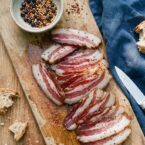
Description
Cure your own pork jowl for intensely flavorful pasta carbonara and other dishes. Its easier than you think!
Ingredients
For the Pork:
- 1 pork jowl, skin on, about 2 pounds (900 g)
- Kosher salt, 3% of pork weight, about 27 g for a 900 g jowl
- Brown sugar, 1.5% of pork weight, about 14 g for a 900 g jowl
For the Spice Rub:
- 1 tablespoon black peppercorns
- 1 tablespoon juniper berries
- 1 teaspoon red pepper flakes
- 1 teaspoon mustard seeds
- 1 whole star anise
- 1 teaspoon allspice berries
For Drying:
- Butcher’s twine
- Cheesecloth, optional
- Vinegar, for wiping light surface mold if needed
Instructions
Weigh the pork jowl before curing and write down the starting weight.
Calculate the salt at 3% of the pork weight.
Calculate the brown sugar at 1.5% of the pork weight.
For a 900 g pork jowl, use about 27 g kosher salt and 14 g brown sugar.
Place the black peppercorns, juniper berries, red pepper flakes, mustard seeds, star anise, and allspice in a dry skillet over medium heat.
Toast for 1 to 2 minutes, shaking the pan, until fragrant.
Let the spices cool.
Grind the spices in a spice grinder or mortar and pestle.
In a small bowl, mix the kosher salt, brown sugar, and ground spices.
Check the pork jowl for any remaining hair and remove it.
Pat the pork jowl dry with paper towels.
Trim away any loose edges.
Rub the cure mixture over every surface of the pork jowl.
Place the jowl in a sealable bag or non-reactive container.
Add any cure that falls away into the bag or container.
Refrigerate the pork jowl for 5 to 7 days.
Turn the jowl once a day so the cure is redistributed.
Liquid will collect during curing; this is normal.
Remove the pork jowl from the cure.
Rinse it under cold water to remove the surface cure and spices.
Pat it dry very well with paper towels.
Place the jowl on a rack, uncovered, in the refrigerator for 12 to 24 hours to dry the surface.
Tie the pork jowl securely with butcher’s twine.
Wrap loosely in cheesecloth if needed to protect it from dust or insects.
Hang the jowl so air can circulate around the entire piece.
Dry at 50–60°F (10–15°C) with 65–75% relative humidity and gentle airflow.
Avoid direct sunlight and strong airflow blowing directly on the meat.
Weigh the jowl weekly.
Dry until it has lost about 30% of its original weight and feels firm but not hard.
This usually takes 3 to 5 weeks, depending on thickness and drying conditions.
Check the guanciale regularly for aroma, texture, and mold.
If light white surface mold appears, wipe it with a clean cloth dampened with vinegar.
Discard the guanciale if it develops green, black, fuzzy, wet, or unpleasant-smelling mold.
Once dried, wrap the guanciale in parchment or butcher paper and refrigerate.
For longer storage, vacuum seal and refrigerate or freeze.
Slice thinly or cut into small batons.
Cook before serving unless you are using a validated curing process and can verify the finished product’s safety.
Notes
Use a scale for the pork, salt, and sugar. Volume measurements are not reliable enough for curing.
Aim for about 30% weight loss from the starting weight. A 900 g jowl should finish around 630 g.
Guanciale is made from pork jowl. Pancetta is made from pork belly. The curing and drying process is similar, but the cuts are different.
Case hardening happens when the outside dries too fast while the center remains soft. Keep humidity around 65–75% and avoid strong direct airflow.
The drying space should have gentle air circulation, not a fan pointed directly at the meat.
The guanciale should smell clean, cured, and porky. Sour, rotten, ammonia-like, or otherwise unpleasant smells are warning signs.
White powdery mold can be normal in dry-curing. Green, black, fuzzy, wet, or bad-smelling mold is not.
Remove the old note about cooking to 155°F. This recipe has no cooking step; guanciale is cured and dried, then usually cooked in a finished dish.
For home-cured guanciale, cooking before eating is the safest default unless you have controlled curing conditions and a validated process.
- Prep Time: 20 minutes
- Drying Time: 5 weeks
- Cook Time: 5 minutes
- Category: Main Course
- Method: Curing
- Cuisine: Italian
Nutrition
- Serving Size: 2 oz
- Calories: 200
- Sugar: 5
- Sodium: 800
- Fat: 15
- Saturated Fat: 5
- Unsaturated Fat: 10
- Carbohydrates: 2
- Protein: 20
- Cholesterol: 80